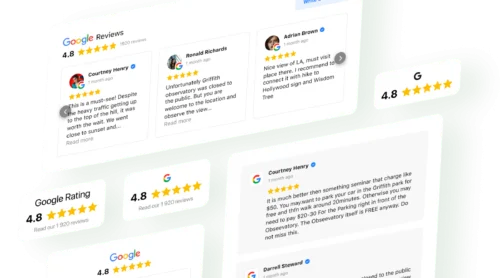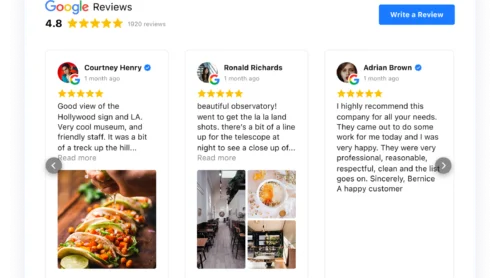


When someone nearby searches for what you sell, your reviews are the first thing they see, sitting in the Local Pack, the Knowledge Panel, and on Google Maps. For a small business, that makes Google reviews for small business owners the most visible trust signal you have, often deciding whether a stranger picks you or the business next door.
It is tempting to treat reviews as a one-time task and move on after collecting a few five-stars. That no longer holds. Rating and recency expectations have climbed: reviews now feed into both local rankings and AI recommendations, and the rules have tightened over the past year. The owners who win treat reviews as an always-on system. Here’s how reviews influence who gets found locally.
- 97% of consumers read reviews for local businesses
- Consistency and recency matter more than five-star reviews
- 68% of consumers avoid businesses rated under four stars
- Reviews feed both Google ranking and AI recommendations
- The FTC rule and Google’s policy set hard limits on incentives
Your most visible local trust signal
Google reviews appear across the surfaces customers check first. They show in the Local Pack, the top-three map results for a “near me” search, in the Knowledge Panel that summarizes your business, and on Google Maps. Before anyone reads your website or picks up the phone, they have usually seen your star rating and a few recent comments.
Reading reviews is close to universal now. 97% of consumers read reviews for local businesses, and the share who “always” read them while browsing climbed to 41% in a single year, up from 29%. Higher prices and uneven product quality push people to research before they spend, and reviews are the easiest research available. At this stage, failing to offer competitive pricing will drive consumers straight to your competitors.
Trust is real, but not blind
Shoppers lean on reviews without switching off their judgment. Just under half (49%) trust online reviews as much as a personal recommendation from someone they know. That is down from the peak years ago, yet it still means nearly half of buyers treat a stranger’s opinion like a friend’s advice.
The effect runs both ways. 85% say positive reviews make them more likely to use a business, and 77% say negative ones make them less likely. Picture your review profile as a storefront window: it is the first impression, working whether you tend to it or not. This is why Google reviews for local business owners carry so much weight.
What customers actually look at
It is tempting to reduce all of this to “get five stars,” but customers look at it in a more layered way. Asked what makes a review trustworthy, they rank a believable, recent pattern above any single rave.
Here is how consumers rank the factors that make a review credible:
| What makes a review trustworthy | Share of consumers |
|---|---|
| It’s backed by other reviews with similar sentiment | 56% |
| It describes a positive experience | 46% |
| It was posted within the last month | 44% |
| It has a high star rating | 42% |
| The business owner responded | 37% |
That reframes the whole job. Consistency and recency outrank a lone five-star testimonial. Customers want a current, believable pattern, which is exactly what an always-on system produces and a one-time push cannot.
Volume is a credibility floor
A handful of reviews reads as thin, however glowing. 47% of consumers will not use a business with fewer than 20 reviews, and only 9% will use one with five or fewer. Twenty reviews work as a rough credibility floor; below it, even strong ratings struggle to convince.
Recency is a moving target
Old reviews do not disappear, but they stop doing much work. 74% of consumers only care about reviews from the last three months, and 32% want something from the last two weeks, up from 20% a year earlier. Past reviews still sit on the profile; they simply no longer sway today’s decision.
This is why fresh Google local business reviews matter more than a single large burst. A profile that keeps gaining recent feedback reads as a living business, while one frozen on last year’s praise quietly loses its pull.
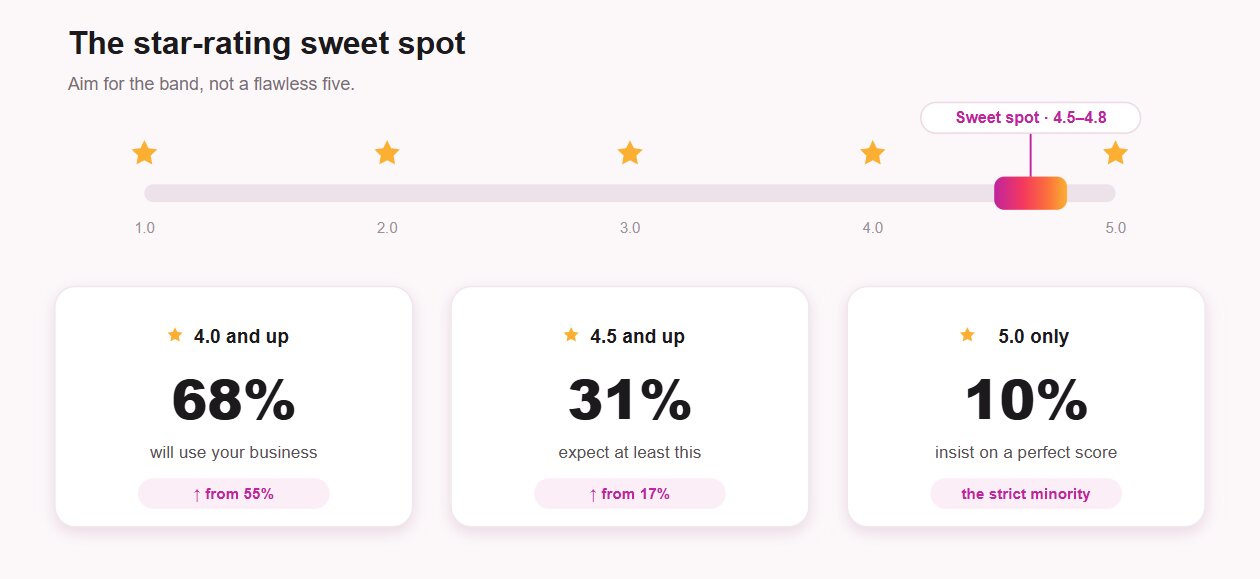
The star-rating sweet spot
Star expectations climbed sharply in a single year, and the bar now sits higher than many owners assume.
- 68% of consumers will only use a business rated 4 stars or higher, up from 55% a year earlier
- 31% now want 4.5 stars or higher, up from 17%
- Only 10% insist on a perfect 5.0
A rating that passed last year can read as substandard now. The realistic target is the 4.5-to-4.8 range, not a flawless five, and a few honest, well-handled negatives make a profile look more credible than an unbroken wall of perfect scores. Earning consistently high ratings is a discipline in its own right.
How reviews shape your local visibility
Recency not only influences customers; it affects rankings too. Reviews are a confirmed local ranking signal, which is what links them directly to the Local Pack. Among local SEO experts, review signals rank as a top-tier, rising factor, trailing Google Business Profile signals as the largest category.
Velocity and recency beat volume
The newest ranking research emphasizes review velocity and recency over raw count. A steady weekly trickle of fresh reviews signals an active, current business more effectively than a big batch collected once and left to age. That is the ranking reason “keep getting reviews” matters, and it lines up neatly with what customers already want to see.
Why proximity still matters
Reviews are powerful, but they are not the whole ranking. Proximity to the searcher still dominates local results, so a modest business a mile away often outranks an excellent one five miles off, simply because it is closer. Reviews sit in the large, controllable share of ranking, alongside an accurate profile and consistent listings. Treat them as a strong lever, not a magic switch.
How reviews now feed AI recommendations
The signals that shape Google rankings now shape something newer: the AI tools people use to find local businesses. This is the fastest-moving part of the picture. Use of ChatGPT and similar generative AI for local recommendations jumped from 6% to 45% in a single year, making AI the third-most-popular source of local recommendations, behind only Google and Facebook.
AI summaries now shape decisions before anyone scrolls to the reviews themselves. 82% of consumers read the AI-generated review summaries that appear above reviews on Google and other platforms, and 23% decide based on that summary alone. Trust is as follows: 42% trust AI platforms for recommendations as much as they trust traditional reviews.
How the plumbing actually works
Local search and AI search now draw on effectively the same inputs. Accurate listings, review sentiment, and consistent business information decide whether you appear in Google, Maps, ChatGPT, or Perplexity. The takeaway needs no technical work: keep your reviews genuine, plentiful, and recent, and keep your business details accurate everywhere they are listed.
One nuance is worth knowing. Current research suggests ChatGPT does not yet pull Google reviews specifically, instead leaning on other listings and local sites, while Google’s own AI does use Business Profile data, including reviews. So “reviews feed AI” holds true, but the wiring varies by platform, and spreading your reviews across sites is a sensible hedge.
The review rules you can’t ignore
All of this rests on reviews being genuine, which is exactly what two sets of rules now enforce. Both tightened in the past year, and small businesses routinely confuse them, sometimes running afoul of one while carefully obeying the other.
The FTC’s fake-reviews rule
“Fake reviews not only waste people’s time and money, but also pollute the marketplace and divert business away from honest competitors.” — Lina M. Khan, then-FTC Chair
In the US, the Federal Trade Commission’s rule on consumer reviews and testimonials took effect on October 21, 2024. It bans a clear set of practices:
- Buying or selling fake reviews, including AI-generated ones
- Paying for reviews that express a specific sentiment, positive or negative
- Posting insider reviews from owners, employees, or relatives without disclosure
- Running company-controlled sites that pose as independent review platforms
- Suppressing genuine negative reviews
Knowing violators can face civil penalties of up to $51,744 per violation, a figure adjusted annually for inflation. The clause that trips up small businesses most is narrower than it sounds: offering compensation in exchange for a review that expresses a particular sentiment is prohibited.
Review laws vary by region, so verify the rules where you operate before building any review-getting process.
Google’s policy goes further
Google’s own review policy is stricter than the FTC rule on one decisive point. It bans offering any incentive, whether cash, a discount, or free goods, in exchange for any review at all, regardless of sentiment. It also bans review gating: selectively asking only the customers you expect to be happy, or steering unhappy ones away.
This is where a common promo goes wrong. “Leave us an honest review for 10% off” can pass a narrow reading of the FTC rule, since it does not demand a positive review. It still violates Google’s policy, because Google prohibits the incentive itself. Getting this distinction right is one of the most valuable moves an owner can make.
The two regimes overlap but are not identical. Here is how they compare on the practices owners ask about most:
| Practice | FTC rule (US) | Google’s policy |
|---|---|---|
| Buying or selling fake reviews | Prohibited | Prohibited |
| Paying for a positive or negative review | Prohibited | Prohibited |
| Offering any incentive for an honest review | Allowed (no sentiment condition) | Prohibited |
| Undisclosed insider reviews | Prohibited | Prohibited |
| Review gating (asking only happy customers) | Not directly addressed | Prohibited |
| Suppressing negative reviews | Prohibited | Prohibited |
Building your review trust system
Put the pieces together, and a system emerges, one that serves trust, ranking, and AI visibility at the same time. It does not take a big budget or technical skill. It takes a routine you can repeat.
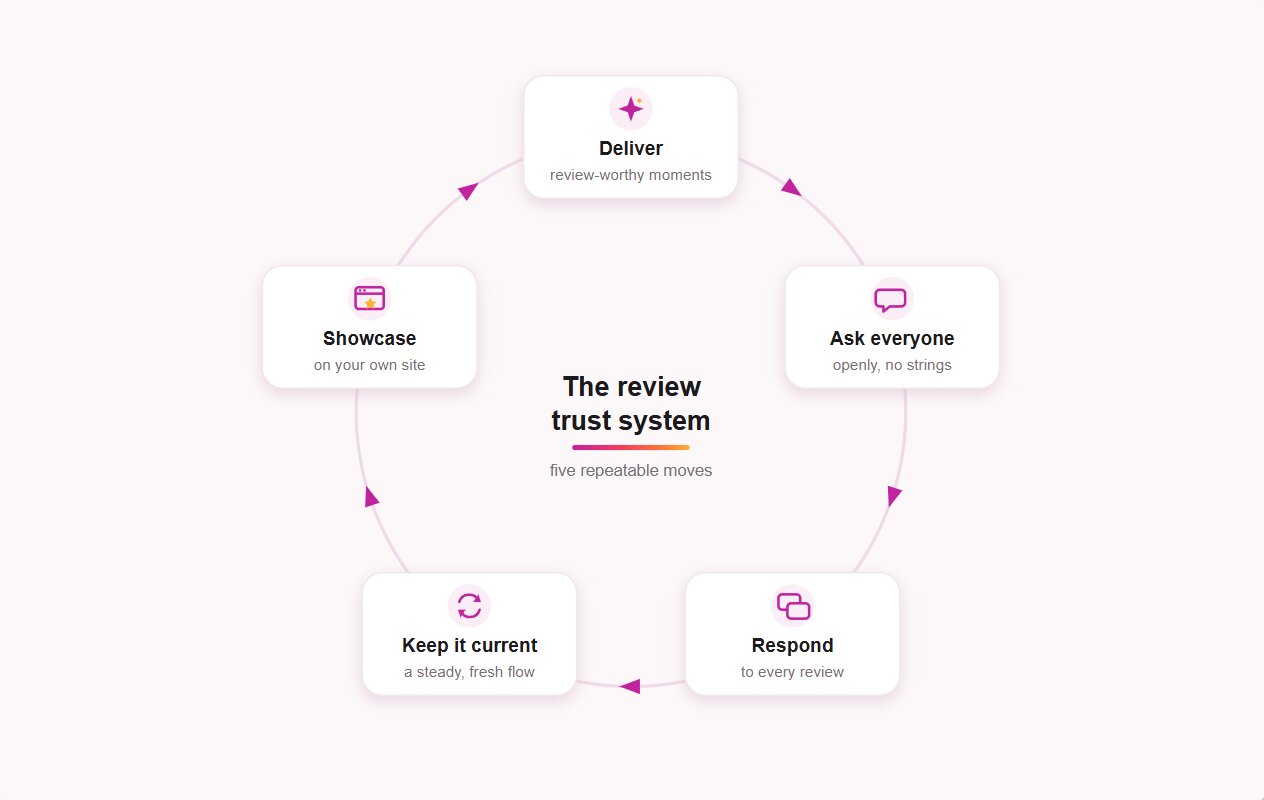
The system comes down to a handful of repeatable moves:
- Deliver review-worthy moments, because good service is the real generator; people share positive experiences far more than negative ones.
- Ask everyone, openly, with a simple, sentiment-neutral request to every customer rather than only the ones you expect to be happy.
- Respond to all of them, since most consumers expect a reply within a week and generic responses put off half of readers, which makes how you respond part of the trust itself.
- Keep the flow current, because a steady process for earning new reviews beats an occasional push, and regular monitoring keeps small problems from becoming surprises.
The compliant path and the effective one turn out to be the same. Discount-for-review offers are fading, from 45% to 27% year over year, as more owners learn they break platform rules. Asking openly, without strings, is both safer and more productive.
Showcase reviews where customers actually land
One move deserves its own attention, because it sits on the surface you fully control. After reading a positive review, 54% of consumers visit the business’s website. That is a high-intent moment, and a site with no visible social proof lets it slip away.
Displaying your Google reviews on your own pages closes that gap. Elfsight’s Google Reviews widget pulls your reviews onto any website platform you use, with:
- Multiple layouts, plus filtering and sorting
- The option to pin your best reviews to the top
- Owner replies and review photos shown inline
- Schema.org markup for potential rich snippets
- A sentiment-neutral “Write a Review” button linking to your Google profile
See Google Reviews in action in the interactive editor ↓
Frequently asked questions
How are Google reviews different from Yelp or Facebook for a local business?
Do Google reviews expire or get deleted over time?
How quickly do new reviews start affecting my local search ranking?
My local business is brand new with no reviews — where do I start?
Are reviews on AI tools like ChatGPT something a small business should track?
Making reviews part of the routine
Reviews are settling in as permanent infrastructure for local trust. They shape first impressions, boost your ranking, feed the AI tools people increasingly ask, and sit within rules that reward genuine feedback and penalize shortcuts.
That is why a one-time push does not hold up, and a system does. Deliver something worth reviewing, ask customers for feedback openly, respond to it, keep it fresh, and showcase it where customers land. You do not have to build the whole routine this week. Pick the move that fixes your weakest spot, start there, and let the rest follow.
Key references
- BrightLocal, Local Consumer Review Survey 2026 — brightlocal.com
- Whitespark, Local Search Ranking Factors 2026 — whitespark.ca
- FTC, Trade Regulation Rule on Consumer Reviews and Testimonials (16 CFR Part 465) — ftc.gov
- FTC, Consumer Reviews and Testimonials Rule: Q&A — ftc.gov
- Google, Prohibited & restricted content (review policy) — support.google.com
- Google 2025 Maps Trust & Safety report (self-reported), via Search Engine Roundtable — seroundtable.com
- Sterling Sky, Google review policy violations — sterlingsky.ca