
Few things sting like the “You got a new 5-star review!” notification that you then can’t find anywhere on your public page. For a lot of business owners, that exact moment is where the Yelp vs Google reviews question really starts: if one platform quietly buries the praise you earned, is it worth your time at all?
For almost every local business, the answer is that Google is the higher-leverage platform — more reach, it feeds your local search ranking, and, critically, it lets you ask customers for reviews. But the most useful part of the Google Reviews vs Yelp comparison isn’t the size gap; it’s the rules. The two platforms have opposite policies on how you’re allowed to collect reviews, and that single difference should decide where you invest.
- Google is the higher-leverage platform for almost every local business
- You can ask for reviews on Google while Yelp explicitly prohibits it
- Only Google reviews directly affect your search ranking
- Yelp reviews disappear due to its recommendation filter, not advertising
Yelp vs Google Reviews: The Quick Verdict
Reviews themselves have never mattered more: 97% of consumers read them when evaluating a local business, and the average person now consults up to six different review sites before deciding. That second figure matters because it means your reputation is spread across multiple surfaces, rather than concentrated on one.
Reach and usage
Google still leads by a wide margin, but its share is softening. The portion of consumers who use Google for reviews slipped from 83% in 2025 to 71% in 2026 — still far ahead of the rest, yet a real drop in a single year. When it comes to where people actually write reviews, fresh ranking shows Google on top, with Yelp holding a meaningful but smaller share:
| Platform | Share of consumers writing reviews |
|---|---|
| 45% | |
| 34% | |
| Yelp | 24% |
| Apple Maps | 17% |
| Tripadvisor | 16% |
| BBB | 16% |
The scale gap
Yelp is smaller than Google, but it isn’t small. Its own FY2025 reporting puts it at 330 million cumulative reviews as of December 31, 2025 (up 7% year over year), with 74 million monthly unique visitors, 8.4 million claimed business locations, and $1.46 billion in net revenue. That’s a real audience, especially in the US.
For scale perspective, Google doesn’t publish a comparable cumulative count, but one figure makes the reach difference concrete: Google reported blocking 240 million fake or policy-breaking reviews in 2024 alone. The reviews Google removed in a single year are within range of Yelp’s entire cumulative total built up over two decades.
You Can Ask for Reviews on Google, But Not on Yelp
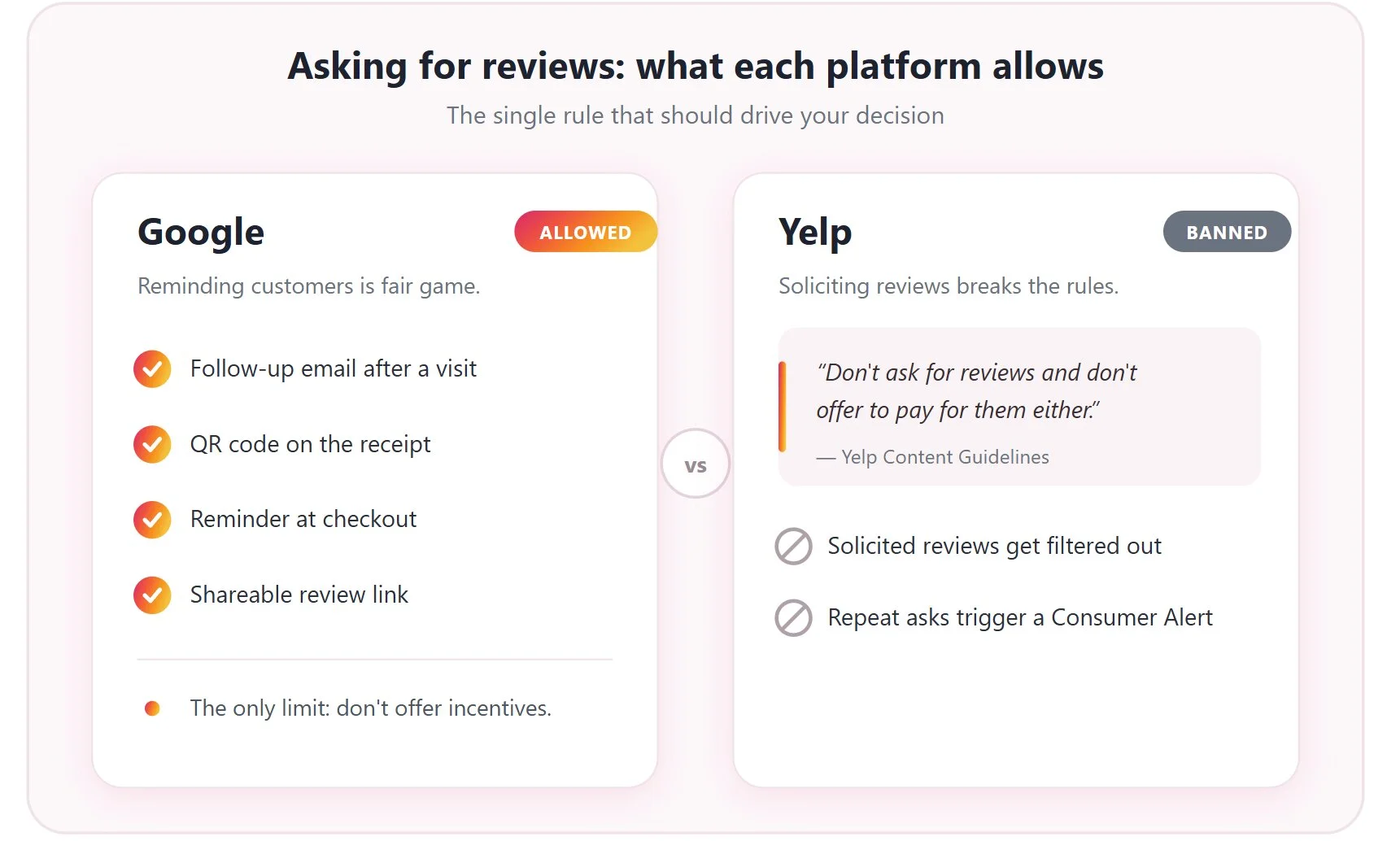
Here is the difference that should drive your decision when comparing Google Reviews vs Yelp: does the platform let you ask customers for reviews at all?
Google encourages asking
Google explicitly permits asking customers for reviews. Its Business Profile guidance encourages reminding customers and even hands you a shareable review link and QR code to make it easy. The entire standard playbook — a follow-up email, a QR code on the receipt, a polite reminder at checkout — is fair game on Google, as long as you don’t cross into incentives.
Yelp bans it
Yelp takes the opposite position and states it plainly in its content guidelines:
“Don’t ask for reviews and don’t offer to pay for them either.” — Yelp Content Guidelines
Yelp’s recommendation software actively looks for reviews it believes were solicited. Cross the line, and those reviews can get filtered out of your rating, and repeated solicitation can trigger a Consumer Alert banner on your page. Reasoning? Businesses tend to ask only their happy customers, which skews ratings upward.
What it means in practice
The practical fallout is significant. Volume is one of the things customers judge you on — 47% say they won’t consider a business with fewer than 20 reviews — and the fastest way to build that volume is to ask. On Google, asking is the core growth lever. On Yelp, that lever is off-limits.
Are Yelp Reviews Worse Than Google?
There are three legitimate reasons Yelp tends to feel worse to businesses, plus one widely held belief that the evidence doesn’t support.
- The recommendation filter hides reviews: Yelp’s automated software routes reviews it deems less reliable into a separate “Not Recommended” section that doesn’t count toward your rating.
- The no-asking rule skews who reviews you: Because you can’t prompt happy customers, Yelp ratings lean toward self-motivated reviewers, who often skew negative.
- Review volume is harder to grow: With far less reach than Google and a ban on soliciting, most businesses accumulate Yelp reviews slowly.
How the recommendation filter works
The filter is the part that stings most. Yelp evaluates every review against what it describes as hundreds of signals and sets aside ones it can’t vouch for — suspected solicited reviews, reviews from accounts it doesn’t recognize, and others it judges potentially biased. Those filtered reviews stay accessible through a link at the bottom of your page, but they don’t factor into your overall star rating or review count.
Does Yelp hide reviews unless you advertise?
This is the belief that drives the search, and it deserves a straight answer: there’s no proof it’s true. The “pay-to-play” theory was litigated in Levitt v. Yelp, and the Ninth Circuit affirmed dismissal of the extortion claims. No court has found that Yelp does this, and Yelp’s stated policy is that its software treats advertisers and non-advertisers identically.
The more recent signal points the other way: Yelp has been taking action against companies that falsely promise to remove negative reviews, including a lawsuit against a reputation-management firm over exactly that kind of advertising. The filter is real and genuinely frustrating, but the specific claim that paying Yelp fixes it isn’t supported.
Google Reviews Feed Your Rankings, Yelp Reviews Don’t
On the Google reviews vs Yelp reviews question for search visibility, most guides land in the right place: Google reviews help, Yelp reviews don’t. The mechanism behind that is worth understanding, because it explains why the two platforms aren’t interchangeable for visibility.
How much reviews weigh in local rankings
According to the Whitespark Local Search Ranking Factors survey of local SEO experts, review signals account for roughly 16% of the factors that determine local-pack rankings, making them the strongest controllable lever after the completeness of your Google Business Profile.
The full picture of relative influence, as estimated by the experts surveyed, looks like this:
| Local-pack ranking factor | Estimated relative weight |
|---|---|
| Proximity to searcher | ~55% |
| Google Business Profile signals | 32% |
| On-page signals | 19% |
| Review signals | 16% |
| Links | 15% |
| Behavioral signals | 8% |
| Citations | 7% |
These are expert estimates of relative emphasis rather than Google-confirmed weights, and proximity is something you can’t control. What you can influence is the review layer, and what counts there is volume, velocity (a steady stream of new reviews rather than a one-time burst), recency, sentiment, and your response rate.
Why only Google reviews count
The decisive point is which algorithm those reviews feed into. Your Google reviews live within Google’s ecosystem and directly influence your Maps and local pack positions. Your Yelp reviews sit with a third party, so they do nothing for your Google ranking — Yelp can still send you high-intent visitors and act as a citation, but it won’t move you up the local pack.
What “good” looks like now
Recency and responsiveness raise the bar further. Around 74% of consumers only pay attention to reviews from the last three months, which is why a steady drip beats a stale pile. And 89% expect businesses to respond to reviews, with generic replies putting off roughly half of them. The ratings threshold has climbed too: 68% now want to see at least 4 stars, and 31% hold out for 4.5 or higher, up from 17% the year before.
If you want a framework for replies that actually land, see our guide on responding to Google reviews.
New Rules and AI Search Are Reshaping Review Strategy
Two shifts make this decision different from the one you’d have made a couple of years ago, and they affect both platforms at once. Understanding them keeps your strategy durable rather than something you’ll have to walk back.
The regulatory layer
The FTC’s Final Rule on fake and misleading reviews took effect in October 2024, making it illegal to buy, write, or incentivize fake reviews, with monetary penalties attached. Enforcement is no longer theoretical — the first action under the rule landed in December 2025. The behavior it targets is more common than you’d hope: BrightLocal found that 11% of consumers were offered an incentive in exchange for a positive review.
Google tightened its own review policies recently, adding restrictions around on-premises solicitation, review quotas, and certain content-prompting tactics. The combined effect is that the old aggressive collection tricks are now risky on both platforms.
That actually narrows the practical gap between “ask hard on Google” and “can’t ask on Yelp,” and it leaves one durable strategy standing: deliver experiences worth reviewing, then ask for reviews compliantly.
AI search is changing where reviews surface
The bigger story in this year’s data is AI. Use of ChatGPT and other generative tools for local recommendations surged from 6% to 45% year over year, making AI the third most-used recommendation source, and 82% of consumers now read AI-generated review summaries.
For a small business, the takeaway is that reviews increasingly feed AI-generated answers regardless of which platform they live on. A Google-only footprint may underperform in AI recommendations that draw on multiple sources.
Exactly how each AI tool weighs Google against Yelp isn’t publicly disclosed, so treat this as an emerging trend rather than a settled mechanic — but it’s a real argument for not letting your Yelp presence go dark.
So, Google or Yelp? A Decision Framework
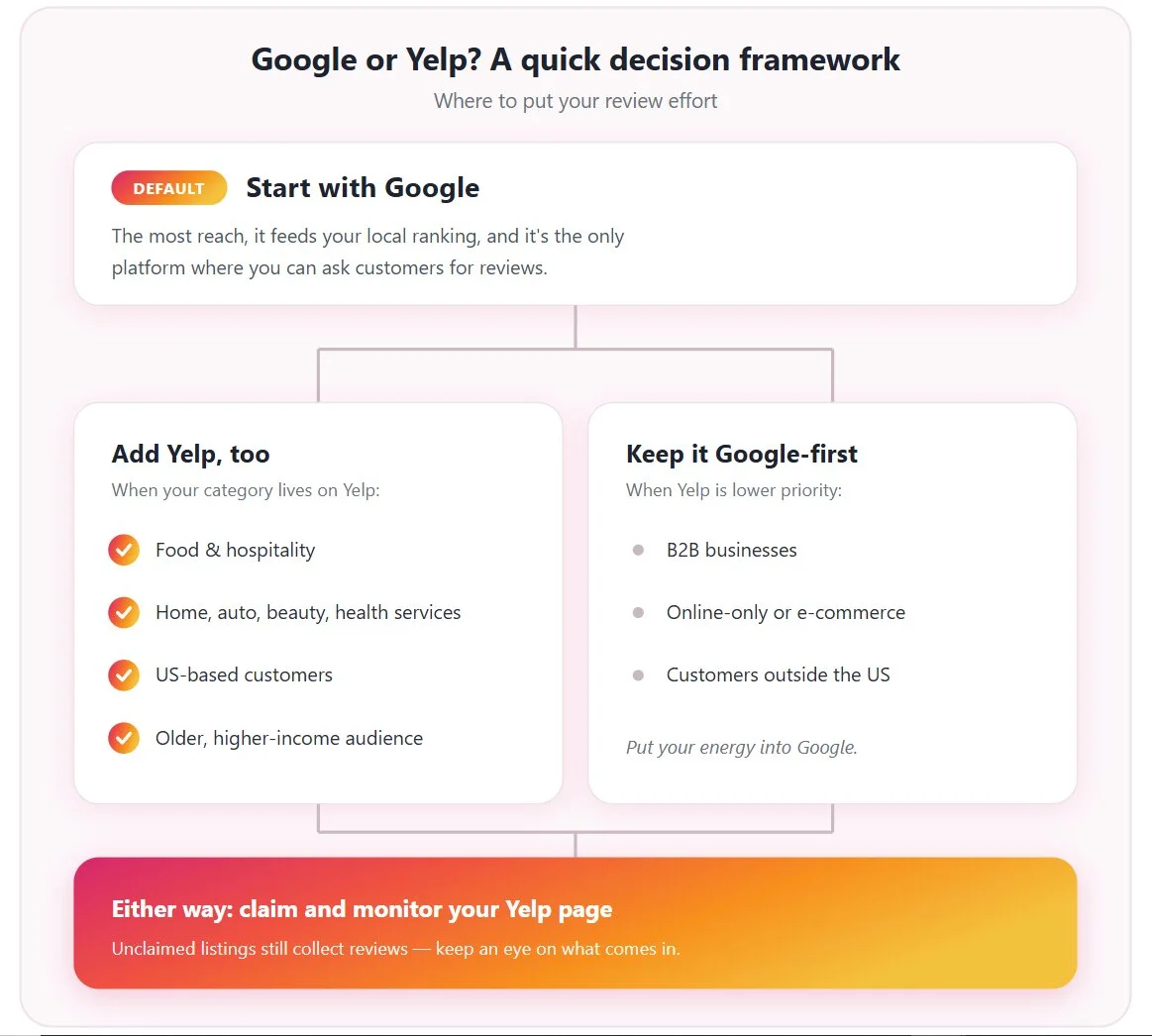
The evidence supports a clear recommendation rather than splitting your effort evenly. For nearly every local business, Google is the one to prioritize: it has the most reach, it’s the only one of the two that feeds your rankings, and it’s the only one where you can build review volume by asking.
When targeting Yelp makes sense
Yelp earns deliberate investment in specific situations rather than by default. Add it to your plan when one or more of these fits:
- You’re in food or hospitality — restaurants, bars, cafes
- You’re a local-service business such as home services, auto, beauty, or healthcare
- Your customer base is in the US, where almost all of Yelp’s traffic sits
- Your audience skews older and higher-income, which matches Yelp’s user base
Pick Google if…
If you’re B2B, online-only, or operating outside the US, put your energy into Google first — that’s where your customers are looking. Either way, claim and monitor your Yelp page even if it isn’t a focus, because listings accrue reviews whether you’ve claimed them or not, and an unwatched page is a reputation risk.
Here’s how the two platforms compare across the dimensions that actually drive the decision:
| Dimension | Yelp | |
|---|---|---|
| Consumer reach | Used by 71% for reviews; clear #1 | 24% share of review writers; meaningful but smaller |
| Can you ask for reviews? | Yes, within policy | No — solicitation is prohibited |
| Effect on your Google ranking | Direct (review signals ~16% of local pack) | None (third-party platform) |
| Scale | Dominant; blocked 240M policy-breaking reviews in 2024 | 330M cumulative reviews; 74M monthly visitors |
| Best fit | Nearly every local business | Food, hospitality, and local services; US-based |
| Audience skew | Broad | Older, higher-income, US-centric |
Show Your Google and Yelp Reviews on Your Own Site
Wherever you collect them, your Google and Yelp reviews can do their hardest work right when a visitor is deciding whether to trust you. Pulling that social proof onto your website pages keeps people from bouncing to a third-party site to make up their mind — and it’s the natural next step once you’ve decided where to invest.
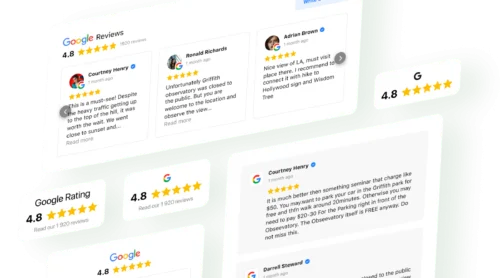
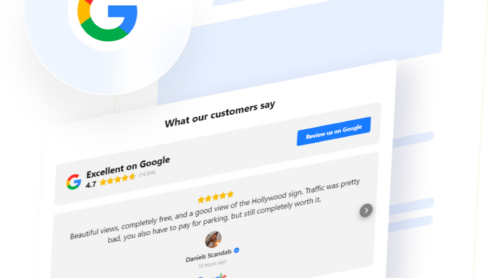
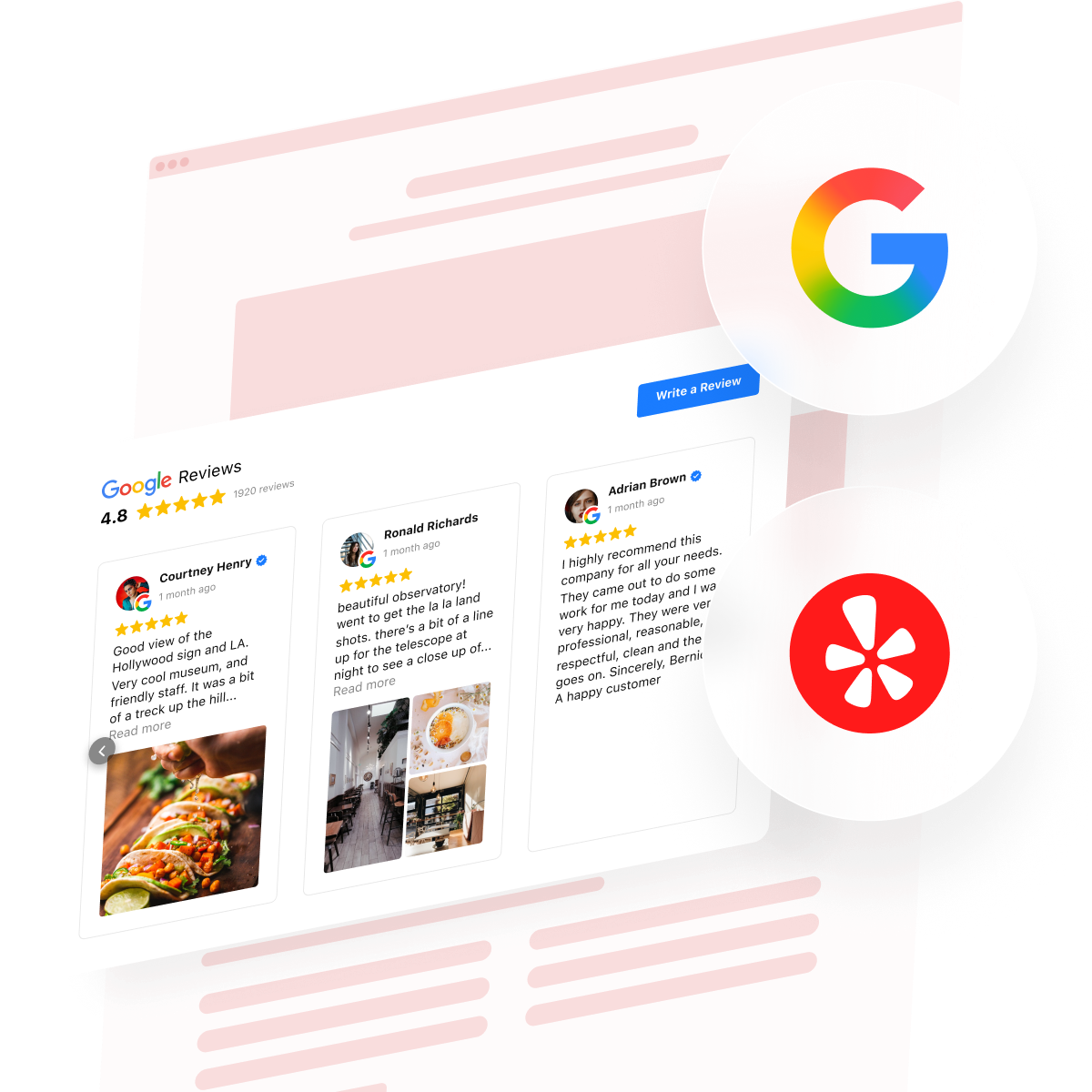
For the Google-only majority, the Elfsight Google Reviews widget displays verified reviews from your Business Profile in a range of layouts, with a built-in “Write a Review” button that sends new visitors to Google to leave fresh feedback.
Build and customize your Google reviews feed right here ↓
If you want to display multiple sources, the All-in-One Reviews widget combines Google, Yelp, Tripadvisor, and other platforms in a single display — the right fit if you’re actively running both your Yelp and Google reviews.
Frequently Asked Questions
Are Google reviews or Yelp reviews more trustworthy to customers?
Can I ask customers for reviews on both Google and Yelp?
Why do my Yelp reviews keep disappearing?
Does Yelp lower my rating if I don't advertise?
Do Yelp reviews help my Google ranking?
If I can only manage one, should I focus on Yelp or Google reviews?
Where to Put Your Energy
Google is the higher-leverage choice for almost every local business, and the reason isn’t just that it’s bigger — it’s that the rules favor you. You can build volume by asking, your reviews feed your ranking, and your reputation reaches the most people. Yelp is a real platform worth a deliberate spot if you’re in the right category, but it’s a complement to a Google-first strategy, not a substitute for one.
With fake-review rules now enforced, Google’s solicitation policies tightened, and AI search pulling from reviews across platforms, the durable play is the same one good businesses were already making: earn experiences worth reviewing, ask for reviews compliantly on Google, claim and watch your Yelp page, and put that social proof to work on your own site.
Key references
- BrightLocal — Local Consumer Review Survey 2026. Published Feb 11, 2026 https://www.brightlocal.com/research/local-consumer-review-survey/
- Yelp Inc. — FY2025 Results / Investor Relations. Feb 12, 2026. https://www.yelp-ir.com/
- Yelp — Content Guidelines (“Don’t Ask for Reviews”). Living document; policy blog Apr 2024. https://www.yelp.com/guidelines/content-guidelines
- Yelp — Recommendation Software (Trust & Safety / Support Center). Living document. https://trust.yelp.com/recommendation-software/
- Whitespark — Local Search Ranking Factors 2026. Released Nov 2025. https://whitespark.ca/local-search-ranking-factors/
- Google Business Profile Help — “Get reviews.” Living document. https://support.google.com/business/answer/3474122