
Diners decide where to eat by checking what other people thought, so a steady stream of recent, positive Google restaurant reviews quietly does your marketing for you, pulling in strangers who’d never have found you otherwise. The trick is knowing what makes guests leave a review in the first place, and how to gently encourage more of it.
We’ll cover what actually drives diners to write a review, practical ways to ask for more without being pushy, how to respond so every reply works in your favor, and how to showcase your best reviews on your own site.
- Google is where diners check restaurant ratings first — 46% start there.
- 43% of diners won’t visit a restaurant rated below 3 to 3.5 stars.
- As of 2026, offering anything for a review violates both Google policy and US federal law.
- Google screens reviews with AI before they publish to identify incentivised ones.
- You can’t delete a genuine negative review, but a calm public reply is a must.
Why reviews decide where people eat
Reviews have quietly become a mandatory step in choosing a restaurant. Diners rarely commit to a new place on instinct anymore — they check, compare, and validate first, and they overwhelmingly do that validation on Google. Understanding exactly how that decision plays out tells you where to spend your effort.
How diners actually choose
When diners want to know whether a restaurant is any good, Google is the first place most of them look. In Toast’s diner survey, 46% said they check Google reviews first for restaurant ratings — roughly double the share who start with Yelp. The full picture of where people look first makes the gap clear.
| Where diners check restaurant ratings first | Share of diners |
|---|---|
| 46% | |
| Yelp | 23% |
| TripAdvisor | 9% |
| OpenTable | 6% |
| Resy | 3% |
| None of these | 10% |
That two-to-one lead over Yelp is the practical reason Google is where your attention belongs, though it’s worth understanding how the two platforms differ before you write either off. Discovery itself is still largely offline through word of mouth or by walking past. But the moment they want reassurance, they reach for Google.
What more reviews are worth
Expectations are tightening every year, raising the stakes for your rating. The share of consumers who say they’ll only use a business rated 4.5 stars or higher climbed to 31% from 17% in a single year, and 47% won’t use a business with fewer than 20 reviews. Volume and quality have both become entry tickets, not tiebreakers.
The exact link between your rating and your revenue is hard to pin to a single number — there’s no clean per-star figure for Google. The directional evidence is encouraging, though. In an analysis of 1.4 million reviews across the major platforms, restaurants with stronger guest sentiment outpaced the market by 2.4% in sales growth and 1.8% in traffic growth, with Google standing out as the most important review platform of the set.
Google is essential, but not the whole picture
Google reviews for local restaurants remain the foundation of trust, but they increasingly sit alongside other surfaces rather than standing alone. Its share as the top review-discovery platform fell from 83% to 71% year over year, the average consumer now consults around six review sites, and the share using AI tools for local recommendations jumped from 6% to 45%.
The takeaway is to treat Google as essential and primary, then build outward. A strong, current Google profile feeds the local pack for high-intent searches like “best tacos near me,” anchors your presence when diners cross-check elsewhere, and increasingly informs what AI assistants recommend.
Review policy changes
Hospitality has always been the most incentive-happy corner of the review world. “Leave us a review for a free dessert,” tablets at the host stand, quietly steering happy guests to Google while routing unhappy ones to a private form — these tactics were everywhere. Today, Google and US regulators made nearly all of them off-limits.
What Google now prohibits
Google’s user-generated-content policy now explicitly bans the practices that restaurants relied on most, and it’s actively enforcing them. The prohibited list covers offering incentives “such as payment, discounts, free goods and/or services” in exchange for a review, selectively soliciting only happy customers (review gating), and pressuring guests to review while they’re still on the premises.
The practical translation for a restaurant is blunt. The free-appetizer offer, the lobby review kiosk, the “if you had a great time, scan this before you go” prompt at the table, and the “mention your server by name” contest are all now policy violations. These were standard moves, which is precisely why getting ahead of them is an advantage.
The FTC rule on top of it
Fake reviews “pollute the marketplace and divert business away from honest competitors.”— Lina M. Khan, then FTC Chair
Federal law now reinforces the platform rules. The FTC’s rule on consumer reviews took effect in October 2024 and carries civil penalties of up to $52k per violation. Its most relevant provision for restaurants prohibits conditioning any incentive on a review that expresses a particular sentiment — whether stated outright or merely implied — and a separate provision requires disclosure when employees or their relatives post reviews.
Why this is being enforced now
Google reported removing or blocking 292 million policy-violating reviews in 2025 and rolled out AI-powered moderation that screens reviews before they ever publish. The risk to a restaurant that incentivizes reviews isn’t hypothetical. Its reviews are getting stripped, and a profile is losing the trust it was trying to build. Here’s what’s still allowed:
| Tactic | Status under new rules |
|---|---|
| Free dish, discount, or loyalty points for a review | Prohibited (Google + FTC) |
| In-restaurant review kiosk or shared tablet | Prohibited (on-premises pressure) |
| Routing only happy guests to Google (gating) | Prohibited |
| Asking guests to name a specific server | Prohibited (specific-content request) |
| QR code on the printed check linking to your review form | Allowed |
| Post-visit SMS or email asking for honest feedback | Allowed |
How to get more restaurant reviews
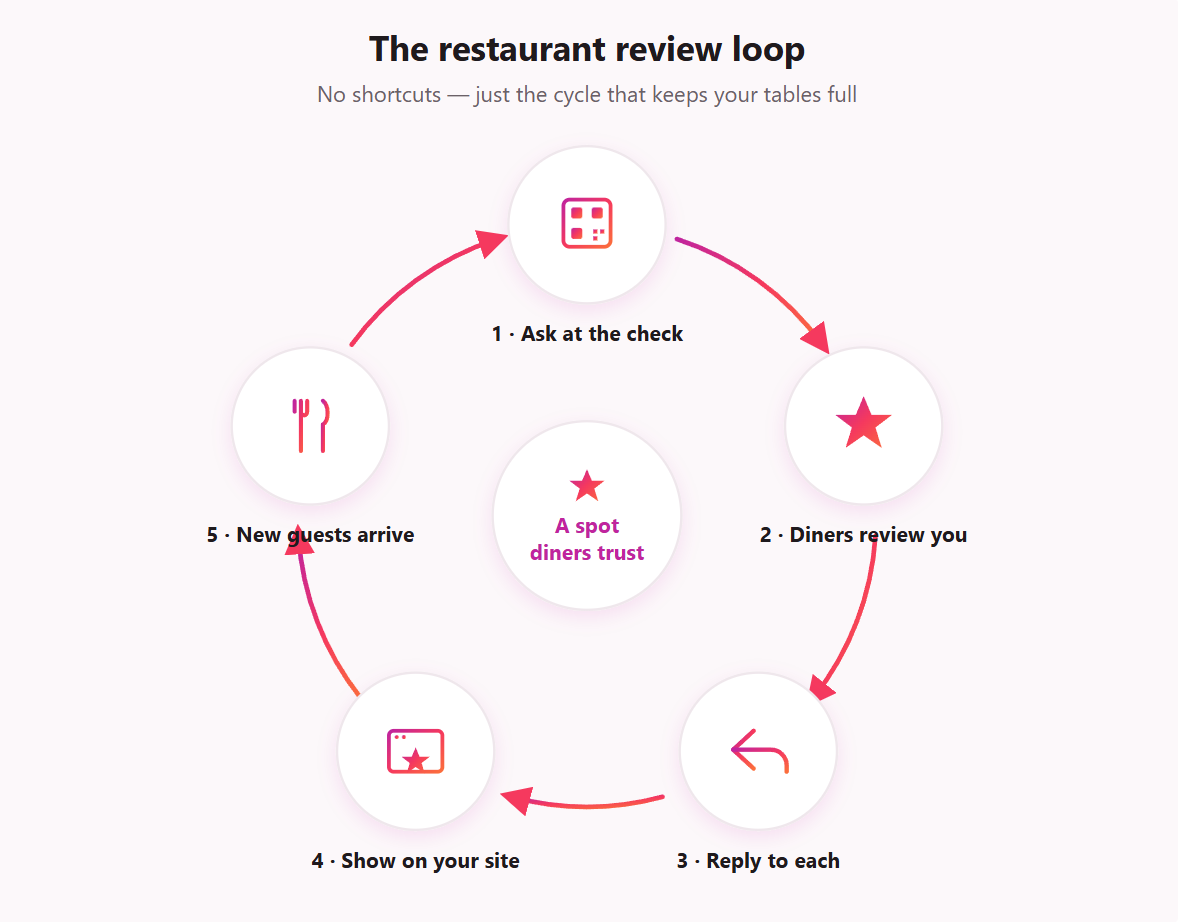
Losing the shortcuts doesn’t leave you without options — it leaves you with the ones that actually build a durable reputation. A compliant approach to boosting Google reviews for restaurants comes down to a single principle: make the same honest ask to every guest after they’ve left.
Compliant ways to ask
The strongest tools are printed, passive, and post-visit. Each of these invites a review without incentivizing, pressuring, or pre-screening anyone:
- A QR code on the check or check presenter that links directly to your Google review form.
- Table tents as passive printed prompts, with no rating direction and no reward attached.
- A post-meal SMS or email triggered by your POS or reservation system once the guest has left.
- A natural verbal nudge at check drop, not requesting a specific rating or dangling a perk.
- Encouraging guests to add a photo of their dish and mention what they ordered.
Practitioner data points to the check presenter as the highest-converting spot, with table tents close behind and receipt footers as a backup that fades on thermal paper.
| Placement | Reported scan-to-review range |
|---|---|
| Checkout or counter | ~15–20% |
| Table tents | ~8–12% |
| Receipt footer | ~5–8% |
Tactics to retire
A few long-standing habits now do more harm than good, and each has a clean replacement. Swap the lobby review tablet for a QR code on the check. Replace the “review for a free appetizer” sign with a simple, sincere ask. Drop the “mention your server” contest, and retire any workflow that surveys guests first and only forwards the happy ones to Google.
Responding to reviews
Collecting reviews is only half the job; what you do with them shapes how the next diner reads your profile. Responding to every review, positive and negative, signals an owner who’s paying attention — and diners notice. In BrightLocal’s survey, 88% of customers said they’d use a business that responds to all its reviews, against 47% for one that never responds.
One claim worth setting straight: responding to reviews does not directly raise your star average, and Google has never confirmed it as a ranking factor. The math of a star average is fixed by the ratings themselves, so a reply can’t move it. What responses do is build trust and convert browsers into guests — a real and valuable effect, just not an algorithmic lever.
Handling a bad review
A negative review feels personal, but your reply isn’t really for the person who wrote it. It’s for every prospective guest who reads the exchange as they decide between you and a competitor. A measured, accountable response is reputation insurance, and it follows a simple pattern:
- Thank the guest and acknowledge the specific issue without getting defensive.
- Take responsibility where it’s warranted, briefly and sincerely.
- Offer to make it right offline with a real point of contact.
- Keep it short — future readers, not the algorithm, are your audience.
Showing restaurant reviews on your website
Once you’ve earned strong reviews, the highest-value place to show them is the surface you fully control: your own website. Displaying existing reviews is a display action, not a solicitation, so it sits entirely outside the new collection rules. This makes it one of the few review tactics that carries trust without carrying risk.
Why display on your own site
Putting your Google reviews on your site does three things at once:
- It reinforces trust at the exact moment a visitor is deciding whether to book.
- It adds a stream of fresh, keyword-rich content that supports your SEO.
- It lets the dish photos guests have already taken work for you.
For a restaurant, where people eat with their eyes first, that visual social proof is hard to overstate.
Displaying reviews with Elfsight
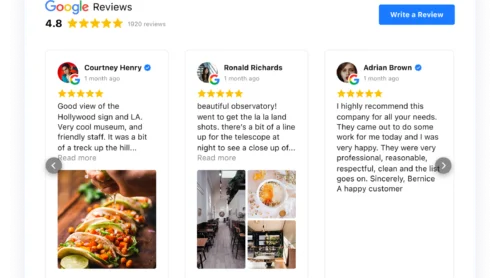
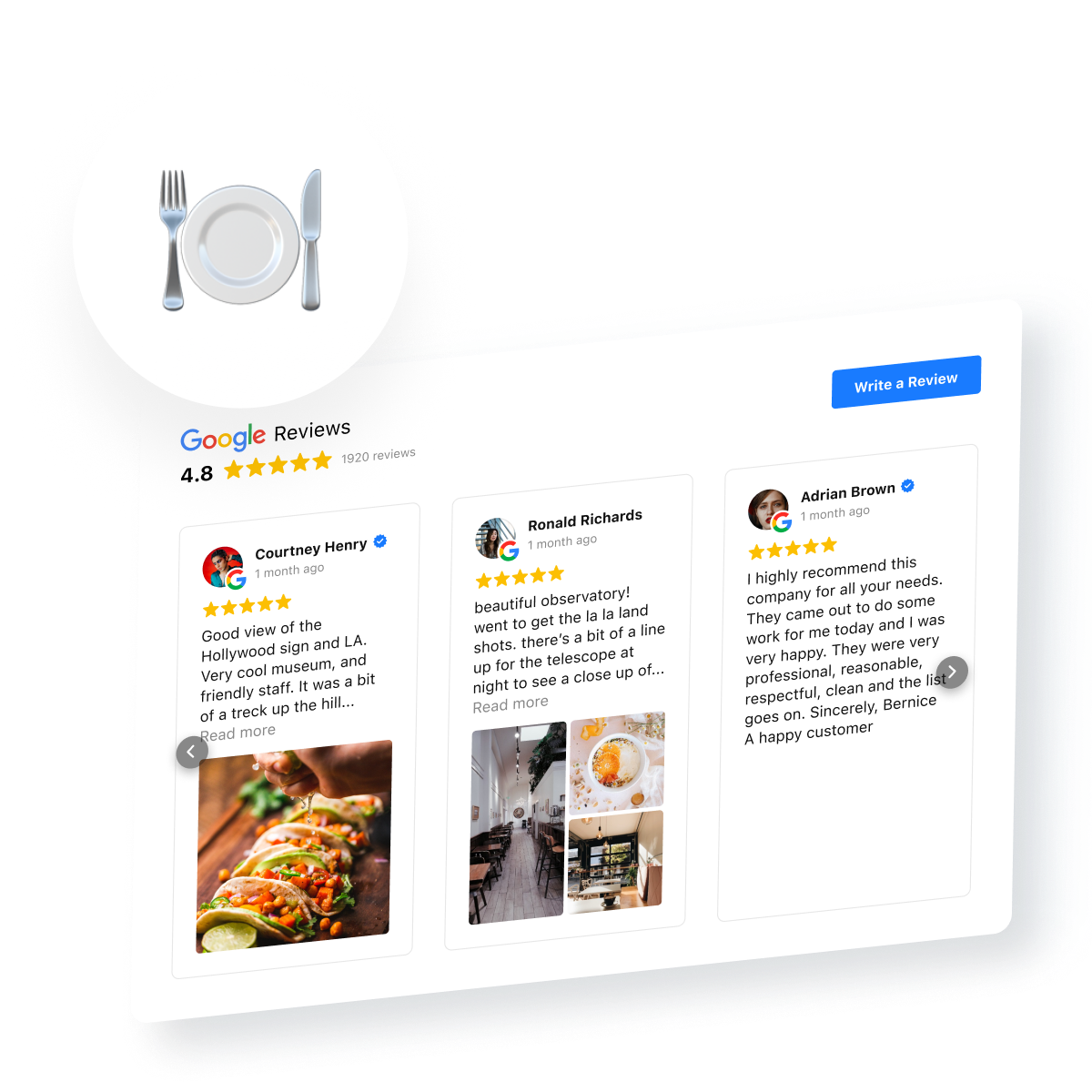
The Elfsight Google Reviews widget pulls your restaurant reviews right from your Google Business Profile and shows them on any website platform that supports HTML snippets. It includes various layout options and customization settings, support for photos guests attach, your own public replies, along with filtering and sorting.
The “Write a Review” button is an open redirect to your Google profile — compliant, since it adds no incentive or pressure, turning the reviews you’ve earned into trust on the page where bookings happen.
Build your Google reviews for restaurants widget ↓
Common questions
How many Google reviews does my restaurant need to rank well?
What's a typical Google star rating for restaurants?
Can I get a fake or unfair restaurant review removed?
Is it okay to ask my employees or family to leave reviews?
Why did a review disappear, or why is it taking so long to appear?
Final thoughts
For an independent restaurant, Google reviews for restaurant profiles are the cheapest, highest-leverage trust asset you have — and the new rules didn’t take that away. They took away the shortcuts: the free-dessert bribe, the lobby tablet, the quiet gating of unhappy guests. What’s left is the part that actually builds a reputation worth having — asking every guest honestly, after they leave, with nothing attached.
If you do three things, you’ll be ahead of nearly everyone still ranking in your area. Put a QR code on the check that links straight to your review form, respond to every review so future diners see an owner who cares, and display your strongest reviews where people decide to book. Earn them the right way, show them off, and let the proof do the work.
Key references
- BrightLocal — Local Consumer Review Survey 2026. https://www.brightlocal.com/research/local-consumer-review-survey/
- Google — Maps user-generated content policy, “Prohibited & restricted content.” https://support.google.com/contributionpolicy/answer/7400114
- FTC — Final Rule on the Use of Consumer Reviews and Testimonials (16 CFR Part 465), Aug 14, 2024. https://www.ftc.gov/news-events/news/press-releases/2024/08/federal-trade-commission-announces-final-rule-banning-fake-reviews-testimonials
- Toast, 2024 Restaurant Reviews and Ratings Surbey – https://pos.toasttab.com/blog/on-the-line/restaurant-reviews-and-ratings-data?srsltid=AfmBOoobDbbRrjpAqa7OW2qf0Q2FzNcuaMl–_f-oqTZvfXvMzq-Wfnl
- Black Box Intelligence, The 4 Main Impacts of Average Star Ratings on Restaurant Brands and 7 Best Practices – https://blackboxintelligence.com/blog/impacts-of-average-star-ratings/