
In 2025, Google blocked or removed 292 million policy-violating reviews — approximately 22% of all review activity on the platform.” — Google 2025 Trust & Safety Report
You’re looking at a Google review that’s unfair, fake, or outright damaging — and you want it gone. The question of how to delete a Google review has a frustrating answer: you can’t delete reviews that other people left. Only the reviewer or Google can remove them. But Google’s moderation is more active than ever, and the process for flagging violations is more structured than most guides explain.
This article covers the exact removal process: how to remove Google reviews that violate policy, including the post-flag workflow and one-time appeal. If the review can’t be removed, you’ll know that too — along with what to do next.
- Whether a review qualifies for removal — and a quick way to tell
- The step-by-step flagging process across all Google channels
- What actually happens after you flag: statuses, timelines, and the one-time appeal
- The extortion report form most guides don’t mention
- What to do when removal isn’t an option
Can You Delete a Google Review?
It depends on who wrote it. You have full control over reviews you posted yourself, but no ability to directly delete reviews left by customers, competitors, or anyone else. That distinction shapes everything that follows.
Deleting your own review
If you left a review and want to remove it, the process takes about 30 seconds:
- Open Google Maps and tap your profile icon
- Select “Your contributions,” then “Reviews”
- Find the review, tap the three-dot menu, and select “Delete review”
The review disappears immediately. This works on both desktop and mobile, and there’s no approval process — it’s your review, so deletion is instant.
Removing a review someone else left
This is the real question most business owners are asking, and the answer is direct: you cannot delete Google reviews posted by others. There is no button, no setting, and no support request that lets a business owner remove someone else’s review from their profile.
What you can do is flag the review to Google for a policy violation. If Google agrees the review violates its Prohibited and Restricted Content policy, Google removes it. If it doesn’t violate policy — even if it’s unfair, exaggerated, or based on a misunderstanding — the review stays, and your best option is a strong response.
Which Reviews Can Google Remove?
Google removes reviews that violate its content policy — not reviews that are simply negative, unfair, or one-sided. If you’re trying to remove bad reviews from your Google Business Profile, the first question is whether the review actually breaks a rule. Recent policy updates featured prohibitions on staff name solicitation, review quotas, and on-premises pressure tactics.
Common violations
Here’s the full taxonomy of removable violations as of the most recent policy update:
| Category | What It Covers | Common Examples |
|---|---|---|
| Fake engagement | Reviews not based on real experience, paid reviews, multi-account posting, device tampering | Competitor posts a review despite never visiting; someone is paid to leave a 1-star rating |
| Rating manipulation | Incentivized or biased reviews, unusual volume patterns, conflict of interest, on-premises pressure, staff quota solicitation | A business offers discounts for 5-star reviews; a manager requires staff to collect a set number of reviews per week |
| Impersonation | Pretending to be a person, group, or organization | Someone posts as a health inspector or government official |
| Harassment | Threats, doxxing, unwanted sexualization | A review threatens the business owner personally or publishes their home address |
| Hate speech | Violence or dehumanization based on protected characteristics | Slurs, calls for violence against a group |
| Offensive content | Attacks, provocation, unsubstantiated criminal accusations | “The owner is a criminal” with no basis in fact |
| Personal information | Publishing others’ personal, financial, or medical information | A review includes someone’s phone number, medical details, or financial records |
| Misinformation | Harmful false health, civic, or news claims | False medical claims about a healthcare provider |
| Off-topic | General commentary, political rants, content unrelated to the business experience | A review about a political issue with no connection to the actual business |
| Advertising | Promotional content, URLs, phone numbers | A competitor leaves a “review” that is actually an ad for their own business |
| Obscenity / sexually explicit content | Profanity used to attack; sexually explicit material | A review that’s primarily vulgar language rather than a description of experience |
A practical test
Ask whether the review describes a real experience with your business. If it does, even if it’s exaggerated or unfair, Google probably won’t remove it. Negative reviews alone aren’t enough.
If the reviewer never visited, the content is fabricated, or it attacks a person instead of describing a service, you likely have grounds to flag it.
How to Flag a Google Review for Removal
Google provides four channels for reporting a review, and all of them feed into the same moderation system. Whether you need to report fake Google reviews or flag a policy violation, such as harassment or off-topic content, the outcome doesn’t depend on which channel you use.
Via Google Business Profile dashboard
This is the most direct method for business owners who manage their profile through Google Business Profile:
- Sign in at business.google.com
- Select “Read reviews” from your profile dashboard
- Find the review you want to report
- Click the Report icon (flag) next to the review
- Select the violation type that best matches the content
- Submit the report
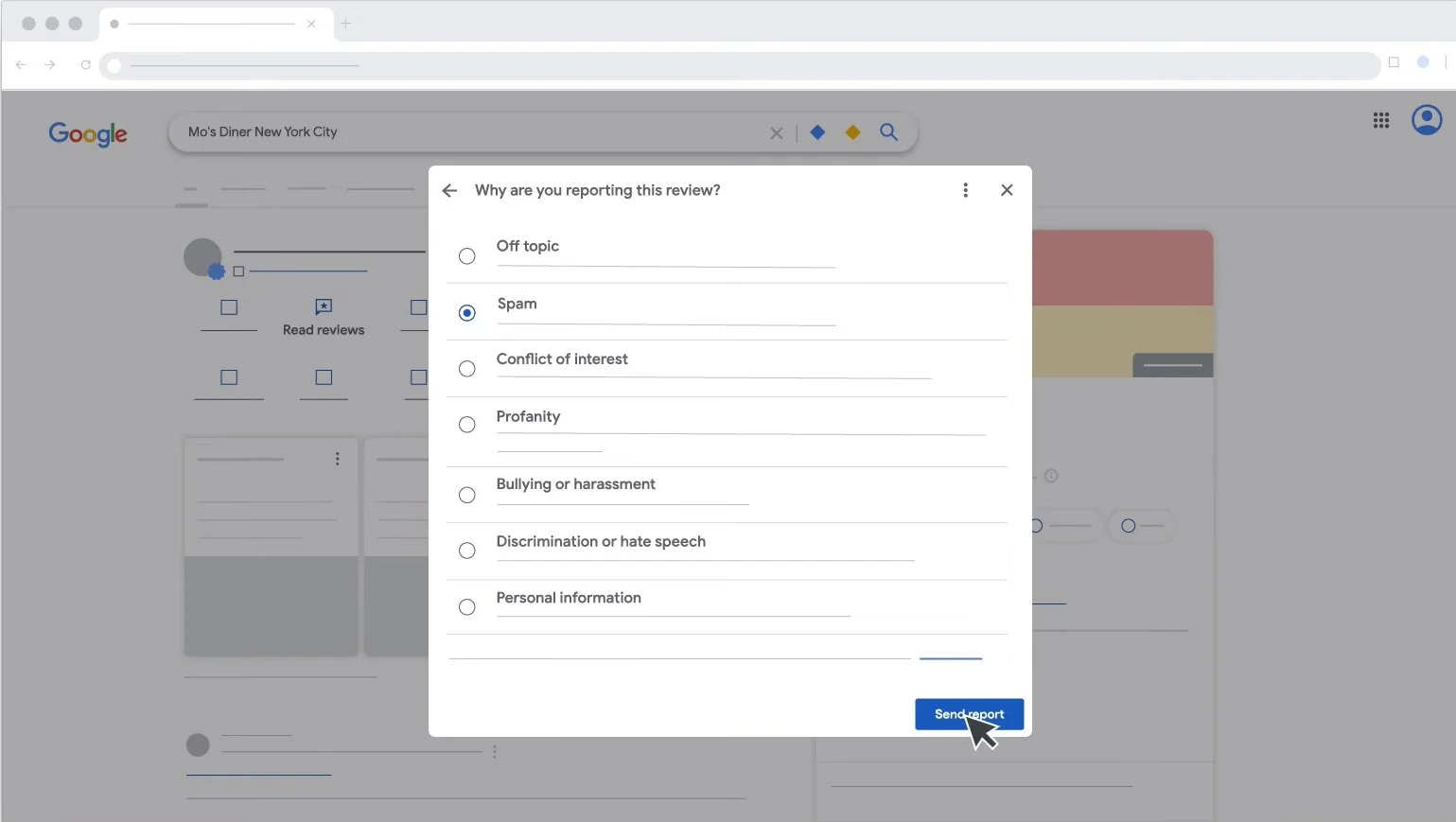
After submitting, there’s no case number or confirmation email. The review enters Google’s moderation queue, and you can track its status through the Reviews Management Tool.
Via the Reviews Management Tool
Google’s dedicated Reviews Management Tool is the most comprehensive option. It handles flagging, status tracking, and appeals from a single interface:
- Go to the Reviews Management Tool
- Confirm your email address
- Select the business profile
- Choose “Report a new review for removal” and continue
- Select the review you want to report
- Choose the violation type
- Submit
This is also where you’ll check the status of reports and submit appeals later, so it’s worth bookmarking.
Via Google Search
You can flag a review directly from Google Search results without logging into a dashboard:
- Search for your business name on Google
- Click on your Google reviews in the Business Profile panel
- Find the review and click the three vertical dots (⋮)
- Select “Report review”
- Choose the violation type and submit
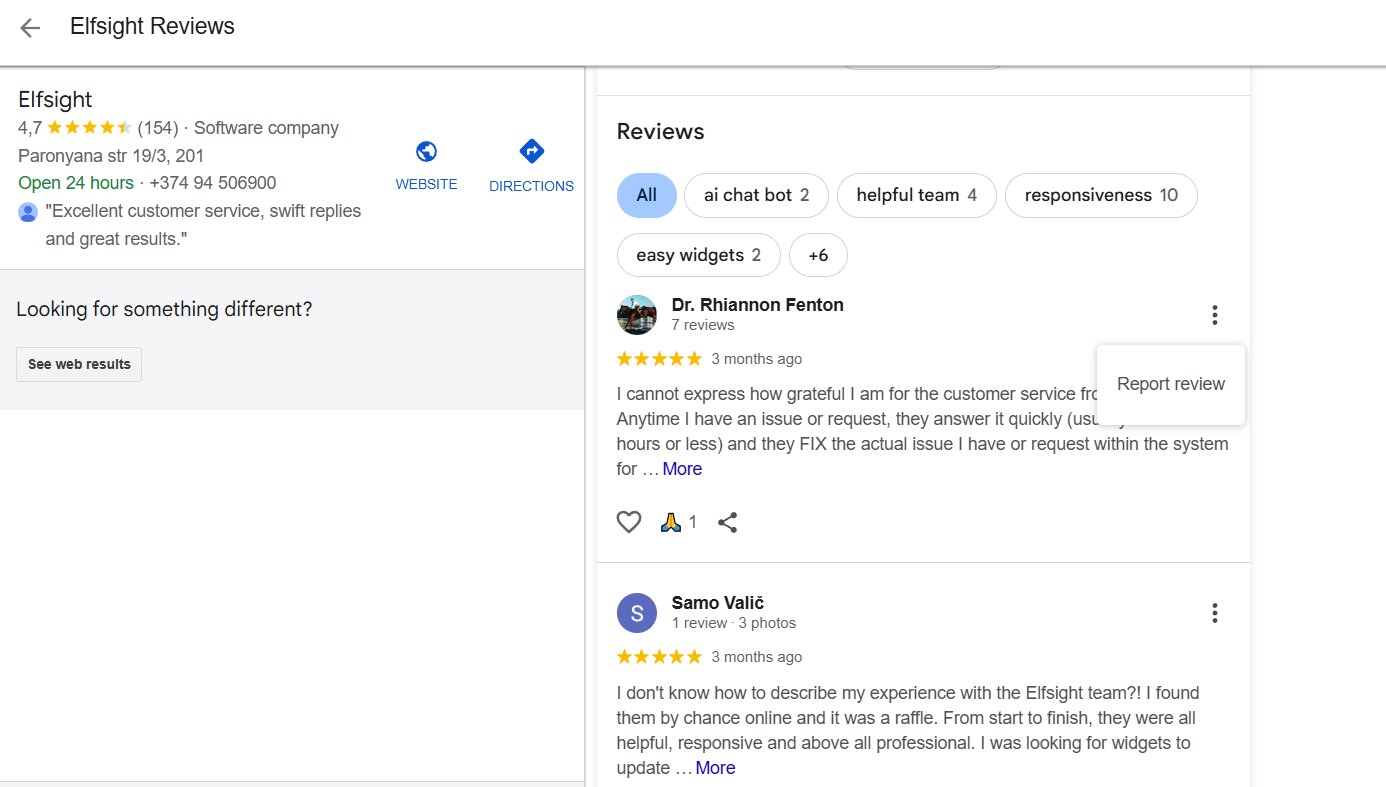
This method is quick but doesn’t provide status tracking. If you need to follow up or appeal, you’ll still need to use the Reviews Management Tool.
Via Google Maps
The process on Google Maps works the same way on both desktop and mobile:
- Open Google Maps and find your business listing
- Scroll to the review you want to report
- Click or tap the three-dot menu on the review
- Select “Flag as inappropriate”
- Choose the violation type and submit
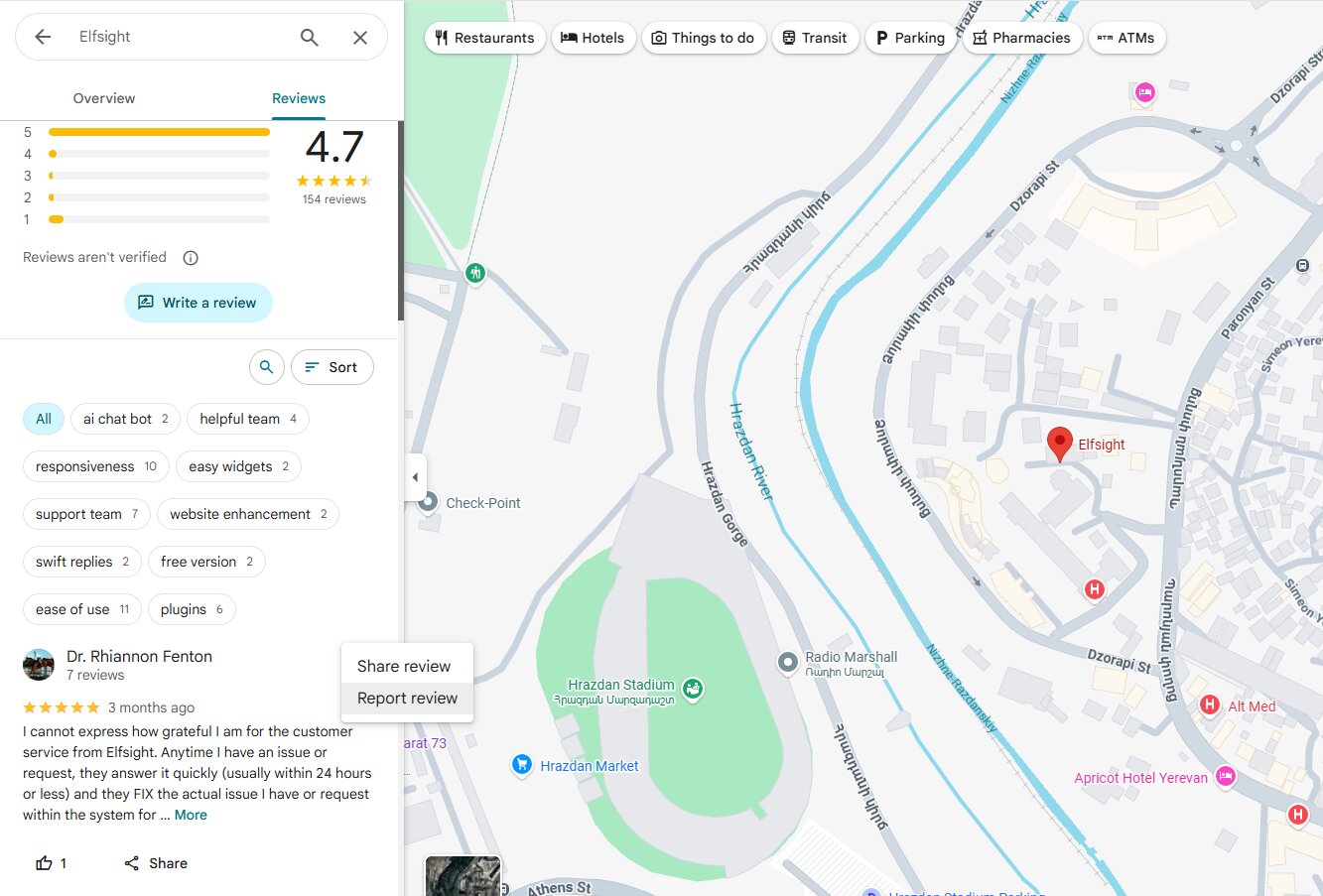
Like the Search method, Maps flagging doesn’t give you a tracking interface. For status updates, use the Reviews Management Tool after submitting.
The Merchant Extortion Form
If your business is receiving fake negative reviews paired with demands for money or services in exchange for removal, Google has a dedicated extortion report form that’s separate from the standard flagging process. Reviews reported through this channel are typically processed within 24 hours to a few days — significantly faster than standard flags.
To use it, you’ll need evidence of both the fake reviews and the extortion communications (screenshots of messages demanding payment, emails, WhatsApp conversations, or similar). Submit through the Merchant Extortion Reporting form with your business details, links to the suspected reviews, and the communication evidence.
What Happens After You Flag a Review
Flagging a review is step one. What follows is a structured workflow with specific statuses, a one-time appeal, and a set of escalation options if the appeal doesn’t work.
Google officially states that most review reports are processed within three business days. In practice, timelines vary widely. Practitioners consistently report 5–20 business days, with some cases taking a month or longer, particularly during periods of high moderation volume.
You can track the progress through the Reviews Management Tool. Your report will show one of three statuses:
| Status | What It Means | What to Do |
|---|---|---|
| Decision pending | Your report is in the moderation queue and hasn’t been evaluated yet | Wait at least 3 business days before checking again |
| Report reviewed – no policy violation | Google evaluated the review and found no violation. Your one-time appeal is now available. | Submit an appeal through the Reviews Management Tool (see below) |
| Escalated – check your email | Your appeal has been escalated to a specialist team. The final decision arrives via email. | Monitor your email. No further action available until Google responds. |
If your report comes back as “no policy violation,” don’t assume the review is untouchable. The initial review is often a quick assessment, and the appeal step is where you can provide more context and evidence.
One-time appeal
If Google’s initial evaluation finds no violation, you get exactly one appeal. This is a critical detail that most guides miss.
“Google now allows just one removal request and one appeal. After that, the review stays and can’t be flagged again. This makes accuracy critical.” — RetainTrust
- Go to the Reviews Management Tool
- Confirm your email and select the business
- Choose “Check the status of a review I reported previously and appeal options”
- Select “Appeal eligible reviews”
- Choose the review(s) you want to appeal — you can batch up to 10 reviews per submission
- Select “Submit an appeal”
- Fill out the appeal form with additional context and evidence
- Submit
The appeal is reviewed by a different team than the one that handled your initial flag. This is your opportunity to explain specifically which policy the review violates and provide any supporting evidence. The appeal is final within Google’s internal system, so take time to make your case thoroughly rather than rushing through the form.
If the appeal fails
After a rejected appeal, there are no further internal review cycles. Your remaining options narrow to a few paths, each with different tradeoffs:
- Contact Google Business Profile support through the GBP Help Center chat. Support agents can sometimes escalate cases that the automated workflow missed, though outcomes vary.
- Post in the Google Business Profile Community forum. Google Product Experts (experienced volunteers with some escalation ability) monitor the forum and can sometimes flag reviews for a second look.
- Consider legal removal if the review contains provably false statements causing measurable financial harm. Google maintains a legal removal request process for court-ordered content removal and defamation claims.
- Focus on your response strategy. For reviews that can’t be removed, how you respond shapes how future customers interpret the situation — often more than the review itself does.
Display selected reviews with the Google reviews widget ↓
Common Questions
Can businesses delete Google reviews?
How long does it take Google to remove a flagged review?
Can you pay to remove Google reviews?
How do I remove fake Google reviews from my business?
Does responding to a negative Google review help?
Will deleting my Google Business account delete the reviews?
Where to Start
Match your situation to the right next step. If the review violates Google’s content policy (e.g., fake engagement, harassment, off-topic content), flag it through the Reviews Management Tool and be prepared to use your one-time appeal if the initial flag is rejected.
If the review describes a real customer experience, even an unfair one, removal is unlikely, and your response becomes the thing future customers will actually read. For the longer game, generating steady, organic review volume shifts your average more effectively than any single review removal.
One thing you can always control is how reviews appear on your own website. While Google determines what shows on your Business Profile, your site is your space. Elfsight’s Google Reviews widget lets you display curated Google reviews directly on your pages — giving visitors social proof in a context you own, with the layout and selection you choose.