Google gives every business with a Business Profile a free review QR code, and a code you make yourself is only as good as the review link inside it. When we checked 30 review QR codes on real businesses’ websites, 9 didn’t open the review form directly: they sent customers to a profile, a search page or somewhere off Google first.
A scannable QR code on the counter, table, or receipt lets customers review you without having to search for your business themselves. That only works if the code holds the right link. A code that opens your Maps profile or a search page leaves them hunting for the review button, and every extra tap is a chance to lose a reviewer halfway.
We wanted to know how often businesses get this wrong, so we decoded 30 review QR codes that small businesses show on their websites, followed every link, and scanned them as a customer would. Only the codes holding a real review link, or a redirect to one, opened the form with the stars ready.
- Google makes a free review QR code for you; get it from your Business Profile in a computer browser.
- Only a real review link opens the form with stars ready; read-reviews and search links add a tap, and Maps links open your profile.
- A static code holds your link itself and keeps working; a dynamic code from a generator can stop when the plan ends.
- On your website, use a review button next to your reviews instead of a code.
- Ask every customer the same way and never offer anything for a review: Google removes reviews it counts as fake engagement.
How to get Google’s free QR code for reviews
You don’t really need a generator to get a QR code for Google reviews – a basic one at least. Google creates one for you, free, in your Business Profile. You’ll need a computer for it, though: the QR code option shows up only when you manage your profile in a computer browser, not on a phone.
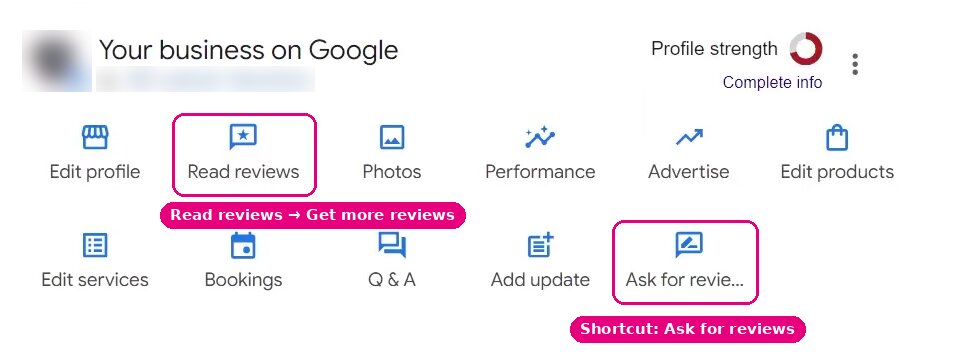
Google’s help gives these steps:
- On a computer, go to your Business Profile (prior Google My Business).
- Select Read reviews → Get more reviews to open the panel with your link and code.
- Right-click the QR code and choose Save image as, or use the Copy button to take the link instead.
The link in that panel is your Google review link, and it belongs in any code you make yourself.
How to make your own Google review QR code
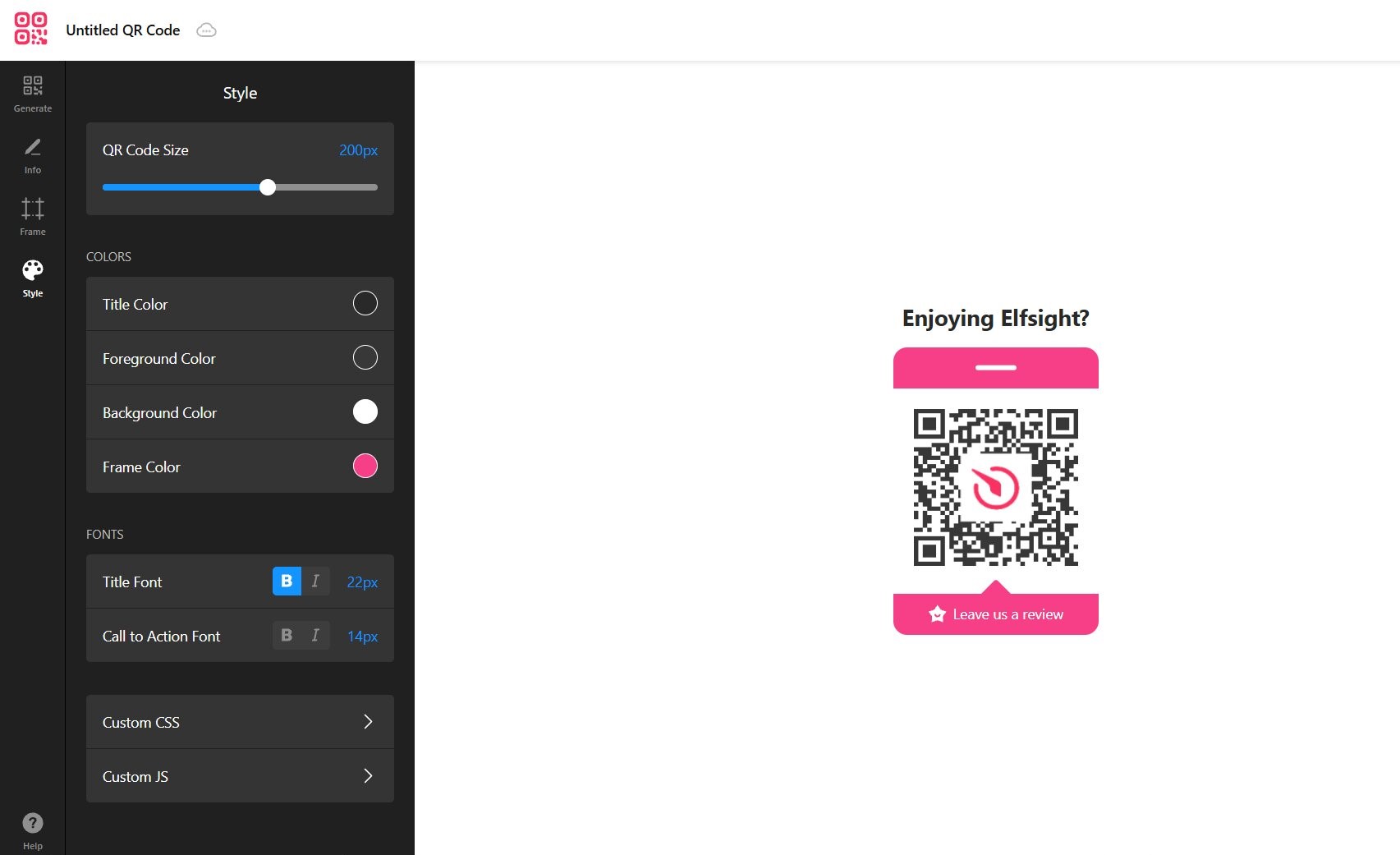
If you want to make a QR code for Google reviews with a custom frame, colors, and built-in CTAs, you can do so using free generators.
Steps to follow:
- Copy the link from Google’s Get more reviews panel, not a Maps share link or your profile’s address
- To generate the QR code for Google reviews, choose a URL (website) code in a generator, and paste the link there.
- Add a call to action that says what happens on scan, and keep your logo and colors in the frame, not over the code.
- Download the code at the largest size offered, then test it before printing: the link your phone shows should start with Google’s address, not the generator’s.
Whichever tool you use, the link determines what customers see, and real businesses’ codes show how often that goes wrong.
What a Google review QR code opens: 30 real codes checked
A code opens Google’s review form with the stars ready only when it holds a review link or redirects to one. Read-reviews links and copied search links add a tap, and a Maps link opens your profile with no form on the first screen.
To see how often businesses get this right, we found 30 review QR codes that US businesses show on their own websites, decoded each one, and followed its link without signing in.
21 of the 30 codes led to Google’s review form, behind a Google sign-in. The other 9 didn’t, at least not directly, and 2 of those never reached Google at all.
We also scanned 8 random codes from that sample group with an iPhone’s camera. Here’s what each kind of link opened:
| Link inside the code | Codes in our sample | What it opened |
|---|---|---|
| Google review link (g.page/r/…/review) | 14 | Review form, stars ready |
| Google “write review” link (search.google.com/local/writereview) | 5 | Review form (link check only) |
| Generator redirect to a review link | 2 | Review form, stars ready |
| Read-reviews link | 2 | Reviews list with a “Rate and review” row |
| Copied Google search link (1 behind a generator) | 3 | Search results on the Reviews tab |
| Google Maps link | 1 | Maps profile, no form |
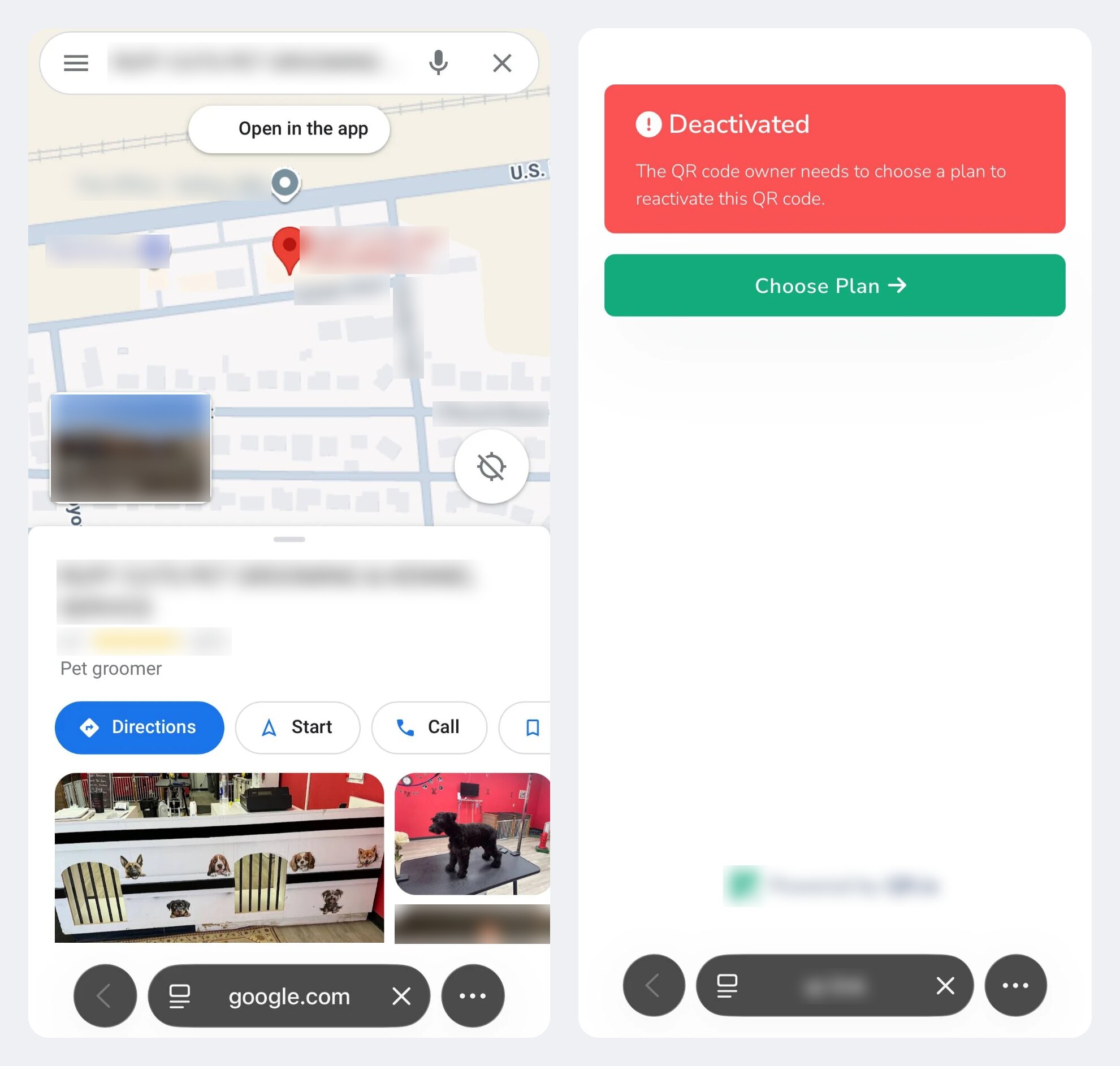
| Generator code that was switched off | 1 | “Deactivated” page, never Google |
| Not a Google link | 2 | The business’s contact page, or a digital business card with a review link on it |
Every extra tap is a point where a customer can give up and put the phone away, so check what your code holds before it goes to print.
Free static vs paid dynamic codes: will yours stop working?
A static code holds your link itself and keeps working as long as the link does. A dynamic code holds the generator’s short redirect link, and most providers require an active plan to keep that redirect running.
That’s what happened to one of the 30 codes in our check: a massage studio’s review QR code now opens the generator’s “Deactivated” page, which asks the code’s owner to choose a plan, instead of Google. We checked it twice on the same day, both via link check and on the phone.
Generators’ own help pages confirm it: the vendor QR Code Generator deactivates dynamic codes when its free trial ends, while static codes keep working, and QRCodeChimp pauses dynamic codes over a plan’s monthly scan limit or beyond the free allowance once a paid plan lapses.
What that means for a Google reviews QR code you print:
| Question | Static code | Dynamic code |
|---|---|---|
| What the code holds | Your link itself | The generator’s redirect link |
| What keeps it working | A working link, nothing else | An active plan, with most providers |
| When a trial or plan ends | Keeps working | Paused or deactivated until you upgrade |
To tell which kind you have, scan it and look at the link your phone shows: if it starts with the generator’s domain rather than Google’s, the code is a redirect.
Print it and put it where people can see
Two things to settle before ordering a batch: the size, and the spot where customers will see it.
How big to print it and how to test it
DENSO WAVE, which invented the QR code, gives no minimum size for phone cameras. Its guidance, written for printers and scanners, says larger modules (the code’s small squares) read more reliably, so print the code as large as the space allows.
Leave a blank margin, the quiet zone, at least four modules wide on every side, and keep stickers, art and text out of it. Then run a test scan before you order:
- Print one code at the size you’ll use and scan it with your phone’s camera.
- Check that the review form opens, not your profile or a search page.
- Scan it on an iPhone and an Android phone if you can; our own scans used one iPhone.
Where to put it, by business type
Put the code where customers have a free hand and a minute, right after the part of the visit they’d review: the table or the bill at a restaurant, the reception counter at a salon, the invoice for a service job. Google’s own suggestions include receipts and a printed code displayed in your store.
A printed code works where people stand in front of it. On your website, they’re holding the screen the code would be on.
Ask on your website with a review button
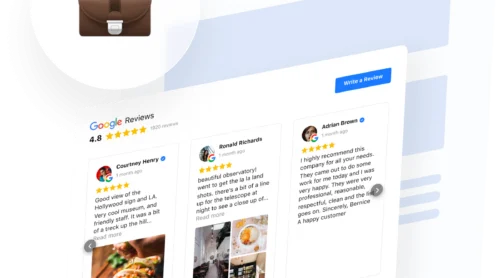
A QR code doesn’t help people who are already on your website: on a phone, they can’t scan a code on the screen they’re reading. For them, a Google reviews widget does both jobs on the page itself. It shows the reviews your other customers left, and its review button opens Google’s review form, so visitors can leave theirs right after reading.
The Google Reviews widget shows your Google reviews on your website, keeps them up to date, and lets you style their display in a visual editor. Enable the “Write a Review” toggle in the Header tab – it reads “Review us on Google”.
Build your Google reviews widget in the live editor below ↓
When we clicked it on a computer, it opened Google’s review dialog with five empty stars and a text box, the same zero-tap result as the best QR codes from our test.
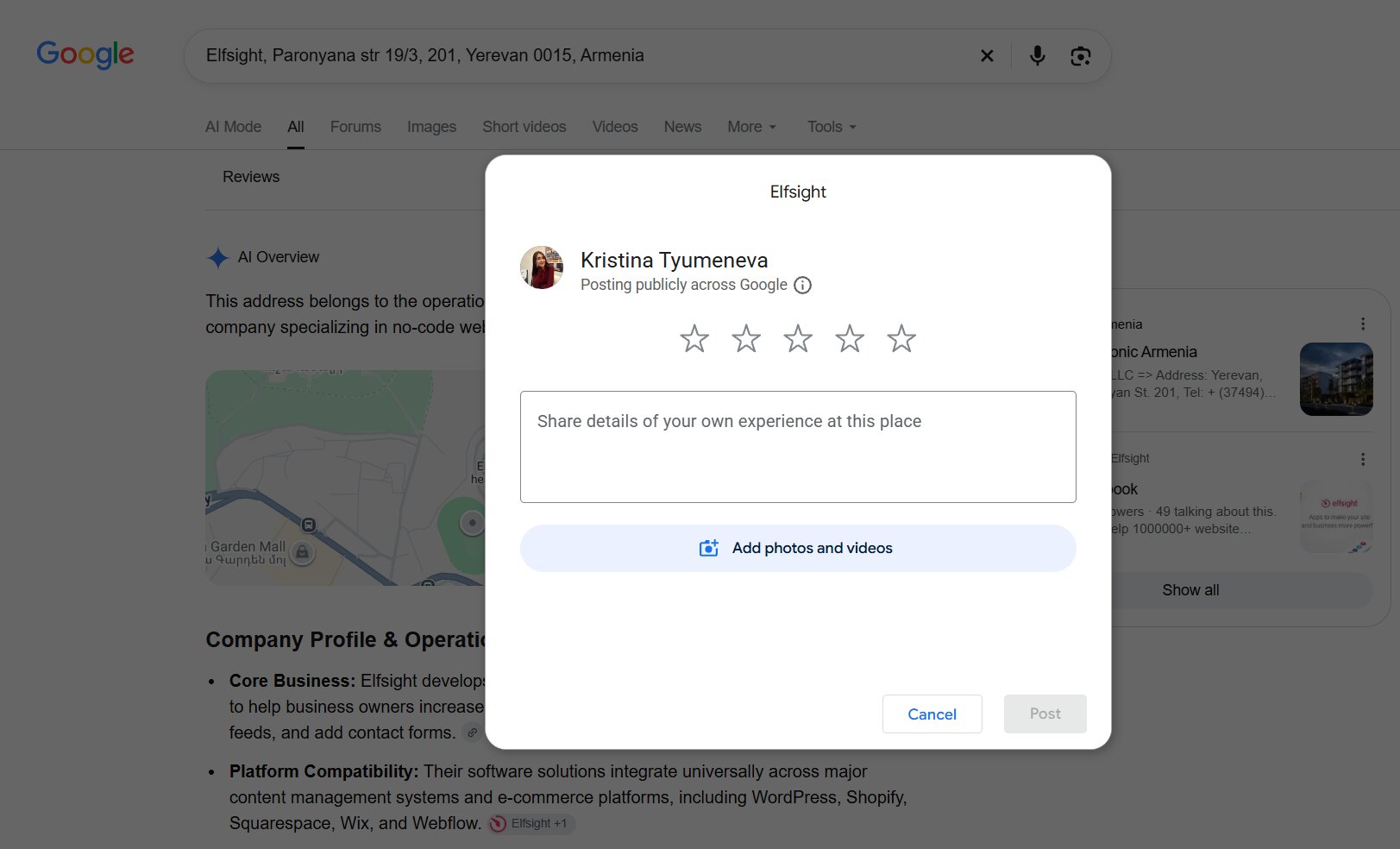
Whether it’s a printed code or a button on your website, the same Google rules apply to how you ask.
How to ask for Google reviews without breaking the rules
Asking every customer to review a genuine experience is allowed, in your store too. What Google’s Maps review policy rules out:
- Requiring or pressuring customers to rate or review while they’re on your premises, or asking for specific content.
- Setting staff review quotas, or asking staff to collect reviews that mention them by name.
- Offering any incentive for a review, such as payment, a discount, or free goods or services.
- Discouraging negative reviews, or asking only happy customers for reviews, which is called review gating. If Google finds a violation, it removes the reviews and may block new ones or unpublish existing ones for a time.
In practice, ask everyone the same way: one sign, one button, the same words, and no pressure on anyone who’d rather not. Word the sign by what happens (“Scan to review us on Google”), not by who should scan: “Loved your visit?” reads as a filter for happy customers. Decide when and how to ask once, then use it with everyone.
Frequently asked questions
Can I track how many people scan my Google review QR code?
Do customers need a Google account to leave a review?
Can one QR code work for several locations?
Should I put my review QR code on my website or social media?
Can I make a QR code for other review sites?
Your first step: get the code and scan it
The link inside the code decides whether a customer lands on the review form, and 9 of the 30 real codes we checked didn’t open it directly.
So start on a computer today: open your Business Profile, save Google’s QR code or paste its review link into a free generator, then scan the code on your phone and make sure the form opens before you print anything.
Key references
- Create a Google link or QR code to request reviews, Google Business Profile Help
- Prohibited & restricted content, Google Maps User Generated Content Policy Help