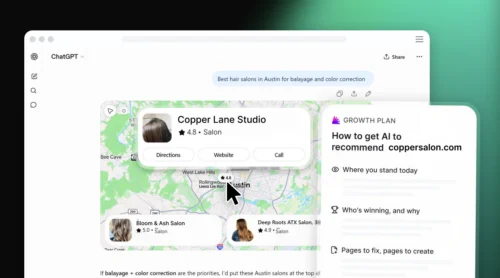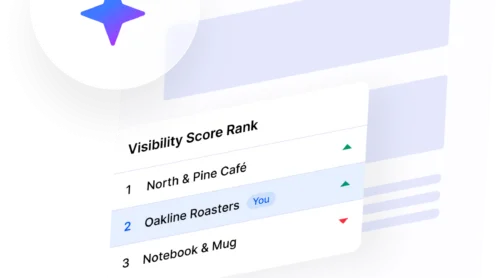


Checking ChatGPT once can give you a surprisingly confident answer about your brand. The problem is that the next prompt or even the same prompt run again may produce a different shortlist. Your company might appear first for one question, lower for another, and disappear completely when the wording changes.
That makes ChatGPT visibility less about “Did we appear?” and more about “How consistently do we appear across the questions that matter?”
Different tracking tools answer that question differently. Some calculate the percentage of AI responses that mention your brand. Others combine presence with position, compare you with competitors, or use large prompt databases to estimate visibility beyond the questions you manually track.
This guide compares seven platforms specifically on how they monitor brand visibility in ChatGPT, what you can inspect behind their headline metrics, and how much that tracking costs.
- What ChatGPT visibility actually measures.
- Why visibility scores can differ between tools.
- How 7 trackers compare on metrics, prompts, response data, and pricing.
- Which tools are better suited to website owners, marketers, and larger teams.
What to check before choosing a ChatGPT visibility tracker.
ChatGPT visibility tracking vs. checking ChatGPT manually
You can test your visibility for free by opening ChatGPT and asking a few customer-style questions.
For example:
- What are the best accounting tools for freelancers?
- Which hotels are best for families in Berlin?
- What are good alternatives to Product X?
If your business appears, you have learned something useful but only about those particular answers at that moment.
A ChatGPT visibility tracker repeats relevant prompts on a schedule and turns the responses into measurable data. Depending on the platform, that can include brand presence, average position, Share of Voice, citations, sentiment, competitors, and historical trends.
In simple terms:
- Manual checking gives you individual examples.
- Visibility tracking shows whether those appearances form a repeatable pattern.
- Deeper AI-search analytics helps explain what is driving that pattern.
If you want to compare visibility across ChatGPT, Gemini, Perplexity, Google AI, and other platforms together, our broader Best AI Visibility Tools guide covers that market. This comparison stays focused on ChatGPT.
Best tools for ChatGPT visibility monitoring compared
The platforms below all track ChatGPT, but their headline visibility metrics do not mean exactly the same thing. Compare the measurement model first – then look at prompt limits, supporting data, and price.
| Tool | Starting price | How visibility is measured | What stands out | Best for |
| Beamtrace | $20/mo annually | Share of tracked prompt runs where the business appears | Clear presence score connected to rankings, competitors, citations, reputation, and improvement Actions | SMBs and website owners |
| Otterly.AI | $25/mo annually | Brand Coverage plus a separate position-based Brand Visibility Index | Separates how often you appear from how prominently you appear | Small teams |
| Peec AI | $80/mo annually | Responses mentioning your brand ÷ total responses × 100 | Transparent formula with daily tracking and underlying response data | Marketing teams |
| Semrush AI Visibility | $99/mo/domain annually | Topic Coverage + Mention Consistency; custom prompts can also be tracked daily | Large prompt database connected with traditional SEO | SEO teams |
| Profound | $99/mo annually | Visibility Score supported by Visibility Rank and Share of Voice | Daily browser-captured answers plus real-user prompt research | Advanced marketing teams |
| Scrunch | $250/mo | Brand Presence with separate competitive, position, citation, and sentiment metrics | Deep segmentation by audience, topic, funnel stage, and location | Larger organizations |
| AthenaHQ | Free entry | Brand mentions and competitive Share of Voice across tracked responses | Competitive visibility connected with citations and optimization | GEO teams |
Pricing and packaging change frequently, so check each provider’s current terms before purchasing.
Best ChatGPT Visibility Trackers for Businesses
These tools all monitor brand presence in ChatGPT, but they differ substantially in what they consider “visibility” and how much evidence you can inspect behind the score.
1. Beamtrace

Built by the team behind Elfsight, Beamtrace takes a straightforward approach to measuring ChatGPT visibility. Its AI Visibility Score represents the share of tracked prompt runs where an AI answer mentions your business, expressed on a 0–100 scale.
The prompt set is based on the business itself rather than generic SEO keywords. Beamtrace researches the website, generates customer-style questions around the company’s category and offering, and lets users add their own prompts. The underlying answers remain available, so the visibility score can be traced back to the exact questions behind it.
Visibility also connects with the rest of the Beamtrace workflow. Users can examine rankings, competitors, citations, reputation, and individual prompts when they need to understand why visibility changed, then move identified gaps into optimization Actions.
Main Features:
- AI Visibility Score and historical trend
- Customer-style prompt generation
- Custom prompt tracking
- Complete ChatGPT responses
- Prompt-level brand presence
- Ranking and position analysis
- Competitor Share of Voice
- Citation tracking
- Sentiment and reputation context
- Optimization Actions based on identified gaps
| 👍 Best for | 💰 Pricing plans |
| SMBs, local businesses, and website owners that want an easy-to-interpret visibility baseline with deeper analysis when something changes. |
|
Better suited to focused visibility tracking than large-scale enterprise monitoring.
2. Otterly.AI

Otterly.AI separates two ideas that are often combined under the word visibility.
Its Brand Coverage measures the percentage of monitored prompts in which a brand appears. Separately, its Brand Visibility Index looks at coverage alongside a position-derived “Likelihood to Buy” dimension, making it possible to distinguish brands that appear frequently from those that appear less often but tend to rank prominently when they do.
That makes the dashboard particularly useful for website owners who want more context than a single percentage without moving into an enterprise analytics product. Daily tracking, Share of Voice, citations, and sentiment provide additional ways to investigate changes.
Main Features:
- Brand Coverage
- Brand Visibility Index
- Average Brand Position
- Share of Voice
- Daily visibility tracking
- Citation analysis
- Sentiment analysis
- Individual prompt results
- Historical visibility changes
- GEO audits and recommendations
| 👍 Best for | 💰 Pricing plans |
| Small businesses and marketers that want affordable daily tracking with separate visibility and position signals. |
|
The Lite plan includes only 15 prompts. Gemini, Claude, and Google AI Mode also require additional add-ons rather than being included in the base package.
3. Peec AI

Peec AI publishes one of the clearest visibility formulas in this comparison:
Visibility = responses mentioning your brand ÷ total analyzed responses × 100.
If your brand appears in 30 out of 50 analyzed answers, the Visibility Score is 60%. Position, sentiment, and Share of Voice remain separate metrics instead of being folded into the same score.
Peec runs monitored prompts daily and gives users access to the underlying response data. Starter includes 50 prompts and lets you choose three models, making it a stronger fit for teams that need greater prompt volume than most entry-level SMB tools.
Main Features:
- Published percentage-based Visibility Score
- 50 prompts on Starter
- Daily tracking
- Three selected models
- Position tracking
- Share of Voice
- Sentiment
- Competitor monitoring
- Response-level analysis
- Unlimited users
| 👍 Best for | 💰 Pricing plans |
| Marketing and SEO teams that want a transparent visibility metric, daily monitoring, and a larger prompt allowance. |
|
Self-serve plans let you choose three models. Adding broader model coverage increases the cost, so the $80 entry price does not represent every AI platform Peec supports.
4. Semrush AI Visibility

Semrush approaches visibility from two directions.
Its broader AI Visibility Score uses a large prompt database and combines Topic Coverage – how broadly a brand appears across relevant topics – with Mention Consistency, or how frequently the brand appears within those topics. Semrush says the database currently contains more than 317 million prompts and responses across ChatGPT and other AI-search experiences.
For businesses that want to monitor a specific set of ChatGPT questions instead, Prompt Tracking runs selected prompts daily and reports visibility and average position over time. This makes Semrush unusual in offering both market-level discovery and controlled recurring tracking.
The main advantage for existing Semrush users is that AI visibility can be viewed alongside conventional SEO data instead of becoming an entirely separate reporting stack.
Main Features:
- AI Visibility Score
- Topic Coverage
- Mention Consistency
- Daily custom Prompt Tracking
- ChatGPT-specific reporting
- Competitor benchmarking
- Share of Voice
- Sentiment
- Citation analysis
- Large AI prompt database
- Traditional SEO integration
| 👍 Best for | 💰 Pricing plans |
| SEO teams that want ChatGPT visibility tracking connected with their existing keyword, competitor, backlink, and content research. |
|
Semrush has several separate AI visibility datasets and reports. That provides depth, but it can be less straightforward than a tracker built around one visibility metric and one fixed prompt set.
5. Profound

Profound takes a more research-heavy approach to visibility tracking.
Its Answer Engine Insights product runs monitored prompts daily and reports Visibility Score alongside Visibility Rank, Share of Voice, citations, sentiment, and positioning. Profound explicitly runs prompts repeatedly because AI platforms can return different answers to the same question over time.
A particularly distinctive part of the platform is prompt selection. Profound’s Prompt Tracking can draw from a dataset of more than 1.3 billion real-user AI conversations, helping teams judge whether the questions they monitor resemble queries people actually submit to AI assistants.
Profound also captures responses from the consumer browser experience rather than relying solely on API output, which may matter to teams that want monitoring to resemble what an ordinary ChatGPT user sees.
Main Features:
- Daily ChatGPT prompt tracking
- Visibility Score
- Visibility Rank
- Share of Voice
- Browser-captured responses
- Citation tracking
- Sentiment analysis
- Prompt-level trends
- Audience and segment filters
- Real-user Prompt Volumes
| 👍 Best for | 💰 Pricing plans |
| Larger marketing teams that want ChatGPT visibility tied to deeper prompt research and answer-engine intelligence. |
|
Profound is considerably more research-heavy than most SMBs need. Starter also focuses on ChatGPT, while broader answer-engine coverage requires higher plans.
6. Scrunch

Scrunch is useful when one overall visibility percentage hides too much.
Its core Brand Presence concept measures how often a brand appears in collected AI responses, but users can then break that visibility down by topic, persona, funnel stage, country, branded versus non-branded prompts, and other dimensions.
That changes the questions a team can ask. Instead of simply checking whether visibility increased, a business can determine whether it performs well for awareness-stage prompts but disappears during purchase-oriented questions, or whether one customer persona sees the brand much more frequently than another.
Scrunch also keeps positioning, competitive presence, citations, and sentiment as related signals rather than treating them as the same metric.
Main Features:
- Brand Presence
- Competitive Presence
- Prompt-level tracking
- Persona segmentation
- Funnel-stage segmentation
- Branded vs. non-branded analysis
- Position in responses
- Sentiment
- Citations
- Full AI-response inspection
- Historical trends
| 👍 Best for | 💰 Pricing plans |
| Mid-market and larger organizations that need to understand visibility across different audiences, topics, and stages of the buying journey. |
|
At $250 per month, Scrunch is difficult to justify if you only need a straightforward ChatGPT visibility trend for one small website.
7. AthenaHQ

AthenaHQ treats AI visibility largely through a competitive lens.
Instead of publishing a simple standalone ChatGPT visibility formula like Beamtrace or Peec, Athena emphasizes brand mentions, citation coverage, and Share of Voice – how much of the total brand conversation you capture compared with competitors.
That makes it useful when “Are we visible?” is less important than “Are we getting more of the relevant AI conversation than competing brands?” Prompt and response analysis, citations, sources, competitors, and optimization recommendations sit inside the same platform.
Athena also has a free entry plan, although the price jump to its paid Starter tier is substantial.
Main Features:
- Brand mention tracking
- Competitive Share of Voice
- Prompt and response analysis
- Citation tracking
- Competitor intelligence
- Sentiment monitoring
- Multi-model visibility
- Source analysis
- Content recommendations
- Optimization agent
| 👍 Best for | 💰 Pricing plans |
| GEO and marketing teams that think about ChatGPT visibility primarily in relation to competitors and want monitoring connected with optimization. |
|
AthenaHQ is less useful if you specifically want one simple ChatGPT visibility percentage. Its paid tier is also a major jump from the free plan.
Why ChatGPT visibility scores differ between tools
Seeing 35% visibility in one tool and 50% in another does not automatically mean one of them is wrong.
There are several reasons two best tools for tracking brand visibility in ChatGPT can produce different results.
💬 They may monitor different prompts
Visibility is only meaningful relative to the questions being measured.
A prompt set filled with your brand name will usually produce higher visibility than one built entirely around generic customer discovery questions.
Likewise, these prompts measure very different things:
“What features does Brand X offer?”
and
“What are the best tools for solving this problem?”
Before comparing scores, check whether the tools are monitoring equivalent customer journeys.
📊 They may define visibility differently
There is no universal industry formula.
Beamtrace measures the share of tracked prompt runs where the business appears. Peec measures the percentage of analyzed responses mentioning the brand. Otterly uses Brand Coverage for presence while separately accounting for position through its Brand Visibility Index. Semrush combines topic breadth with mention consistency in its broader AI Visibility Score.
Those approaches are related, but they are not interchangeable.
📡 They may collect ChatGPT responses differently
Profound explicitly captures consumer browser responses, while other platforms may use platform-specific methods, APIs, or their own collection infrastructure.
Collection method matters because the version of ChatGPT being monitored and whether search is enabled can influence the resulting answer.
🔄 They may refresh at different frequencies
AI answers change.
Daily monitoring produces a different dataset from checking every few days, especially over short periods. A higher refresh rate does not automatically make a tracker better, but teams comparing short-term changes should understand the cadence.
🧩 They may mix presence with other signals
Visibility, ranking, Share of Voice, sentiment, and citations are useful together, but they answer different questions.
A good dashboard should make it clear whether its headline number means:
- How often you appear
- Where you appear
- How often you appear relative to competitors
- Or a combination of several factors
Before comparing two visibility scores, compare the prompt set, formula, ChatGPT collection method, and refresh frequency behind them.
How to choose the best ChatGPT visibility tracker
The best tool is not necessarily the one with the most metrics. Choose based on how you plan to use the data.
- Start with the visibility definition
If you want a number that is easy to explain internally, look for a transparent presence-based metric.
Beamtrace and Peec are particularly straightforward here, while Otterly deliberately separates basic coverage from its broader position-oriented model.
- Check the prompts behind the score
A visibility score is only as relevant as the questions being tracked.
The best tools to track brand visibility in ChatGPT should let you add your own commercially important prompts or provide a sensible way to discover them.
Profound stands out for real-user prompt research, while Beamtrace generates an initial set around the business itself.
- Make sure you can inspect real answers
A graph showing visibility moving from 40 to 35 is not enough to understand what happened.
Look for access to the underlying ChatGPT responses so you can see:
- Which prompt changed.
- Whether a competitor replaced you.
- Where your brand appeared.
- How it was described.
- Which sources supported the answer.
- Match prompt volume to your business
More prompts are not always better.
A local service business might learn a lot from 10–20 carefully selected questions. A company with several products, audiences, markets, and funnel stages may need hundreds.
Pay attention to what the entry price actually includes rather than comparing subscriptions on price alone.
- Track trends instead of individual answers
ChatGPT is not deterministic. One good or bad response should not drive your strategy.
Keep a stable core prompt set and watch whether visibility improves or declines over several collection cycles. That will usually tell you more than reacting to daily fluctuations.
Which ChatGPT visibility tracker should you choose?
Different tools are strongest at different ways of measuring visibility.
| Priority | Strong fit |
| Clear visibility baseline connected to deeper analysis and improvements | Beamtrace |
| Affordable daily visibility + position tracking | Otterly.AI |
| Transparent formula with higher prompt volume | Peec AI |
| ChatGPT visibility alongside established SEO | Semrush |
| Research-heavy daily prompt intelligence | Profound |
| Deep audience and funnel segmentation | Scrunch |
| Competitive Share of Voice + GEO workflows | AthenaHQ |
For a small or medium-sized website, start by deciding how many customer questions you genuinely need to track and how much analysis you need beyond the basic visibility percentage.
Larger platforms become more valuable when you need audience segmentation, large prompt sets, several markets, competitive research, or reporting across a wider organization.