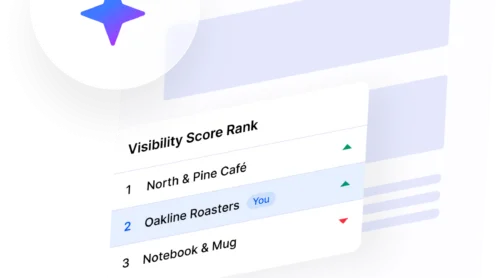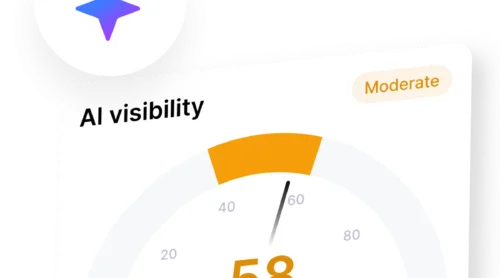

You can hold the top spot on Google and still go unnamed when a potential client asks ChatGPT for a recommendation, because a page-one Google ranking does not carry over to ChatGPT. In a synthesized AI answer, there is no page two to slip onto: your brand is either inside the answer, or it is invisible, and most businesses cannot yet see which.
This guide compares the best AI rank trackers for website owners and small teams, organized by the AI engine each one watches and read through an SMB budget lens.
- Rank tracking reflects ongoing prompt performance, not a one-time score.
- In AI answers, “ranking” is a probability of appearing (vs fixed slot to win)
- Tooling is deepest for ChatGPT and most relevant for SMBs on Google AI Overviews.
- Share-of-voice metrics vary by tool, so compare trends within one platform.
Does AI rank even matter?
The shift toward AI answers is real but still green: Google still accounts for 73.7% of US desktop searches while dedicated AI tools make up 3.2%. With more buyers researching products in AI assistants, AI rank tracking shows where your brand ranks in their recommendations.
Why AI rank is a probability, not a position
AI answers are generated freach each time, so the same prompt rarely returns the same result twice. In a reproducibility study across ChatGPT, Claude, and Google AI, the same list of brands appeared less than 1% of the time, and an identical list in identical order almost never.
The sources behind those answers change just as quickly. One analysis found that ChatGPT replaced up to 74% of its cited sources each week and Google around 56%. Even model updates can reshuffle citations within days, making any single position a snapshot of a moving target.
What that means when picking a tool
A tool that runs each prompt several times (so-called multi-pass sampling) gives a steadier read than one that checks once, since a single run is closer to noise than signal. Besides, providers compute share of voice differently, which is why the reliable signal is directional change within one tool over time, not an absolute score compared across dashboards.
What makes the best AI rank tracker
Plenty of tools that surface for rank tracking are not cut out for the job, so it helps to set the bar before comparing them. The table below lines up online AI rank trackers that clear that bar by covered engines, entry price, and an effective cost per tracked prompt:
| Tool | Engines tracked | Starting price (annual) | ≈ Cost per prompt | What it tracks for rank |
| Beamtrace | ChatGPT-exclusive (more coming soon) | $20/mo | ≈ $2.00 | Average position, ranking trends, competitor rankings, citations |
| Otterly.AI | ChatGPT, AI Overviews, Perplexity, Copilot | $25/mo | ≈ $1.7 | Domain ranking, average position, share of AI voice |
| Mangools AI Search Watcher | 6 LLMs | ≈ $15.60/mo (bundled) | multi-pass 2× | Position across engines, each prompt sampled five times |
| SE Visible | AI Overviews, AI Mode, Perplexity, ChatGPT, Gemini | $79/mo | ≈ $1.2 | Position and share of voice across five engines, competitor benchmarking |
| Semrush AI Visibility Toolkit | ChatGPT, AI Overviews, AI Mode, Gemini, Perplexity | $99/mo per domain | ≈ $3.96 | Citation share and share of voice, historical trends |
| Peec AI | 3 engines of your choice | $70/mo | ≈ $1.4 | Placement in answers, share of voice, competitor benchmarking |
| Rankscale | 17+ engines | ≈ $20/mo | credit-based | Rankings, share of voice, historical trends |
| Nightwatch | 6 LLMs | $79/mo | ≈ $1.58 | Classic position history plus AI answer tracking |
Before committing to any of them, or vetting a tool not listed here, run it past a quick checklist. A reliable AI rank tracking tool does four things rather than hand you a single number:
- Charts your position over time, so you can see trends rather than a one-off reading.
- Reports prompt-level position or prominence, not just a yes-or-no mention.
- Compares you against named competitors on the same prompts.
- Calculates share of voice, so you know how much of the answer space you hold.
Best AI rank trackers for ChatGPT
ChatGPT has the deepest tooling of any engine, which is fortunate because non-determinism bites hardest there. The model cites around 15 sources per response and leans heavily on community platforms like Reddit, so the set of brands it names can swing widely between runs.
Beamtrace
Beamtrace is a simplicity-first AI rank tracker built by the team behind Elfsight, with 14 years of SaaS experience and more than 3 million business users.
With the Search Rank Tracker, you can:
- Track your position in AI answers across key prompts and user queries
- See whether your position improves or declines over time and identify what drives changes
- Understand the competitive landscape in AI answers for the same prompts
- Identify which web pages, articles, or references AI systems rely on
This tool is a low-cost on-ramp for owners whose priority engine is ChatGPT. Pricing is flat at $20, $40, and $100 a month, scaling prompts from 10 to 60 and checks from every three days to daily. 14-day free trial is offered across all plans.

Otterly.AI
Otterly.AI is one of the lowest-friction ways into multi-engine tracking, covering ChatGPT, Google AI Overviews, Perplexity, and Copilot on every plan.
For rank, it reports:
- Your average position and Domain Ranking in AI answers
- Share of AI Voice measured against named competitors
- Daily tracking across four engines on the base plan
- The sources and links each answer draws on
The Lite plan runs $25 a month for 15 prompts, about $1.7 per prompt, an unusually broad entry for the price. Gemini and Google AI Mode sit behind paid add-ons of roughly $9 to $149 a month each.
Mangools AI Search Watcher
Mangools AI Search Watcher tackles non-determinism directly by running each prompt twice, so its readings lean on repeated sampling rather than a single check.
For rank, it lets you:
- Track your position across six major LLMs
- Sample each prompt twice to smooth out run-to-run variation
- Monitor a generous allowance of roughly 500 tracked prompts a week
- Work inside the wider Mangools SEO suite you may already use
It comes bundled in the Mangools SEO suite for around $15.60 a month on annual billing, the lowest-cost option here.
Once you can see your ChatGPT position, the work shifts to improving it. A practical walkthrough covers how to rank higher on ChatGPT this week, from profile and schema fixes to authentic community presence.
Best AI rank trackers for Google AI Overviews
Google AI Overviews are the most SMB-relevant surface, since they appear inside the Google results your buyers already use. How often they show up depends on the keyword sample: from about 15.69% of tracked queries in a 10-million-keyword sample, to roughly 60%.

SE Visible
SE Visible is SE Ranking’s standalone AI visibility tracker, and it covers the widest mainstream engine set here: ChatGPT, Gemini, Google AI Mode, Perplexity, and AI Overviews.
For rank, it reports:
- Where your brand lands in each answer, tracked over time
- How often you appear against named competitors as a share of voice
- Which sources and prompts favor competitors over you
- The sentiment and context around each mention
The Basic plan is $79 a month on annual billing for 200 prompts with unlimited seats and three projects, about $1.2 per prompt, and it analyzes roughly 12,000 AI answers a month, enough to sample each prompt repeatedly rather than once.

Semrush AI Visibility Toolkit
Semrush’s toolkit tracks AI visibility inside the same dashboard as your traditional SEO, across ChatGPT, AI Overviews, AI Mode, Gemini, and Perplexity.
For rank, it lets you:
- Track citation share and share of voice across five engines
- Follow historical trends from a prompt database refreshed daily
- Benchmark against competitors on the same prompts
- Keep AI and classic SEO metrics in one place
It is a $99-a-month add-on charged per domain, with extra prompts, domains, and users billed on top. At 25 prompts on the entry add-on, that is about $3.96 per prompt, the highest in the budget-to-mid band.
Seeing your AI Overview position is half the job; earning it is the other half. A deeper explainer on ranking in AI Overviews shows why it behaves as a probability rather than a fixed slot, and what actually moves citation order.
Best AI rank trackers for Perplexity
Perplexity is the most rank-like engine of the group, because it searches the live web on every query and attaches a traceable citation to each claim. That makes position on Perplexity less of a probability guess than on ChatGPT, and it is why several dedicated trackers treat it as a first-class engine.
Peec AI
Peec AI centers on placement in answers and share of voice, with competitor benchmarking and citation-source analysis, and it treats Perplexity as a first-class engine.
For rank, it reports:
- Your placement within each AI answer
- Share of voice against tracked competitors
- The citation sources behind every answer
- Clean daily tracking across three engines of your choice
The Starter tier is $70 a month for 50 prompts, about $1.4 per prompt, with Perplexity among the three included engines.

Rankscale
Rankscale offers the broadest coverage on this list, tracking rankings, share of voice, and historical trends across 17-plus engines including Perplexity.
For rank, it lets you:
- Track rankings and share of voice across 17-plus engines
- Follow historical trends over time
- Benchmark against competitors on the same prompts
- Reach a long tail of engines beyond the big three
Pricing is credit-based, starting near $20 a month on the Essential tier, though the credit allowance there is tight enough that most teams settle on the Pro tier around $99.
Once you are tracking Perplexity, the next move is becoming the passage it quotes. A six-lever guide to optimizing for Perplexity covers answer-first structure, crawlability, freshness, and the earned-media signals it leans on.
Best AI rank trackers for other engines
Coverage thins once you move past the big three, and position tracking on Gemini, Google AI Mode, Grok, and Claude is still early-stage. Gemini is worth measuring carefully: it cites just three sources on average, and the overlap between the brands it mentions and the domains it cites can fall as low as 30%, so being named and being cited diverge sharply. Measure both rather than assuming a mention means a citation.

Nightwatch
Nightwatch approaches these engines from the SEO side: it is a classic SERP rank tracker with an AI add-on covering ChatGPT, Gemini, Claude, and AI Overviews.
For rank, it lets you:
- Track AI-answer position with traditional rank-tracking rigor
- Cover ChatGPT, Gemini, Claude, and AI Overviews in one place
- Keep AI tracking beside your classic keyword rankings
- Add unlimited team seats without extra per-seat cost
The Starter plan is $79 a month for 50 tracked prompts and 500 keywords, bringing the combined cost to about $1.58 per prompt.
For the widest engine list, Rankscale reaches Grok and Claude among its 17-plus engines, and Trakkr covers eight major engines including both. Across every tool, though, true position tracking on Grok and Claude remains immature, so treat readings there as early signals rather than settled rankings.
Matching a tracker to your budget
Real budget bands exist in this market, and the practical move is to match the band to your needs rather than chase engine count. The ladder below groups the options and flags what raises the real cost in each tier.
| Band | Monthly range | Example tools | Watch for |
| Entry | ≈ $15 to $30 | Mangools, Beamtrace, Rankscale, Otterly Lite | Few prompts; checks every few days rather than daily |
| SMB core | ≈ $32 to $99 | Nightwatch plus AI add-on, Semrush Toolkit, Peec Starter | Per-seat, per-domain, and per-engine add-ons |
| SMB ceiling | ≈ $100 to $250 | Beamtrace Premium, SE Ranking AI add-on, Otterly Standard, Peec Pro | Add-ons stack on top of a base plan |
| Beyond SMB range | $400+ | Profound, Ahrefs Brand Radar, Scrunch, Peec Advanced | Enterprise pricing, often no self-serve signup |
The headline price is rarely the real price, so it pays to read for the multipliers before you commit.
Hidden multipliers to check
- Per-domain fees (add-ons for each tracked site).
- Per-engine add-ons (e.g., Gemini or Claude behind extras).
- Base-plan requirements that layer AI tracking on top of a paid SEO suite base.
- Credit models, where monthly cost shifts with how many checks you run.
- Per-seat charges, common once you add collaborators on team plans.
For most SMBs and website owners, the entry and SMB-core bands cover the job. The last row is built for large teams with dedicated budgets – reach for these only when your tracking needs genuinely outgrow the self-serve tier.
Frequently asked questions
What is the best AI LLM rank tracker?
There is no independent benchmark that crowns one, so the best AI LLM rank tracker is the one that covers your priority engine at your budget. For a ChatGPT-first market, a focused low-cost tracker does the job. For Google exposure, a tool that maps AI Overview position beside your SERP position helps more. For many engines at once, a broad-coverage tracker earns its keep. Match the tool to the engine your buyers use before comparing anything else.
Why do two trackers show a different position for the same brand?
Because AI answers are non-deterministic and every tool samples them differently, then computes share of voice its own way. Two dashboards can watch the same brand on the same day and disagree, and neither is simply wrong. Treat absolute positions as tool-specific rather than universal, and read the comparable signal, which is directional movement within one tool over time.
How often should I check my AI rankings?
It depends on your market’s pace and the tool’s sampling. Daily checks catch fast shifts, and they matter because a model update can reshuffle citations overnight. Weekly is enough for slower categories. More important than raw frequency is that each prompt is sampled several times, since a single run is closer to noise than to a reliable reading.
Do I need a separate tracker for each AI engine?
Not necessarily. Several AI rank tracker tools cover multiple engines from one dashboard, though base plans often limit you to three or four and charge for the rest. The efficient path is to start with the single engine your buyers use most, confirm the tool tracks position and share of voice there, then add engines as your audience spreads across more assistants.
Is there a genuinely free AI rank tracker?
Not for ongoing monitoring. Free diagnostics and trials are useful for a first read, but they cannot chart how your position moves over time. The practical path is to use a free check or trial to confirm a tool fits your prompts and engines, then move to a paid entry tier for continuous tracking, which typically starts around $15 to $30 a month, well below enterprise pricing.
Where to start
Start by confirming which AI engine your buyers use for recommendations, then pick a tracker that charts position and share of voice there within your budget. Run each prompt often enough to sample past the noise, watch how you move against named competitors, and ignore absolute numbers that will not transfer between tools. If ChatGPT is your priority engine, a focused, affordable tracker is the most direct place to begin.
Keep enough detail to revisit what you saw. SEO Field Notes includes an observation sheet for saving the answer and its conditions. If you edit a page between checks, use the Search Change Log to record the baseline, the edit and other changes that could explain the result. A different answer gives you something to investigate; it does not establish what caused the difference.
Landing inside the answer, and holding your place there, is the ranking that increasingly decides who gets the click. It is a moving target rather than a fixed slot, so the honest way to read it is as a trend line, not a single position. This is a young category with no independent accuracy benchmark yet, which means the tool that helps you see directional change clearly, within your means, is the one worth keeping.
Sources
- Semrush, 2026 AI Visibility Index (June 26, 2026) — https://www.semrush.com/news/463141-semrush-releases-expanded-2026-ai-visibility-index-analyzing-126-million-ai-search-prompts/
- SparkToro and Datos clickstream analysis (2026) — https://sparktoro.com/blog/new-research-search-happens-everywhere-an-analysis-of-41-websites-with-significant-search-activity/
- SparkToro and Gumshoe.ai, AI recommendation reproducibility study (2026) — https://www.searchenginejournal.com/ai-recommendations-change-with-nearly-every-query-sparktoro/566242/
- Sistrix, “AI Citation Drift: How Stable Are Sources in AI Search Results?” (2026) — https://sistrix.com/blog/ai-citation-drift-how-stable-are-sources-in-ai-search-results/
- Semrush AI Overviews study, via Search Engine Land (2026) — https://searchengineland.com/google-ai-overviews-surge-pullback-data-466314