
“AI is quickly becoming the primary interface between consumers and their favorite brands.” — Vivek Pandya, Director, Adobe Digital Insights
Online opinions about your brand shape whether new customers trust you. Reviews, social posts, forum threads, and news mentions still drive reputation, but a growing share of first impressions now form within AI assistants, when a buyer asks ChatGPT, Perplexity, or Claude for a recommendation. For a website owner, that is a blind spot worth closing, and the best AI brand mention tracking tools exist to help you with that.
This guide leads with dedicated, affordable trackers that watch AI answers directly with focus on whether your brand gets named, how often, in what context, and which questions trigger mentions. We’ll also cover the established social-listening tools that have started adding AI mention tracking.
- AI mention tracking helps you see whether AI assistants mention your business.
- AI answers aren’t crawlable pages, so tracking them needs a purpose-built tool.
- Affordable dedicated trackers start around $20/mo, well below enterprise platforms.
- AI answers vary from run to run, so results are most useful read as trends over time.
What you need to know about AI mentions
Before comparing tools, it’s worth understanding what AI brand mention tracking actually involves, because it works differently from the web and social monitoring many teams already run.
Why AI brand mentions matter
Buyers are forming shortlists inside AI assistants, often before they ever reach a website or a social page. ChatGPT alone passed 800 million weekly users, and in one B2B survey 94% of buyers said they used AI assistants during a recent purchase. A large share of that activity is exactly the kind that names or omits a brand, since about half of ChatGPT messages are people asking for information or advice.
The commercial stakes are real, not theoretical. In Adobe’s analysis of US retail traffic, AI-referred visitors recently converted 42% better than other traffic, alongside higher revenue per visit and longer time on site. When the assistant that shapes a high-intent buyer leaves your brand out of the answer, you lose the customer before the visit.
AI mention tracking vs social listening
Traditional monitoring tools do their job by crawling public, persistent pages: a post, an article, a forum thread that lives at a URL. AI answers have no such page. They are generated on demand, vary between runs, and often contain no link at all, which is why established social tools can’t reach them.
“ChatGPT responses aren’t deterministic. Run the same prompt twice and you’ll get totally different answers.” — Ahrefs
That non-determinism forces a different method. Dedicated trackers run a fixed set of prompts on a schedule, read each generated answer for your brand and competitors, and aggregate the results into rates and averages, because any single run is noise. This is why mention count, share of voice, per-prompt breakdowns, and consistency are the native metrics here, rather than a single ranking.
Mentions, citations, and recommendations
These three often get blurred together. A mention is your brand name appearing in the answer text. A citation is a linked source the answer references. A recommendation is the answer actively suggesting you. Many mentions carry no citation link at all, so mention tracking captures influence that link-based or click-based analytics miss entirely. This guide foregrounds the mention: were you named, how often, and in what framing.
The best AI brand mention tracking tools
This comparison of the best AI brand mention tracking tools groups them by fit rather than ranking them, so you can match answer engines and price to your actual needs.
| Tool | Group | AI engines tracked | Entry price (annual billing) | Key benefit |
|---|---|---|---|---|
| Beamtrace | Budget-friendly | ChatGPT (more coming soon) | $20/mo | Affordable ChatGPT-first mention tracking |
| Otterly.AI | Budget-friendly | ChatGPT, Perplexity, AI Overviews, Copilot | $29/mo | Lowest-friction entry |
| LLM Pulse | Budget-friendly | ChatGPT, Perplexity, Gemini, Google AI Mode, AI Overviews | $50/mo | Mention rate and share of voice at entry price |
| Omnia | Mid-range | 7 engines (3 on request) | $63/mo | Good for small teams wanting an action layer |
| Trakkr | Mid-range | All 8 major engines | $83/mo | Perception and flat pricing |
| Rankscale | Mid-range | 17 engines | $20 to $99/mo (credit-based) | Broadest engine coverage |
The real spread is depth: whether a tool simply counts mentions, or also reads how your brand is framed and what to do about it, which is largely what the step from budget to mid-range buys you.
Budget-friendly AI mention trackers
These are purpose-built to watch AI answers, running your prompts on a schedule and delivering brand mention analysis across AI models.
Beamtrace
Beamtrace is an AI brand mention tracking tool built by the team behind Elfsight, with 14 years of experience and more than 3 million business users. It works best for SMBs and website owners who want an affordable, direct way to see whether LLMs name them, how they compare, and how to start improving their content.
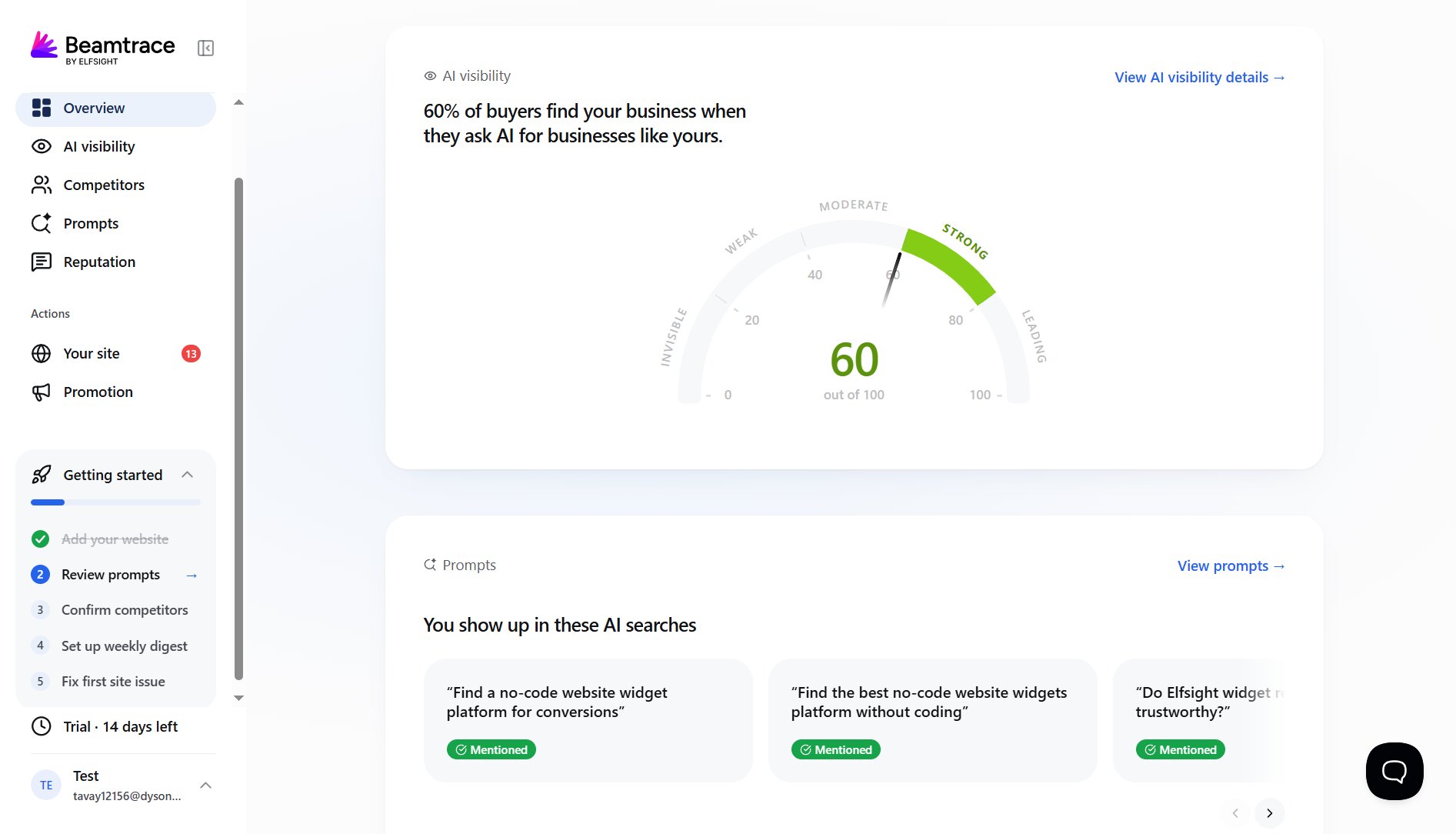
With this tracker, you can:
- Track every AI mention of your brand, products, or business across leading AI assistants.
- View complete AI responses to understand how your brand is described and in what context.
- Monitor mention trends over time to spot changes in visibility and performance.
- Receive real-time alerts whenever your brand appears in new AI-generated answers.
- Discover citation sources to see which websites and content influence AI mentions.
There are three paid tiers at $20/mo, $40/mo, and $100/mo, scaling prompts from 10 to 60 and checks from every three days to daily. You can explore the tracker’s capabilities for free with the 14-day free trial (no card required).
Otterly.AI
Otterly.AI is one of the lowest-friction ways into AI mention tracking, monitoring brand mentions and link citations across the major engines. It is well reviewed and quick to set up. Otterly.AI works best for SMBs, freelancers, and agencies that want the simplest starting point across several engines.
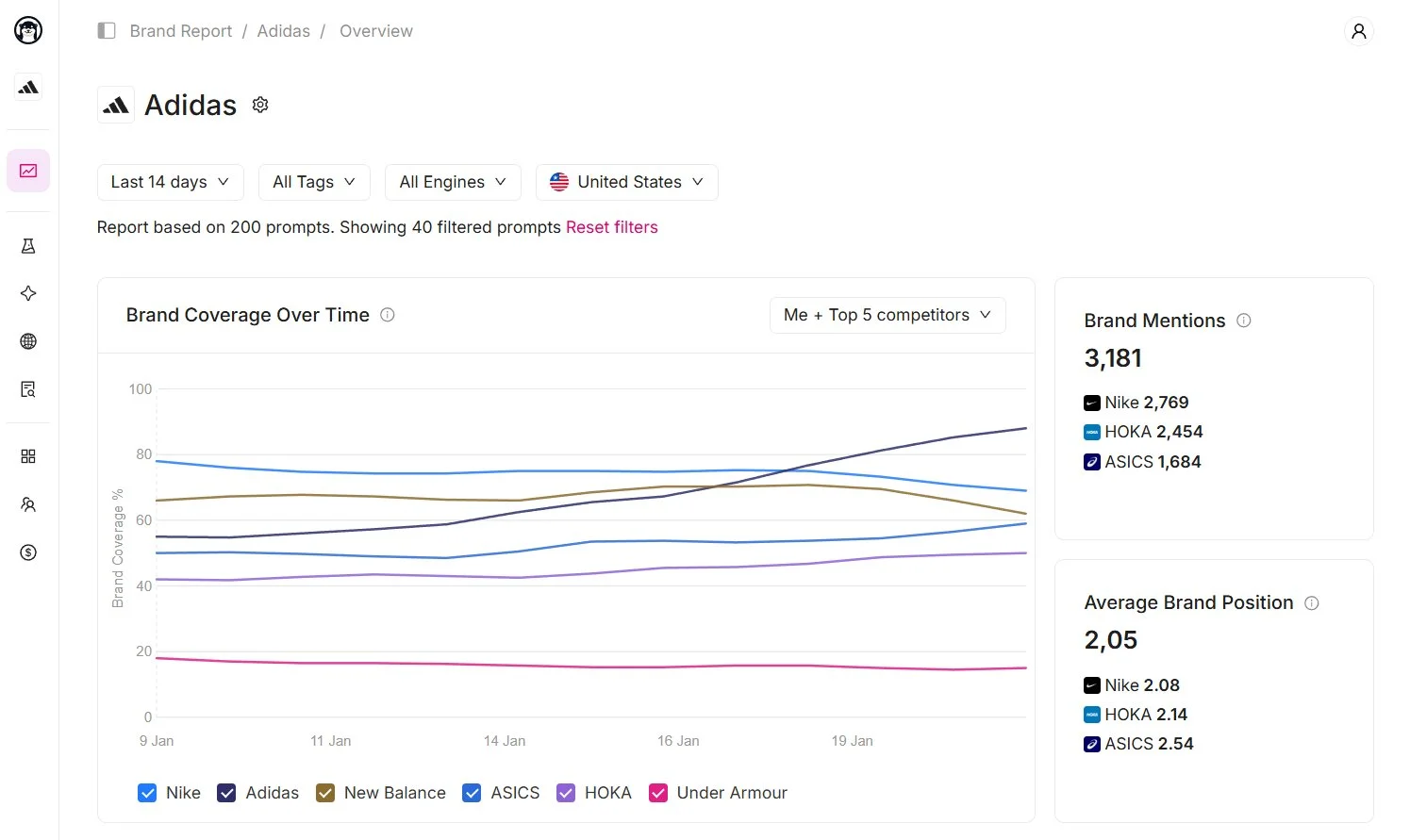
This tool allows you to:
- Track brand mentions across ChatGPT and other leading AI search engines.
- Compare your visibility against competitors with brand mention benchmarking.
- Analyze brand sentiment to see whether AI recommends, questions, or dismisses your brand.
- Monitor domain citations to understand which sources AI relies on when mentioning your brand.
- Measure brand visibility over time with an AI visibility index and historical trends.
The Lite plan starts at $29/mo for 15 prompts, with Standard at $189/mo, on a 14-day free trial with no card required for sign-up.
LLM Pulse
LLM Pulse puts mentions at the core of the product rather than treating them as a byproduct of a wider audit, reading the context and positioning of each mention. It works best for SMBs that want mention rate and share of voice at an entry price. It fills the budget gap for mention monitoring; for sentiment analysis, you would step up to a higher tier.
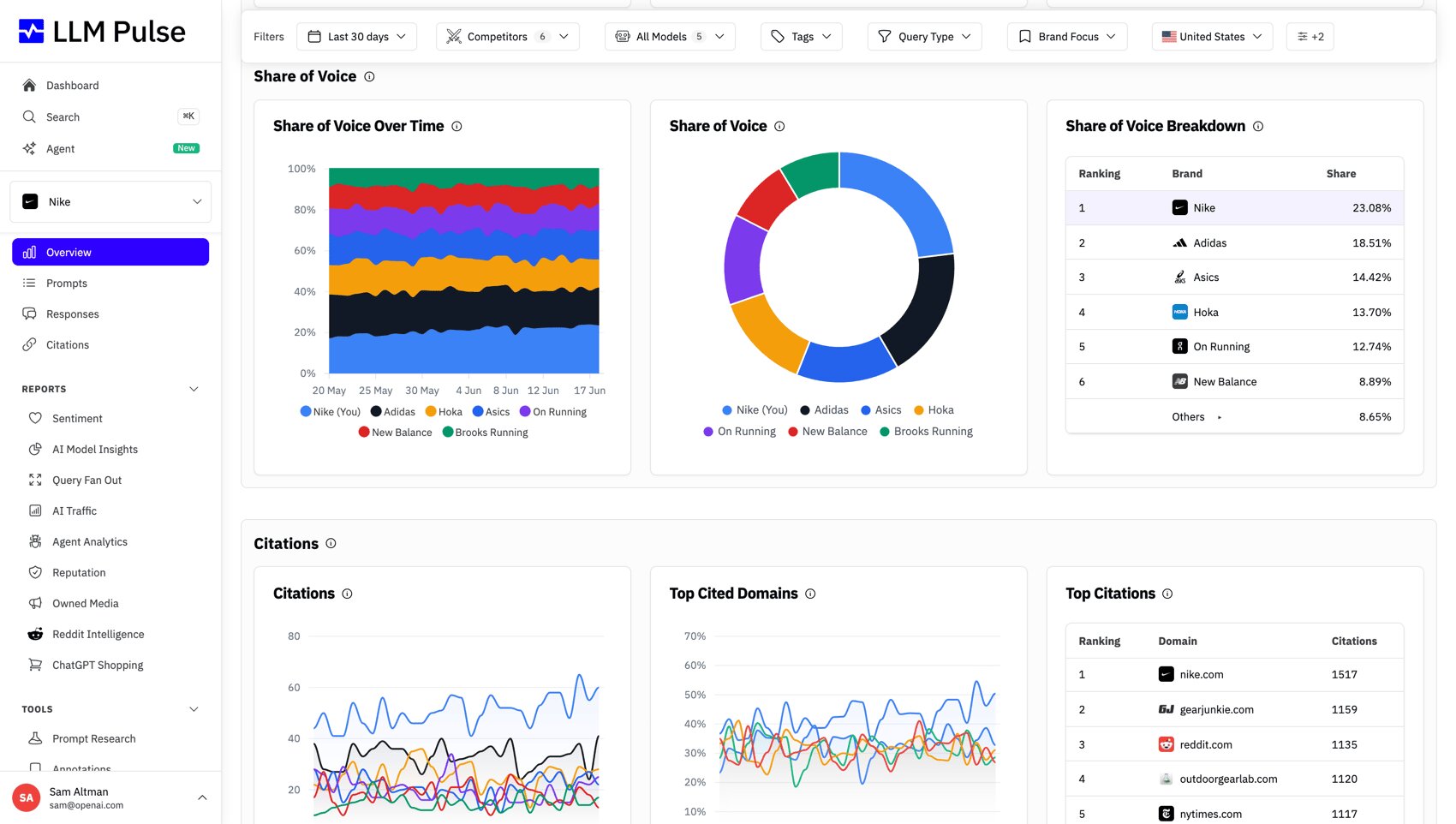
- Track brand mentions across ChatGPT, Gemini, Perplexity, Google AI, and other leading AI platforms.
- Monitor brand sentiment to understand how AI describes and recommends your business.
- Compare AI visibility against competitors with share of voice and recommendation analysis.
- Analyze citation sources to identify the content and websites influencing AI mentions.
- Track visibility trends over time to measure changes in AI mentions and reputation.
Starter is priced $50/mo on annual billing with 14-day free trial available. Sentiment, AI traffic analytics and a smart LLM Pulse agent are behind a higher Growth tier at $100/mo.
Mid-range AI mention trackers
These trackers add depth: sentiment, perception, and a closer read on how AI describes your brand, not just whether it appears.
Omnia
Omnia is built explicitly for small marketing teams. It tracks how your brand shows up in AI answers and turns that into next steps. Omnia works best for startups and in-house marketers who want an affordable, action-oriented tracker without a dedicated AI-search expert on staff.
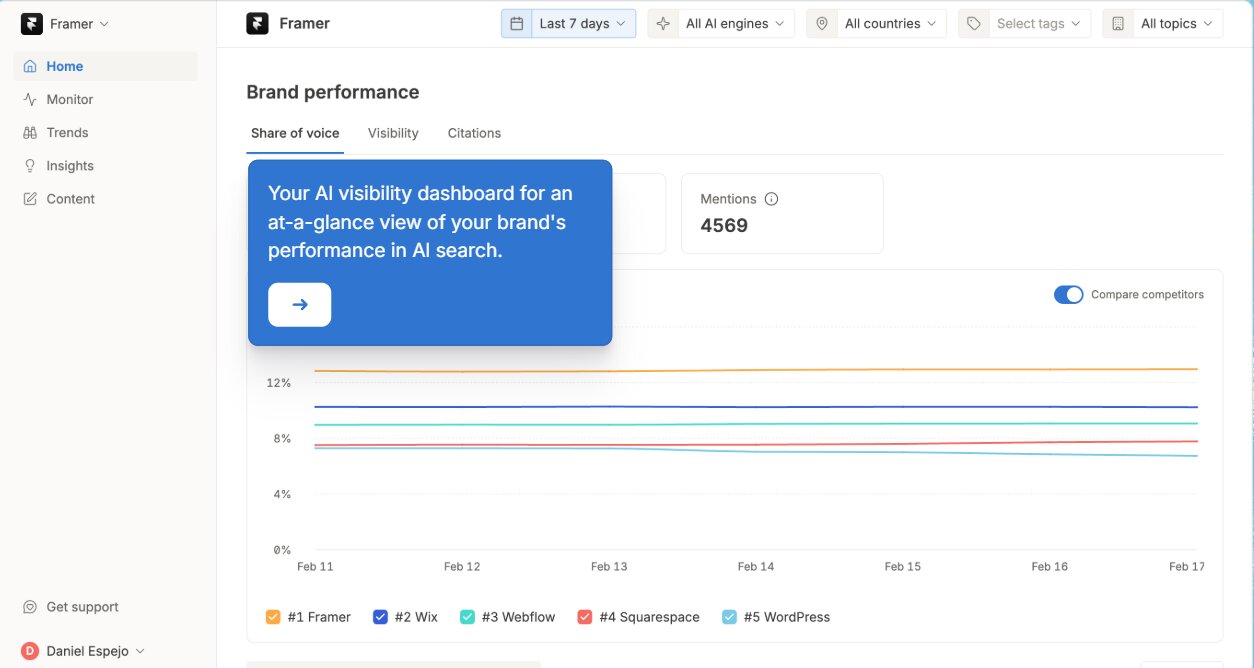
What the tool offers:
- Track AI brand mentions across ChatGPT, Google AI Overviews, Perplexity, and more.
- Benchmark AI visibility against competitors to measure share of voice and brand presence.
- Monitor citation sources to see which websites influence AI mentions of your brand.
- Discover high-impact AI prompts that buyers use to find products in your category.
- Understand AI brand perception to see which product features AI is praising or criticizing.
Growth starts at $63/mo with a free trial period of 14 days, covering 25 prompts and seven engines (three of them enabled upon request).
Trakkr
Trakkr focuses on perception, tracking how AI models describe, cite, and recommend your brand, with transparent flat pricing. Every plan covers all eight major engines, so coverage doesn’t depend on your tier. Trakkr works best for single-brand owners and agencies that want flat pricing and a perception-first lens.
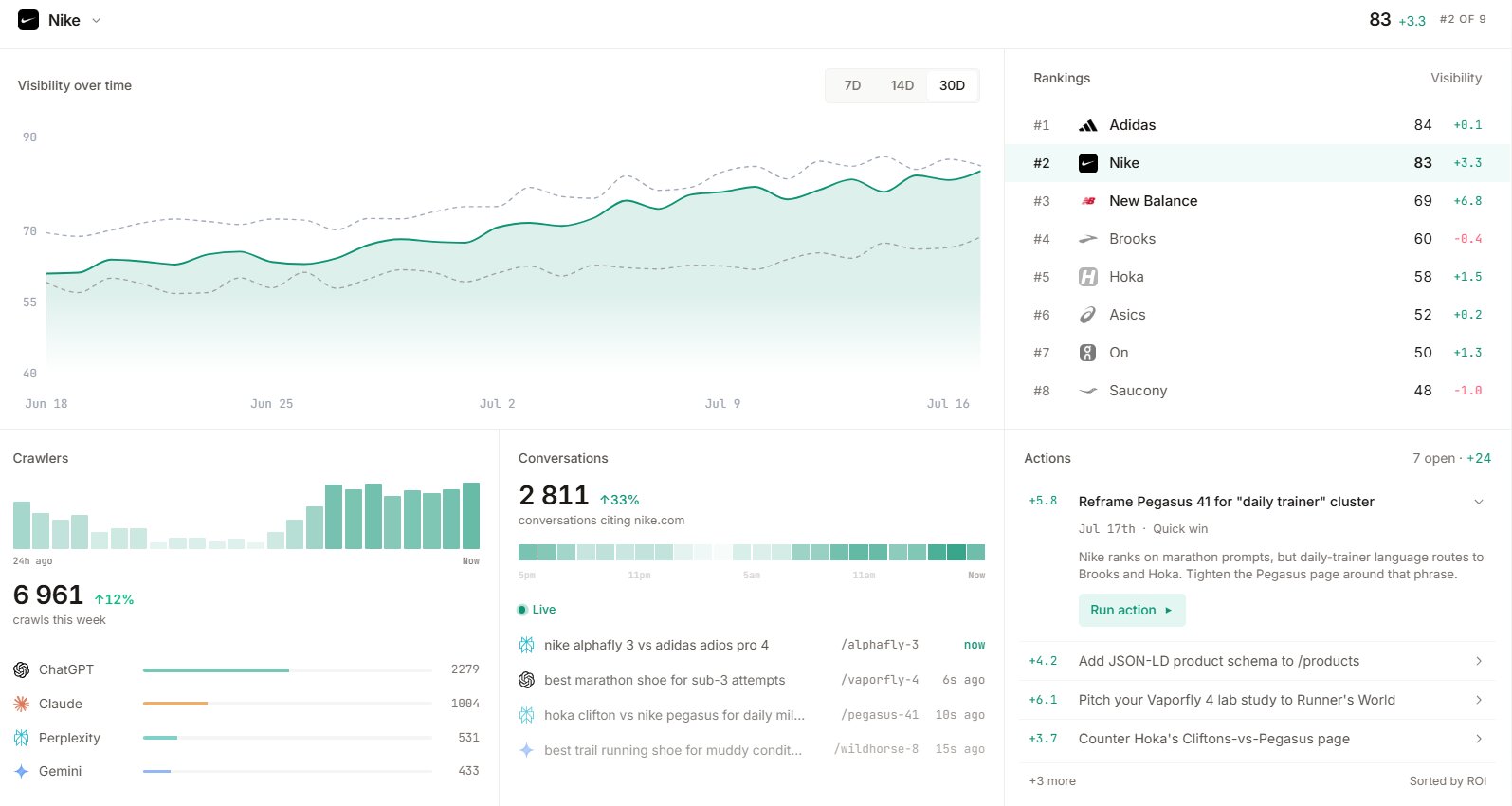
This tool lets you:
- Track brand mentions across ChatGPT, Claude, Gemini, Perplexity, and other AI platforms.
- Monitor citation sources to see which websites AI uses when mentioning your brand.
- Analyze brand perception to understand how AI describes and recommends your business.
- Benchmark against competitors with AI visibility and share of voice comparisons.
- Track visibility trends to see when and how your AI recommendations change over time.
Growth is $83/mo for one brand and 50 prompts across all engines, with Scale at $417/mo for multi-brand and API access. Both tiers include a 14-day free trial.
Rankscale
For the broadest engine coverage, Rankscale tracks brand mentions and framing across 17+ engines. It fits teams that want to see how they appear well beyond ChatGPT. Rankscale works best for budget-conscious SMBs and agencies that want maximum engine breadth per dollar.
What you can do with it:
- Track brand mentions across ChatGPT, Gemini, Claude, and other major AI engines.
- Monitor AI visibility with historical trends, rankings, and share of voice in one dashboard.
- Analyze citation sources to see where AI systems find information about your brand.
- Track brand sentiment to understand how AI describes your business across models and topics.
- Compare your brand against competitors for mentions, citations, visibility, and sentiment.
Pricing is credit-based, with Essential at about $20/mo for 120 credits, but that allowance is tight, so most teams land on Pro at $99/mo, which is why it sits with the mid-range tools here.
SEO and social tools with AI mention tracking
Established brand mention monitoring software built for SEO and social listening is now integrating AI mention tracking. These platforms make sense when you already rely on them and want an AI layer in the same dashboard, rather than as a first dedicated AI tracker.
Brand24
Brand24 is an established social and web listening tool that added an AI Visibility feature running your prompts across LLMs on a schedule. It layers AI-answer tracking onto its core monitoring of 25 million-plus sources. Its AI features include:
- A Brand Score combining mention frequency and position
- Median position and AI share of voice
- The key prompts where you appear and the sources cited
- Coverage of four engines in the base add-on, with up to nine advertised
The AI Visibility feature is a $99/mo add-on on top of an active Brand24 plan, and base plans start around $149 to $199/mo, so the effective entry cost to get AI tracking is roughly $250/mo.
Semrush
Semrush is a major SEO platform whose AI toolkit now tracks how your brand shows up across AI answers, layered onto its broader search and content tools. For teams already inside Semrush, it adds AI mention tracking without a separate subscription. Its features include:
- Brand mention and share-of-voice tracking across ChatGPT, Google AI Overviews, AI Mode, Gemini, and Perplexity
- Prompt research and competitor research
- An AI site audit
- A large prompt database refreshed daily
The AI toolkit runs as a $99/mo add-on per domain on top of a Semrush plan.
How to choose based on your needs
The right tool depends on which assistants your buyers use and how much detail you need about each mention. A simple sequence keeps the decision manageable:
- Confirm which AI assistants your buyers actually use for product recommendations.
- Decide whether you need framing and sentiment, or just mention count and share of voice.
- Determine your tracking needs: How many prompts? How often? How many projects/domains?
- Match the tier choice to your budget and check if the tool offers a free trial.
If you want the broader ranking, share-of-voice, and optimization view rather than pure mention monitoring, our guide to the best AI visibility tools covers that lane.
Frequently asked questions
Can't I just ask AI assistants myself whether they mention my brand?
You can, and it’s a useful spot check. The catch is that AI answers vary from one run to the next, so a single manual query won’t tell you how often you appear, in what context, or how you stack up against competitors over time. Dedicated trackers run many prompts on a schedule and average the results, which turns a one-off impression into a metric you can actually monitor.
How do LLMs decide which brands to mention?
Models draw on patterns in their training data and, for connected assistants, on live retrieval, so brands that appear consistently across authoritative, well-structured sources are more likely to surface. There is no ranking table to game, and the same prompt can yield different names on different runs. If you’re absent, there are concrete ways to improve how LLMs rank your brand.
Can I track AI brand mentions for free?
Not on an ongoing basis with these tools, but there are two free ways to start. Most dedicated trackers here offer a 14-day free trial with no card, and Omnia has a free AI Visibility Checker for a quick one-off snapshot. You can also ask assistants manually. These suit a baseline read, while continuous tracking across many prompts on a schedule is what the paid tiers are for.
What to look for in the best AI brand mention trackers?
Match the engines a tool covers to the assistants your buyers actually use, then check the depth of its mention metrics: count, share of voice, and ideally framing or sentiment, not just a yes or no. Prompt customization, refresh cadence, and whether the tool suggests next steps all affect how useful it is day to day. Price matters too, since the practical tier is often higher than the headline entry plan.
Why doesn't ChatGPT mention my business?
Usually because the sources it drew on didn’t feature your brand strongly, or competitors have a more consistent presence across the content models learn from. Thin or unstructured information about you, and a lack of authoritative third-party mentions, both play a part. There are several common reasons your brand may be missing from ChatGPT’s answers, and most are fixable over time.
Where to start
Start by confirming the problem, then size the tool to it. A free or near-free check shows whether AI assistants already name your brand, and if they don’t, an affordable ChatGPT-first tracker is the most direct next step. From there, add engines as your buyers spread across more assistants, and layer in sentiment or framing metrics once you want to know not just whether you appear but how you’re described.
The honest summary is that this is a young, fast-moving category with no independent accuracy benchmark yet, so treat any single number as directional. What matters is the trend: whether your brand is becoming more present in the answers your buyers actually read. Watch that, judge each tool on engines, mention detail, and price rather than on marketing, and expand only as the answers start deciding more of your sales.
Key references
- Adobe Digital Insights, 2026 Q2 AI Traffic Report (Apr 16, 2026), business.adobe.com — https://business.adobe.com/blog/the-latest/ai-traffic-report
- TechCrunch, “Sam Altman says ChatGPT has hit 800M weekly active users” (Oct 6, 2025), techcrunch.com — https://techcrunch.com/2025/10/06/sam-altman-says-chatgpt-has-hit-800m-weekly-active-users/
- 6sense, 2025 B2B Buyer Experience Report (Nov 12, 2025), 6sense.com — https://6sense.com/science-of-b2b/buyer-experience-report-2025/
- NBER / OpenAI, “How People Are Using ChatGPT” (2025), openai.com — https://openai.com/index/how-people-are-using-chatgpt