
Running a hotel or travel website means answering the same questions around the clock: parking, check-in times, pet policies, cancellations. Guests ask them from different time zones, often long after your front desk has signed off. A hotel chatbot handles those repetitive inquiries automatically, giving visitors instant answers instead of making them wait until morning.
A travel chatbot does more than answer FAQs: it captures inquiries, responds in a guest’s preferred language, and helps move prospective guests toward booking before they leave your website. This guide covers what hospitality chatbots do well, where they fall short, which businesses benefit most, and how to set one up effectively.
- A hotel chatbot is best at handling repetitive queries and capturing after-hours traffic.
- Hotel chatbots range from lead-capture widgets to live booking engines.
- 70% of guests find chatbots helpful for simple requests, but prefer a human for complex ones.
- Hospitality-chatbot use reduces reliance on OTA bookings that cost 15–30% in commission.
- Accuracy drives guest trust more than any other factor in chatbot deployment.
What a hotel chatbot can do for your business
A hotel chatbot is an AI assistant on your website that answers guest questions, makes recommendations, and captures inquiries around the clock, drawing its answers from the information you provide rather than guessing. Guests increasingly expect that kind of instant help: 56% of travelers used AI for at least one trip in the past year, up from 43% in late 2024, and 58% of hotel guests believe AI can improve their stay.
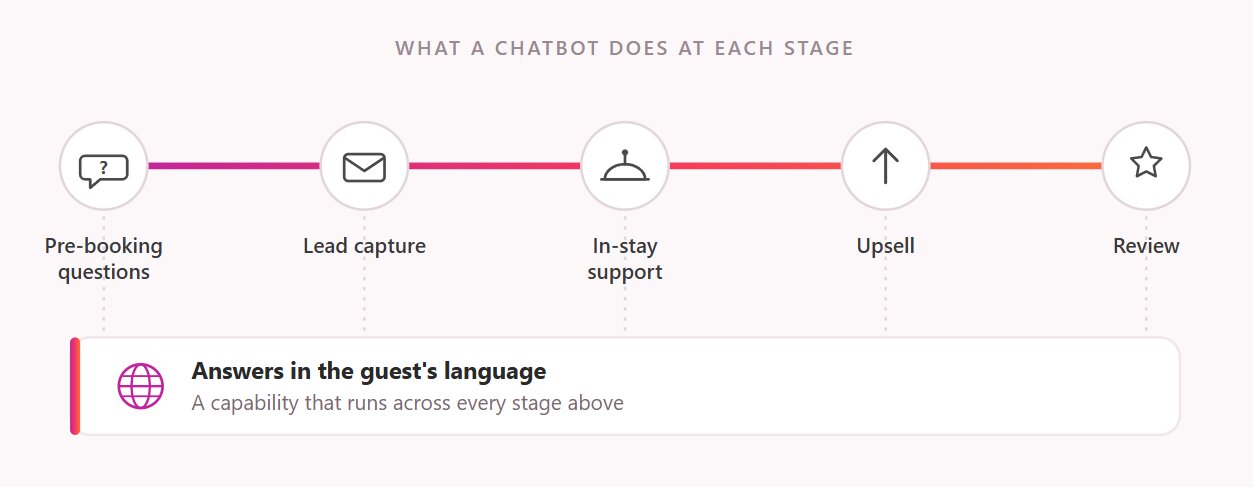
The value is easiest to see by following a guest through their journey, from the first pre-booking question to the review they leave afterward. At each stage, the chatbot does a specific job, and one capability runs across all of them.
Answering pre-booking questions around the clock
Most questions guests ask before booking are predictable and repetitive, which is exactly what makes them easy to automate. They fall into a few clear categories, and training your chatbot on each one lets it resolve the bulk of pre-booking inquiries without staff involvement.
Arrival and logistics
These are the practical questions a guest needs settled before committing, and they tend to spike in the evening when the front desk is quiet. A chatbot answers them instantly, at any hour:
- Check-in and check-out times
- Parking availability and cost
- Directions and airport transfer options
- Early arrival and late checkout
- Luggage storage before and after a stay
Policies and rules
Policy questions often decide whether a guest books at all. A traveler with a dog or a non-refundable flight needs a clear answer before committing, and the bot can state each policy exactly as written:
- Cancellation and refund terms
- Pet and smoking policies
- Minimum age or ID requirements
- Deposit and payment terms
- Rules for groups and extra guests
Amenities and the local area
Guests also weigh what’s included and what’s nearby, and this is where good answers double as soft selling. Drawing on an amenities list and a short local guide, the bot can cover:
- Wi-Fi access and the password
- Breakfast hours and dining options
- Pool, gym, spa, and accessibility features
- Nearby attractions and restaurants
- Public transport and local tips
This is where a website chatbot earns its place. 70% of guests find chatbots helpful for simple inquiries like these, and 39% say they’d specifically use one just to get the Wi-Fi password. An unanswered question late at night is often a guest who books somewhere else, so handling that moment keeps the conversation, and the potential booking, on your website.
Capturing leads and inquiries
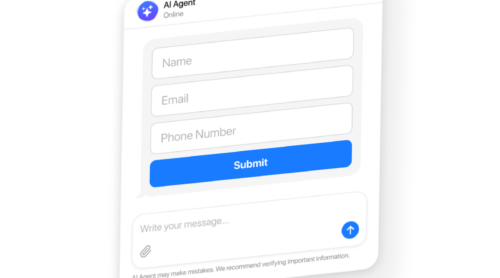
For properties that take inquiries rather than instant bookings, such as boutique hotels, villas, and tour operators, capturing contact details is the chatbot’s core job. A built-in form can collect a guest’s name, email, travel dates, and party size mid-conversation, then route that lead to your booking team or CRM.
This matters most outside business hours, when no one is at the desk to take the inquiry. Instead of losing the lead, you capture it along with the context of the guest’s question, which makes follow-up faster and more relevant.
Supporting guests during their stay
The chatbot’s job doesn’t end at booking questions. During a stay, guests may request extra towels, want a local restaurant recommendation, or need the pool hours. A chatbot fields these instantly and can create service requests that route to the right team.
For small properties without a 24-hour front desk, this is the difference between a guest getting help at 11 pm and waiting until morning. It also frees staff from repetitive requests, allowing them to focus on guests who need real attention.
Upselling and personalizing offers
A hospitality chatbot can drive revenue, not just save time. It can suggest room upgrades, late checkout, spa treatments, or experiences at the moments a guest is most receptive. The demand is there: 61% of consumers are willing to spend more for personalized experiences.
Personalization works best when it’s genuinely useful rather than pushy. A chatbot that offers late checkout to a guest asking about a morning flight is helpful. One that pushes upgrades on every message is not.
Answering in the guest’s language
Hospitality is international by definition, which sets it apart from most chatbot use cases. A travel AI chatbot that answers in a guest’s own language removes a real barrier: 29% of travelers cite language difficulties and unfamiliar transport as a top source of travel stress.
For inbound international guests, an instant answer in their language isn’t a nice-to-have but a conversion lever. A guest who gets a clear response about airport transfers in their own language is far more likely to book than one who hits a wall.
How to set up a travel chatbot
Setting up a hospitality chatbot does not have to be complicated. With a no-code tool, the work is mostly about feeding it good information and configuring its behavior, with no developer help required. Here’s the practical sequence, using Elfsight’s AI Chatbot as the example.
Step 1: Start from a template
The fastest way to launch is from a pre-built template rather than a blank setup. The Hotel Chatbot template comes preconfigured with agent instructions, a greeting, and quick replies tailored for accommodation businesses, from guesthouses to resorts. For travel-service businesses, the ChatGPT Travel template offers a similar head start.
Step 2: Train it on your property’s information
The chatbot is only as good as what you train it on. You build its knowledge base from several source types:
- Web pages. Add your site’s URLs so the bot learns from existing content (add each page individually, and click Retrain after you update anything, since pages don’t refresh automatically)
- Files. Upload an amenities list, room types, house rules, or a local-area guide in PDF, DOCX, TXT, JSON, HTML, MD, or PPTX
- Q&A pairs. Set fixed reference answers for high-stakes questions like cancellation terms
- Text blocks. Paste in business details or policies that don’t live on a page
A good starting set for a property is your amenities list, room descriptions, house rules, and a short local guide. Our walkthrough on building a chatbot knowledge base goes deeper on structuring this well.
Step 3: Set up inquiry capture
To turn conversations into leads, configure the built-in contact form to collect the details your team needs, typically name, email, travel dates, and party size. You choose which fields appear and when the form shows up in the conversation.
After each session, the full chat transcript and any collected details are automatically emailed to you, so your booking team gets the lead with the context of the guest’s questions. That context is what makes follow-up fast and relevant.
Step 4: Configure language and handoff
Because hospitality guests are international, set the bot up to answer in multiple languages. The assistant can respond in a guest’s language, even though its instructions are best written in English, therefore keeping its behavior consistent.
For questions the chatbot shouldn’t answer, give guests a clear path to a person. Elfsight’s Contact Human feature and action buttons connect guests to your team via external channels such as email, WhatsApp, or phone.
Build your own hotel chatbot in the interactive editor ↓
Once you’ve got your hotel chatbot fully configured and customized, the only thing left to do is to embed the widget with a single code snippet that works on Wix, Squarespace, WordPress, Shopify, Webflow, and essentially any website platform.
For the full installation process and tips, see our guide on adding an AI chatbot to your website.
Types of hotel and travel chatbots
“Hotel chatbot” covers a wide range of tools, and choosing the right one starts with understanding where your needs fall on that range. At one end are website widgets that answer questions and capture inquiries. At the other end are platforms wired into a property management system that quote live rates and complete bookings inside the chat.
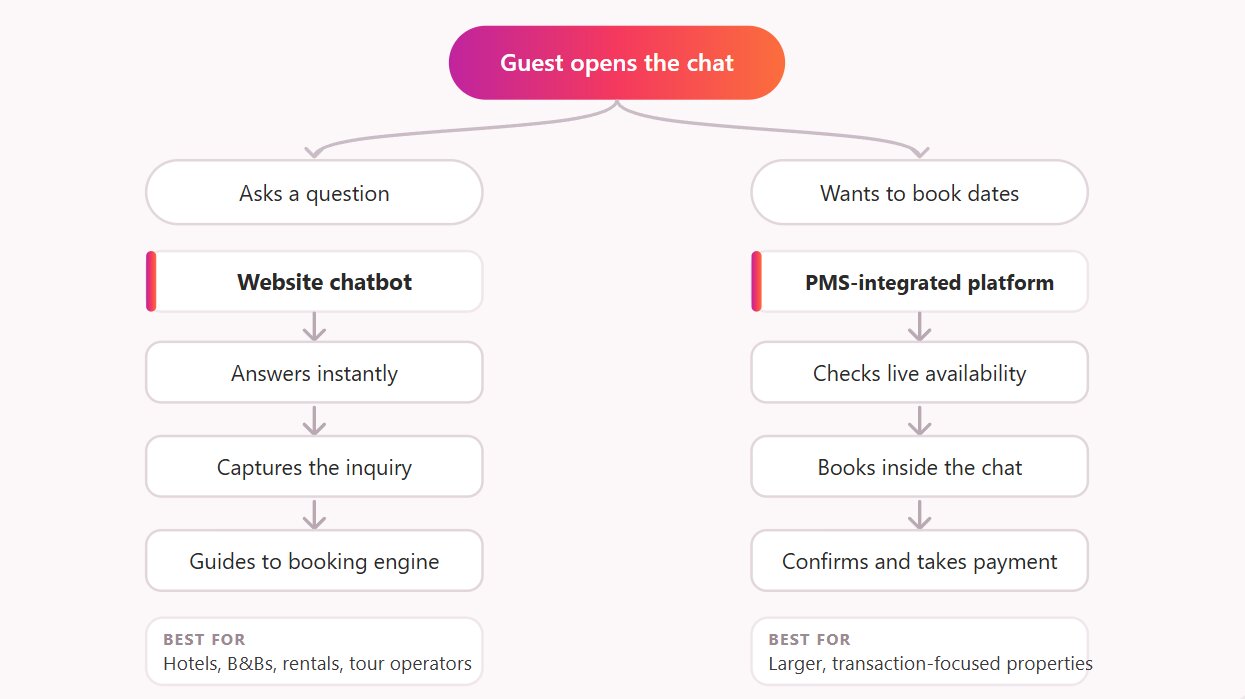
The two ends of the spectrum
A PMS-integrated platform connects to your live inventory. It can tell a guest that a king room is available next Tuesday for $180 and let them book it without leaving the conversation. That depth comes with a setup cost and ongoing contracts that suit larger properties focused on in-chat transactions.
A no-code website chatbot works differently. It answers questions from a knowledge base you train on policies, amenities, and FAQs, captures inquiries through a form, and guides serious prospects to your existing booking engine. It doesn’t quote live availability or process the payment, but it handles the conversation that leads there.
The direct-booking argument
Beyond saving staff time, a hotel chatbot carries a financial argument that’s easy to overlook. Every guest who books directly on your website is a guest you didn’t pay a commission to win — and in travel, those commissions add up fast.
What OTA commissions actually cost
Online travel agencies typically charge 15–30% commission per booking, with Booking.com often around 15–18% and Expedia closer to 18–22%. Effective rates climb past 25% once preferred-placement and promotional fees are added. Independent properties tend to sit at the high end of that range.
The scale becomes clear with a worked example:
A 100-room hotel at 75% occupancy and a $150 average daily rate, with 40% of bookings coming through OTAs, pays roughly $328,000 a year in commissions. Shifting even 10 points of that mix to direct bookings could save over $80,000 annually.Owning the direct guest relationship
The commission isn’t the only cost. When a guest books through an OTA, the hotel often receives limited contact data and can’t easily market to that guest for future stays. A direct booking, captured through your own website, gives you both the relationship and the revenue.
This is where a chatbot’s value compounds. Answering questions and capturing inquiries on your direct channel nudges guests toward booking with you rather than drifting to a platform that owns the customer afterward.
One honest limitation applies: a website chatbot only reaches guests who land on your own site, not those already in an OTA’s funnel.
Matching the tool to your website
The two aren’t really competitors – they’re different tools for different jobs, and many properties use both. This comparison shows where each one fits:
| Capability | Website chatbot | PMS-integrated platform |
|---|---|---|
| Answer FAQs and policy questions | Yes | Yes |
| Capture inquiries and leads | Yes | Yes |
| Answer in multiple languages | Yes | Yes |
| Quote live availability and rates | No | Yes |
| Complete a booking in chat | No | Yes |
For most SMB hospitality businesses such as boutiques, B&Bs, rentals, and tour operators, instant FAQ answers and inquiry capture on a direct site cover the core need without an enterprise contract. A property whose main goal is transactional booking against live inventory is better served by a PMS-integrated platform. Knowing which job you’re solving for makes the choice straightforward.
Why accuracy beats personality
“Users implicitly expect a human-like system to behave like a human. When it doesn’t, the gap between expectation and reality triggers something deeper than disappointment. It triggers a threat response.” — Babak Taheri, Ph.D., Professor of Hospitality, Hotel Management and Tourism, Texas A&M University
A chatbot that sounds human but gives wrong answers is worse than no chatbot at all. Guest comfort with AI is real but uneven. Just 30% of US travelers are comfortable using AI for trip planning, while 40% are not; comfort among 18–24-year-olds fell from 47% to 34% year over year.
In a setting where guests make spending decisions based on what the bot tells them, accuracy is the foundation of whether the tool helps or hurts.
Inaccuracy is the biggest trust risk
A 2026 study published in the International Journal of Hospitality Management found that guests react most negatively when a chatbot in hospitality industry settings seems inaccurate, deceptive, or intrusive, and inaccuracy produced by far the strongest reaction, with a negative effect more than four times larger than the next factor.
The researchers describe an uncanny-valley effect: the more human a chatbot tries to seem, the worse its mistakes land. When a human-sounding assistant gives a wrong price or dodges a question, guests don’t just get annoyed; many disengage or delay booking entirely.
How to keep answers accurate
The same study points to a fix for this issue. Telling guests up front that they’re talking to an AI reduced the discomfort caused by inaccurate answers because people forgave mistakes as AI limitations rather than as deception.
That turns into three practical rules for any chatbot in hotel industry deployments:
- Prioritize accuracy over personality by training the chatbot tightly on freshly verified data.
- Disclose that it’s an AI assistant, clearly and early in the conversation.
- Route low-confidence questions to a human instead of letting AI guess.
The third rule matters most. A chatbot that says “let me connect you with our team” when it isn’t sure builds more trust than one that confidently invents an answer. Writing clear instructions is what makes this behavior reliable; our guide to chatbot scripts and instructions covers how to set those boundaries.
Which hospitality businesses benefit most
The hospitality industry is broader than hotels, and a chatbot fits different businesses in different ways. The common thread is that these are operations fielding repetitive questions from a wide, often international audience — exactly the workload automation handles well. Here’s how the main segments put a chatbot for tourism and travel to work:
| Business type | What the chatbot mainly does |
|---|---|
| Hotels & resorts | Answer FAQs, capture inquiries, suggest upsells, support in-stay requests |
| Vacation rentals, B&Bs, hostels | Handle after-hours questions and capture inquiries with no front desk |
| Travel agencies & tour operators | Answer itinerary and tour questions, share destination info, capture leads |
| Activity & experience providers | Give location-based recommendations and availability info in multiple languages |
| Restaurants and hotel dining | Share menus, answer dietary questions, take reservation inquiries |
Consider this hotel chatbot example: a boutique property trains its bot on its amenities, room types, and cancellation policy. It resolves the bulk of pre-booking questions without staff involvement and captures the rest as leads. A tourism chatbot for a tour operator works differently — it fields itinerary questions for high-consideration trips, where guests ask many questions before committing, making inquiry capture the main goal.
What unites these segments is scale relative to budget. They’re the businesses that can’t justify a five-figure enterprise platform but can deploy a no-code widget today and see value within a week.
Frequently asked questions
How much does a hotel chatbot cost?
Will a hotel chatbot replace front desk or reservation staff?
How long does it take to set up a travel chatbot?
Can a hospitality chatbot work on messaging apps as well as a website?
Do I need technical skills to add a chatbot to my hotel website?
Where to start
A hotel or travel chatbot earns its place by doing a focused job well: answering the routine questions that arrive at all hours, capturing the inquiries you’d otherwise miss, and doing both in your guests’ languages on your own site. The businesses that get the most from it aren’t chasing full automation; they’re automating the routine and routing the rest to a person.
Start by training a chatbot on your real property information, deploy it on your direct site, and be upfront with guests that they’re talking to an AI. Keep its answers accurate and up to date, give people a clear path to your team when they need one, and let it handle the volume that doesn’t require a human. That’s a chatbot that helps guests and staff alike, and a direct channel that works for you 24/7.
Key references
- HotelTechReport, The 2026 State of Hotel Guest Tech Report — https://hoteltechreport.com/news/2026-state-of-hotel-guest-technology-report
- Texas A&M / International Journal of Hospitality Management — https://stories.tamu.edu/news/2026/05/28/research-finds-hotel-booking-chatbots-can-creep-out-customers/
- Phocuswright, The AI Surge (2026) — https://www.phocuswright.com/Travel-Research/Research-Updates/2026/The-fastest-shift-in-travel-behavior-just-became-the-default
- YouGov, Comfort with AI in travel planning (August 2025) — https://yougov.com/en-us/articles/52770-comfort-with-ai-in-travel-planning-dips-among-younger-americans
- OTA commission economics — HotelAmplify (2025–2026) — https://hotelamplify.com/blog/how-to-reduce-ota-commission-costs