
More than a billion people now use AI chatbots. That number, compiled from industry data in 2025, is large enough to be abstract – so here’s a more concrete way to think about it: if chatbot users were a country, it would be the third most populous on Earth, behind only India and China.
This article compiles current chatbot statistics across market size, platform competition, industry-specific data, ROI, and emerging trends. If you’re building a business case, benchmarking a strategy, or backing up a pitch deck – this is the data set to work from.
- The global chatbot market is projected to reach $27.29 billion by 2030.
- ChatGPT’s share of generative-AI web traffic dropped from 87% to 68% in a single year.
- Support AI agents achieved a 50% reduction in cost per call while CSAT scores increased.
- 30% of customer service cases are now handled by AI, projected to reach 50% by 2027.
- 84% of consumers say human interaction should always remain available.
AI Chatbot Market Size and Growth
A market growing at 23% annually doesn’t usually do so quietly, but the chatbot market has managed exactly that, expanding at a pace that would be headline news in most sectors during a period when interest rates stayed elevated, and tech spending faced constant scrutiny. The numbers suggest that whatever belt-tightening happened elsewhere, businesses kept writing checks for conversational AI.
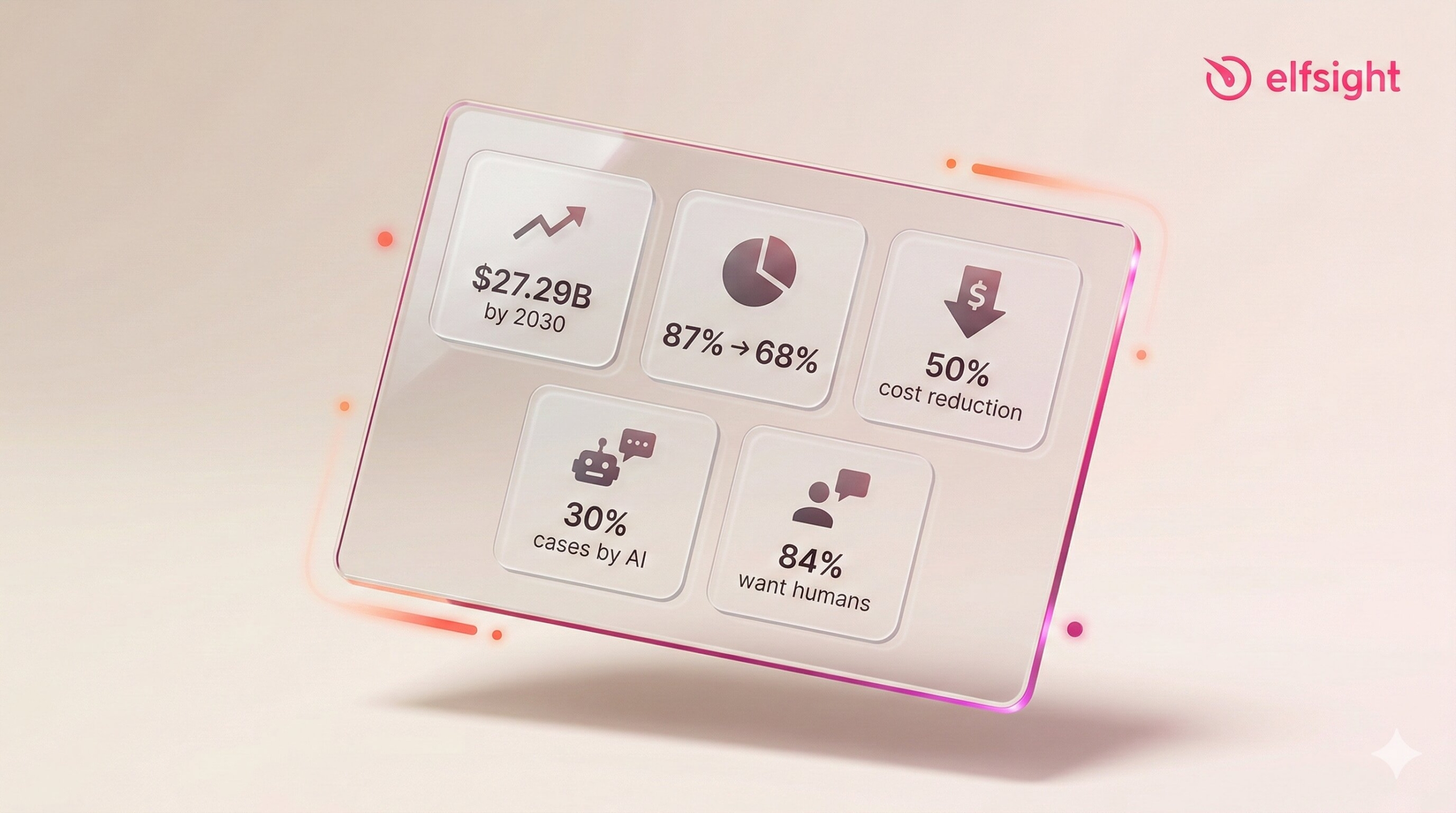
- Grand View Research valued the global chatbot market at $7.76 billion in 2024, with revenue projected to hit $27.29 billion by 2030 – a compound annual growth rate of 23.3%.
- Mordor Intelligence’s outlook tracks slightly higher, projecting $11.45 billion in 2026, growing to $32.45 billion by 2031 at a 23.15% CAGR.
- A longer-range forecast from Roots Analysis, reported by Genuity System, places the market at $61.97 billion by 2035.
The methodologies differ, which accounts for the range. But the directional agreement is striking: three independent research firms converge on roughly the same growth rate across different time horizons. That kind of consistency suggests the trajectory is structural, not speculative.
Regional dynamics
The U.S. remains the single largest national market: North America commanded 38.72% of the chatbot market in 2025 (~$3.6B), but the growth story is increasingly Asian. Mordor Intelligence projects the Asia-Pacific region as the fastest-growing chatbot market, with a 24.71% CAGR through 2031, driven by mobile commerce adoption and government AI programs across India, China, and Southeast Asia.
The Middle East and Africa, while starting from a smaller base, may outpace even the Asia-Pacific region on percentage terms – research estimating a roughly 26% CAGR for the region through 2030. That figure is secondary and should be treated as directional, but it aligns with the broader pattern: chatbot adoption is accelerating fastest in markets where mobile-first digital infrastructure is leapfrogging traditional service models.
Chatbot Usage and Adoption
The headline number, ~1.5 billion chatbot users worldwide, captures scale but not behavior. More revealing is what those users actually do with chatbots, and how adoption splits across business types and consumer segments.
Consumer usage patterns
According to Ipsos’ insights drawn from a decade of AI use in customer experience, 68% of consumers have used a customer service chatbot.
Statista’s survey of 8,301 consumers conducted in late 2024 provides one of the more granular use-case breakdowns available. When seeking support, consumers reported using chatbots for:
| Use Case | % of Consumers |
|---|---|
| Scheduling appointments | ~50% |
| Help with placing orders | ~47% |
| Reporting issues or starting returns | ~46% |
| Tech product support | ~45% |
The clustering is tight – all four categories land within five percentage points of each other. That evenness suggests chatbots aren’t dominated by a single use case. Consumers have normalized them across a range of service tasks, from transactional to troubleshooting.
Business adoption
On the business side, adoption rates depend on how you slice the data. A Tidio study found that 19% of online businesses currently use chatbots – a number that sounds low until you consider the total addressable market includes every Etsy shop and single-page portfolio site. Among companies that have adopted, the split skews B2B: 58% of chatbot-using businesses are B2B, versus 42% B2C.
Salesforce’s report, based on a survey of 6,500 service professionals, adds a sharper enterprise perspective: AI leapt from the #10 priority to the #2 priority for service leaders in a single year, second only to improving the customer experience overall. That velocity of reprioritization – not just adoption, but strategic elevation – signals something beyond gradual integration.
Platform user counts
The competitive landscape at the platform level is worth framing, even if the numbers are approximate. Exploding Topics’ estimates, aggregated from company disclosures and traffic data, suggest that Meta AI leads with roughly 500 million active users, followed by ChatGPT at around 400 million, Google Gemini at 140 million, Microsoft Copilot at 100 million, and Grok with over 35 million. These are approximations, not audited figures – but they illustrate the scale of the largest consumer-facing AI platforms.
AI Chatbot Market Share
General-purpose LLMs now power many business chatbots, so platform trends directly affect their space. In the realm of chatbots as standalone AI tools, ChatGPT still dominates generative-AI web traffic. But the more interesting story is how fast that dominance is eroding.
Similarweb’s traffic share data shows that ChatGPT accounts for 68% of global generative-AI web traffic. One year earlier, that figure was 87.2%. A platform losing nearly 20 percentage points of share in 12 months, while the overall market grows 76%, isn’t declining. It’s being diluted by a wave of viable competitors.
| Platform | Traffic Share |
|---|---|
| ChatGPT | 68.0% |
| Gemini | 18.2% |
| DeepSeek | 3.9% |
| Grok | 2.9% |
| Perplexity | 2.1% |
| Claude | 2.0% |
| Copilot | 1.2% |
Gemini is the primary beneficiary, tripling its share from 5.4% to 18.2% over the same period. The remaining challengers – DeepSeek, Grok, Perplexity, Claude, Copilot – collectively hold about 12%, small individually but significant as a group. The market is fragmenting at the edges while still growing overall.
Overall traffic and engagement growth
The growth numbers are worth pausing on. According to Similarweb’s recent Generative AI report, average monthly visits to generative-AI platforms grew 76% year over year, and Gen-AI app downloads surged 319% over the same period. Those aren’t incremental gains; they represent a step change in how people interact with AI tools.
The referral traffic data adds another dimension. Generative-AI platforms drove 1.1 billion referral visits in June 2025, a 357% increase from the prior year. AI chatbot traffic statistics like these matter because they signal a shift in discovery behavior: users aren’t just chatting with AI – they’re clicking through to external sites based on AI recommendations.
Customer Service Chatbot Statistics
Customer support remains the dominant chatbot use case, and the data has matured significantly in the past year.
How much AI actually handles today
Salesforce puts the current figure at 30% of service cases resolved by AI. That same survey projects this will reach 50% by 2027. These aren’t vendor aspirations; they’re self-reported by the teams running support operations.
Gartner’s survey data adds an important qualifier: resolution rates vary dramatically by issue type. Chatbots resolved 58% of returns and cancellations but only 17% of billing disputes — and customers were just 2% more likely to use a chatbot for the easy task than the hard one, suggesting most consumers don’t yet distinguish between what bots can and can’t handle well.
Cost comparison: bot versus human
The cost gap between AI and human support is wide enough that even approximate figures make the case. McKinsey’s contact center research found that AI agents achieved a 50% reduction in per-call costs while simultaneously increasing customer satisfaction scores. That’s not a tradeoff – it’s a dual improvement, which is rare in cost-optimization exercises.
| Channel | Cost per Minute | Cost per Interaction |
|---|---|---|
| AI chatbot | $0.03–$0.25 | $0.25–$2.00 |
| Human agent | $3.00–$6.50 | $5–$15 |
| Human ticket (full resolution) | — | $6–$40 |
At the per-interaction level, the contrast is stark. An AI chatbot interaction costs roughly $0.50, while a human support ticket runs $6–$40, depending on complexity and channel. That’s a 12× to 80× cost difference on individual transactions.
In 2022, Gartner projected that conversational AI deployments within contact centers would reduce agent labor costs by $80 billion by 2026. With 2026 now underway, that figure serves less as a prediction and more as a benchmark against which actual savings can be measured.
Satisfaction and the hybrid expectation
Cost savings mean nothing if customers hate the experience. The satisfaction data is nuanced, but the nuance matters more than the topline number.
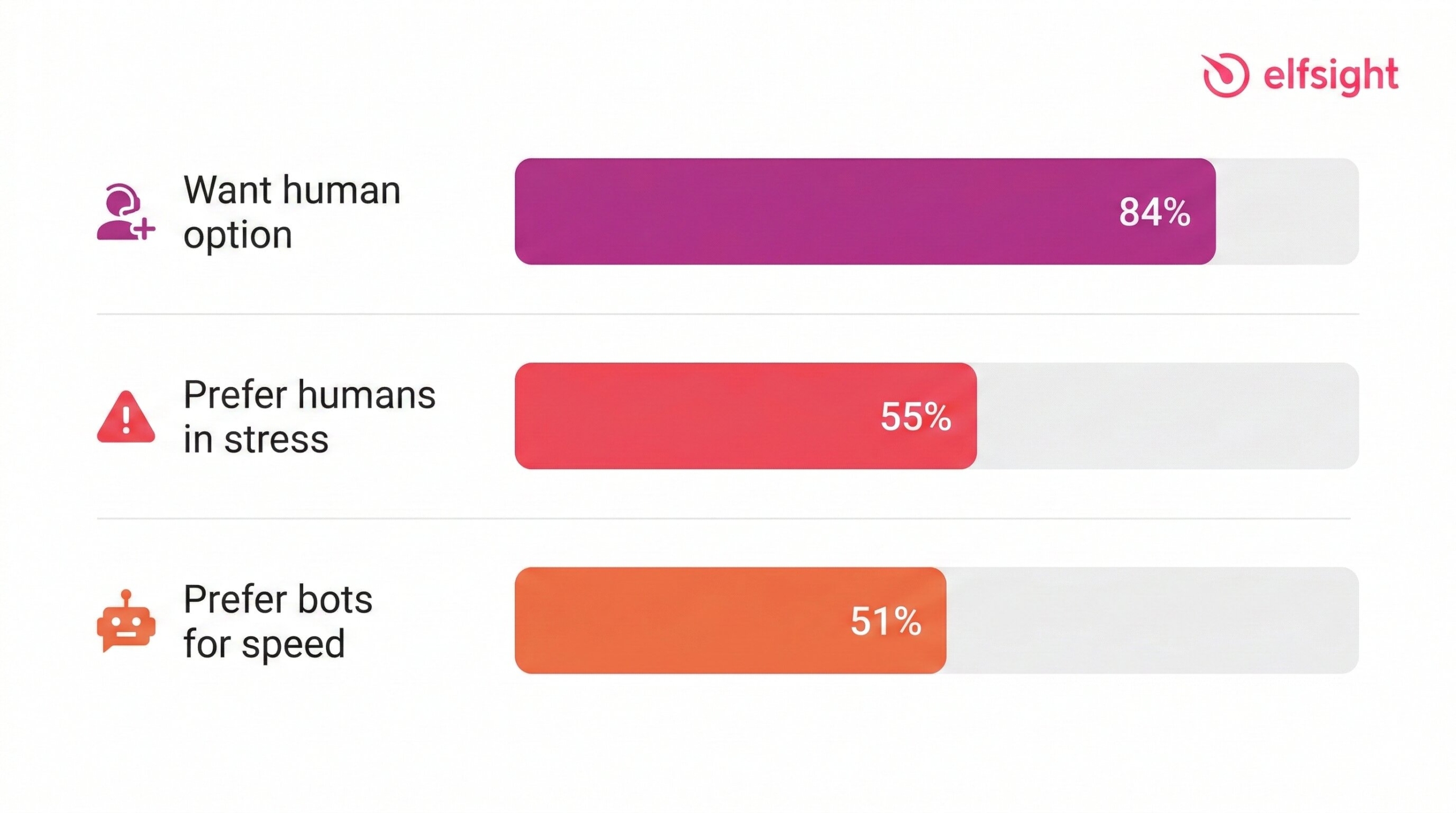
A telling finding comes from Zendesk’s research: 51% of consumers prefer interacting with bots over humans when they want immediate service. That’s a genuine preference, not a grudging acceptance. But the same data set reveals the other side: 84% of consumers say human interaction should always remain an option. This isn’t a contradiction. It’s a hybrid expectation: consumers want bots to handle the routine and humans to be available when things get complicated or emotional.
The Zendesk CX Trends 2025 report reinforces this from the agent side: 79% of support agents say having an AI copilot improves their performance. The operational picture that emerges isn’t bot-versus-human – it’s bot-and-human, with each handling different parts of the same workflow.
Industry-Specific Chatbot Statistics
Chatbot adoption varies significantly by sector. The use cases, value drivers, and consumer attitudes differ enough that aggregate statistics obscure more than they reveal.
E-commerce
E-commerce is where chatbot adoption and consumer willingness converge most visibly. Juniper Research projects worldwide retail chatbot spending will grow from $12 billion in 2023 to $72 billion by 2028 – a trajectory consistent with their earlier (if overambitious) 2020 forecast of $142 billion by 2024.
The generational data make this shift structural. A Yahoo/YouGov poll found that 82% of Gen Z adults have used AI chatbots, compared with 33% of boomers. Five9’s research shows 20% of Gen Z prefer starting customer interactions with a chatbot (vs. 4% of boomers). This is the default behavior for the next dominant consumer cohort, not an edge case.
The revenue signal is already clear. E-commerce brands with chatbot implementations report 7–25% sales lifts and ~4× higher conversion rates among chat-engaged shoppers.
Healthcare
Healthcare chatbot adoption is growing, but the most striking data point isn’t about adoption rates; it’s about patient willingness. Deloitte’s Connected Consumer survey found that 62% of generative-AI users are willing to discuss personal medical topics with AI chatbots. Willingness extends to mental health, relationship advice, and other sensitive areas where conventional wisdom would assume people strongly prefer human interaction.
That 62% figure challenges the assumption that healthcare is inherently resistant to AI-mediated conversations. The data suggests that consumers – particularly those already using generative AI – have developed a comfort level with AI in sensitive contexts faster than many healthcare providers anticipated. The limiting factor may be less about patient willingness and more about regulatory frameworks and provider readiness.
Banking and finance
Financial services present a sharper trust gap than other industries. Statista’s Global Trust Survey found that while 55% of consumers trust AI to collect and combine product information, fewer than 25% trust AI to provide legal advice or handle complex financial activities.
That gap defines the current ceiling for financial chatbots. Consumers are comfortable using bots to check balances, find branch hours, or look up policy terms. They are not comfortable with bots making recommendations about their money.
Marketing and lead generation
The marketing numbers are compelling, though they lean on case-study data rather than broad surveys. Master of Code reports engagement rates between 50% and 80% for chatbot-driven marketing campaigns, alongside a 378% increase in lifetime user base and a 46% uplift in subscription opt-ins after deploying conversational journeys. These are vendor case studies, so they reflect best-case implementations, but the scale of improvement is consistent with what performance marketers report anecdotally.
On the adoption side, 76% of online retailers surveyed had either implemented or were planning to integrate chatbots into their customer experience strategies, according to the same source. The retail sector’s embrace of chatbots is driven partly by ecommerce chatbot statistics showing conversion lifts, and partly by the operational reality that seasonal traffic spikes require scalable support that human teams alone can’t provide cost-effectively.
Chatbot ROI, Cost, and Business Impact
For the first few years of chatbot adoption, ROI was largely theoretical – projections and pilot results, not measured outcomes at scale. New data reflects production deployments with enough runtime to generate meaningful before-and-after comparisons.
Return on investment
The most detailed ROI study available comes from a Forrester Total Economic Impact analysis conducted for Sprinklr, showing 210% ROI over three years, with a payback period under six months and approximately $2.1 million in cumulative cost savings. The same analysis attributed a 35% drop in support costs and a 32% boost in revenue to the AI deployment.
The Zendesk CX Trends 2025 report adds a broader signal: 90% of CX Trendsetters report positive ROI from AI tools for agents, and companies that embrace AI early are 128% more likely to report high ROI than those using traditional approaches. That gap between early adopters and laggards is widening, not narrowing.
Cost savings at scale
McKinsey’s 2025 contact center analysis provides the strongest evidence of cost reduction: AI agents achieved a 50% reduction in per-call cost while CSAT scores increased.
Meanwhile, industry data from vendor deployments suggests average annual savings of roughly $300,000 per organization, along with a 30% reduction in support costs and automation of up to 90% of routine queries.
The savings compound in ways that aren’t immediately obvious. When a chatbot handles the bulk of incoming volume, the remaining queries that reach human agents tend to be more complex, but agents handle them faster because they’re not fatigued by repetitive work.
| Metric | Value |
|---|---|
| Average ROI per $1 invested | $3.50 (up to 8× for top performers) |
| 3-year ROI (enterprise case study) | 210% |
| Payback period | Under 6 months |
| Average annual savings | ~$300,000 |
| Support cost reduction | 25–30% |
Engagement and conversion quality
ROI isn’t only about cost reduction. Similarweb’s 2025 data shows that AI-referred traffic outperforms traditional search traffic on every engagement metric: 15 minutes per visit versus 8 minutes from Google, 12 pages viewed versus 9, and a 7% conversion rate versus 5%. For businesses measuring AI chatbot benefits beyond support cost savings, these engagement numbers represent a revenue-side argument that’s harder to dismiss than efficiency gains alone.
Deloitte’s 2024 Connected Consumer survey reinforces the demand side: two-thirds of generative-AI users say the technology exceeds their expectations, and a third describe it as “significantly better” than expected. Only 8% say it’s worse. Consumer perception has moved past the skepticism phase. The question for most businesses is no longer whether chatbots work; it’s how quickly they can deploy them well.
AI Chatbot Trends and Future Outlook
Three trends define the chatbot landscape heading into 2026 and beyond: sustained market growth, an enterprise shift from experimentation to primary reliance, and a maturing consumer relationship with AI that’s more nuanced than “trust” or “distrust.”
Market trajectory
Both Grand View Research and Mordor Intelligence project CAGRs above 23% through at least 2030, which would roughly triple the market from its current size. That kind of sustained expansion typically requires both new adopters entering the market and existing users increasing their spend — and the survey data supports both dynamics. 79% of service leaders say investing in AI agents is essential to meet current business demands.
The 76% year-over-year growth in generative-AI platform visits and the 319% surge in app downloads reported by Similarweb suggest that the consumer adoption curve is still steepening, not flattening. These chatbot trends point to a market that hasn’t yet reached its inflection point – unusual for a technology already measured in billions.
The enterprise adoption shift
The more significant chatbot industry trend is qualitative, not quantitative. Through 2023 and 2024, most enterprise chatbot deployments were experimental: pilot programs, limited rollouts, proof-of-concept projects. The 2025–2026 data suggests a pivot toward production-scale deployment.
Gartner predicted in 2022 that chatbots would become the primary customer service channel for roughly 25% of organizations by 2027. Salesforce’s 2025 data, showing 30% of cases already resolved by AI with a projection of 50% by 2027, suggests that prediction is tracking ahead of schedule. When a quarter of companies are on track to use chatbots as their primary service channel, the technology has moved from innovation to infrastructure.
This shift changes the competitive dynamics. Early chatbot adoption was a differentiator. As deployment becomes standard, the advantage shifts from having a chatbot to having one that performs well, is trained on quality data, is integrated with existing systems, and is designed around actual customer workflows rather than generic templates.
Consumer trust: more sophisticated than the headline
The most commonly cited chatbot trend – “consumers are learning to trust AI” – is both true and misleading. The Zendesk-YouGov global survey reveals a significantly more layered picture:
- 52% of consumers feel comfortable relying on personal AI assistants for everyday tasks
- 54% believe AI will make customer support faster and more efficient
- 84% say human interaction should always remain an option
- 55% prefer to speak with a human in stressful or urgent situations
Trust isn’t a single dial that moves from low to high. It’s context-dependent, and the businesses reading AI chatbot trends correctly are the ones designing their systems around that granularity. Routine tasks are readily delegated to AI, while high-stakes or emotionally charged situations still demand a human.
McKinsey’s 2025 research adds a generational wrinkle: 71% of Gen Z respondents believe live phone calls are the quickest way to reach customer care. Even the most digitally native generation hasn’t abandoned the phone – they’ve just developed clear expectations about when AI is appropriate and when it isn’t.
Methodology and Sources
Statistics in this article are drawn from primary research reports and surveys, including Grand View Research, Mordor Intelligence, Statista, Similarweb, Zendesk, Salesforce, McKinsey, Deloitte, Forrester/Sprinklr, and Gartner. Secondary compilations from Route Mobile, Master of Code, Exploding Topics, and Rev.com are included where they aggregate data not available from a single primary source. Cost-per-interaction figures are corroborated across multiple independent analyses to ensure directional accuracy.
Frequently Asked Questions
How big is the chatbot market in 2025?
How many people use AI chatbots?
What is ChatGPT's share of AI chatbot traffic?
How much do chatbots cost compared to human agents?
What industries use chatbots the most?
What are the main chatbot future trends?
Where the Numbers Lead
The data across market size, adoption, platform competition, and ROI tells a consistent story: chatbots have moved from a technology that businesses were testing to one they’re building operations around. The market is growing at 23% annually, platforms are fragmenting in ways that create real choice, and the cost economics are no longer theoretical – McKinsey, Forrester, and Salesforce are all reporting measured outcomes from production deployments.
The more important shift may be the one happening on the consumer side. People aren’t broadly “trusting” or “distrusting” AI. They’re developing a segmented relationship with it: comfortable delegating routine tasks, insistent on human access for high-stakes moments, and increasingly sophisticated about where the line falls.
The companies that read that segmentation correctly – building systems that handle volume efficiently and escalate gracefully – are the ones these numbers will favor most over the next several years.