

You already know what a bad chatbot feels like. You typed a question, got three irrelevant menu options, tried rephrasing it, got the same three options, and eventually gave up or hunted for a phone number. It’s one of the most universal frustrations in modern commerce.
Gartner found that 64% of customers would prefer companies not to use AI in customer service at all, with 53% saying they’d consider switching to a competitor if they learned a company planned to – that’s the credibility problem chatbots have to overcome before they earn a place in your business.
Yet the same research firms documenting that frustration are also tracking hundreds of millions of dollars in genuine cost savings and a market growing at 23% annually. Both things are true simultaneously – which is why the chatbot debate keeps producing more heat than light. The real question isn’t whether chatbots work. It’s whether your chatbot will work, which comes down entirely to how you implement it.
- What chatbots measurably deliver — and where the data comes from
- The most common failure modes, with real legal and reputational consequences
- A cost comparison between human agents and chatbot automation
- How to structure implementation to maximize benefits and minimize risk
- A practical checklist for deployment that actually sticks
What follows is an evidence-based look at the actual benefits of chatbots and their genuine drawbacks — with the cases, failure modes, and cost data. If you’re weighing automation against the risk of alienating customers, this is the assessment you need before making that call.
The Real Benefits of AI Chatbots
The case for and against chatbots becomes clearer when you separate documented benefits from implementation failures. Start with what chatbots measurably deliver when deployed correctly.

Cost savings
The most robustly sourced benefit of chatbots is cost reduction, and the numbers are significant. A Forrester Total Economic Impact study for IBM Watson Assistant found a 337% ROI over three years, driven primarily by the cost gap between chatbot and human agent interactions: approximately $0.50 per chatbot conversation versus $6.00 per human agent interaction.
For a business handling 10,000 monthly support inquiries, shifting 70% of those to a chatbot reduces monthly costs from roughly $60,000 to $21,000. The cost savings materialize when you match the chatbot to queries it can reliably handle and escalate everything else.
Response time, 24/7 availability
The speed and availability advantages are inseparable in practice. Human support teams operate within business hours unless you’re staffing night shifts and weekends, each adding 30-50% in labor costs. A chatbot meets the expectation of instant, real-time response at 2 AM on a Sunday for the same cost as Tuesday at noon.
Zendesk’s CX Trends Report found that 51% of consumers prefer chatbots, especially for time-sensitive interactions such as order status or store hours. Klarna’s deployment of an OpenAI-powered assistant handled 2.3 million conversations in its first month, cutting average resolution time from 11 minutes to under 2 minutes. SMBs see similar compression: queries that previously sat in an email queue for 4-6 hours now resolve in seconds.
Consistency and actionable insights
A chatbot trained on your knowledge base delivers the same answer every time, which matters significantly for regulated industries or businesses where policy consistency creates legal exposure. When a support agent leaves, their expertise leaves with them. A chatbot’s knowledge base persists, preventing the knowledge loss that accompanies staff transitions.
Human support conversations typically live in unstructured formats – email threads, phone call notes, chat logs. Chatbot interactions are already structured, tagged by intent, and queryable. You can identify that 40% of your traffic asks about shipping costs, but only 60% of those interactions resolve successfully, which flags either a knowledge base gap or a policy communication problem.
Scalability
The scalability argument is where chatbots deliver something human teams structurally cannot. As Evgeny Kagan, Assistant Professor at Johns Hopkins Carey Business School, put it:
“Chatbots are essentially free once you have them up and running. They can handle an almost limitless number of customers.” – Evgeny Kagan
Human support scales linearly: 100 concurrent chats require roughly 100 agents. A chatbot handles 100 or 10,000 concurrent conversations with no performance degradation and no additional cost. For an SMB managing a product launch, a seasonal spike, or a viral moment, a chatbot absorbs that volume without additional hiring, overtime, or degraded response times. This becomes critical during high-traffic events. Black Friday, product launches, PR spikes – scenarios where a human team would collapse under volume or require expensive temporary staffing.
Chatbot Disadvantages At a Glance
The disadvantages of chatbots cluster around three documented failure categories: customer frustration, wrong answers, and high project discontinuation rates.
Customer frustration
Independent research on chatbot sentiment consistently points to the same conclusion. An Ipsos poll found that among people who had used a customer service chatbot, 77% described the experience as frustrating and 88% said they’d rather have spoken to a human. A SurveyMonkey study put the net promoter score for chatbot interactions at approximately -66, compared to a positive NPS for human agent interactions. That’s not a marginal gap – it reflects a fundamentally different experience quality.
The frustration is mostly structural. Another Forrester study found that 75% of customers agree that chatbots can’t handle complex questions, and more than 50% reported being unable to connect with a human agent even after exhausting the chatbot’s responses. Customers don’t object to automation in principle – they object to being trapped in it when it’s not working.
Legal & reputational risk
Hallucination – the technical term for AI confidently producing incorrect information – isn’t an edge case. OpenAI’s own system card for its o3 model disclosed a 33% hallucination rate on the PersonQA benchmark. When that error rate meets customer-facing deployment, the consequences go beyond a poor experience.
Air Canada’s chatbot invented a bereavement fare refund policy that didn’t exist. A Canadian tribunal ruled that the airline must honor it, awarding C$812 in damages and rejecting Air Canada’s argument that its chatbot was a separate legal entity. NYC’s “MyCity” chatbot advised business owners to take workers’ tips — which is illegal — and was subsequently shut down. The chatbot is legally your business. Anything it says, you’re responsible for.
Discontinuation rates
Klarna’s trajectory is the most instructive example. In February 2024, CEO Sebastian Siemiatkowski announced the AI chatbot as a triumph – 700 full-time agent equivalents, $40 million in projected savings. By May 2025, he told Bloomberg:
“As cost unfortunately seems to have been a too predominant evaluation factor when organizing this, what you end up having is lower quality.”
The company reversed course, moving back toward human agents. Optimizing for cost alone degraded the customer experience to a point where it cost more than it saved.
Most common failure points
Cross-referencing academic research, Gartner data, and industry analyses reveals that chatbot failures follow predictable patterns:
- Scope mismatches — Customers bring queries that the chatbot was never designed to handle
- Context loss — Chatbots treat each message as isolated, failing to maintain conversation threads across multiple exchanges.
- Escalation failures — No seamless handoff to human agents, or context lost during transfers.
- Hallucinated responses — Providing confident but incorrect information, especially dangerous in regulated domains like healthcare, finance, and legal services.
- Loop behaviors — Cycling through identical responses without progress toward resolution, leaving users trapped with no path forward.
Are Chatbots Worth It? The Cost Reality
Those documented disadvantages explain why customer sentiment remains negative even as adoption accelerates. The question isn’t whether the problems are real — they are. It’s whether the economics justify the effort required to avoid them.
Chatbot vs human agent debate
The cost case for chatbot automation is straightforward to model. A full-time customer service representative costs $42,827 per year in median salary (Bureau of Labor Statistics) – before benefits, management overhead, or turnover costs.
A no-code chatbot subscription for an SMB runs $20–$150 per month ($240–$1,800/year). At the consensus per-interaction cost ratio of $0.50 chatbot vs. $6.00 human, a chatbot handling 80% of 1,000 monthly queries could save approximately $5,500/month, reaching break-even in under one month on the subscription cost alone.
| Cost Factor | Human Agent (Annual) | AI Chatbot (Annual) |
| Base cost | $42,827 (median salary) | $240–$1,800 (subscription) |
| Per-interaction cost | ~$6.00 | ~$0.50 |
| Scalability | Linear (hire more staff) | Unlimited concurrent conversations |
| Availability | Business hours only (unless shift coverage) | 24/7 with no additional cost |
That math is illustrative, not a guarantee. It assumes the chatbot actually resolves those queries – which, as the Gartner resolution data shows, is highly dependent on query type and knowledge base quality. For a detailed breakdown of what chatbot implementation actually costs at different scales, our cost guide covers platform pricing, setup costs, and ongoing maintenance.
SMB adoption
Small business AI adoption jumped significantly in 2025. The Thryv survey found U.S. small business AI adoption increased from 39% in 2024 to 55% in 2025, with firms of 10–100 employees moving from 47% to 68%. Among AI-adopting SMBs, 46% use chatbots.
AI-powered chatbots now dominate new deployments. Rule-based chatbots are declining rapidly in market share, though they persist in narrow, highly structured use cases. This adoption curve makes the cost math more urgent. As competitors deploy chatbots that respond in seconds while you’re staffing email queues, the gap in customer expectations widens.
The hybrid model
The more important question is what model you’re building toward. Researchers at Harvard Business School analyzed over 250,000 chat conversations and found that AI works best when augmenting human intelligence, not replacing it.
“You should not use AI as a one-size-fits-all solution in your business, even when you are thinking about a very specific context such as customer service.” – Shunyuan Zhang, Harvard Business School
The evidence points consistently toward a hybrid model: AI chatbots handling routine, well-defined queries (order status, FAQs, return policies, store hours) with seamless escalation to humans for complex, emotional, or high-stakes interactions. That structure is where chatbot ROI and customer satisfaction coexist – not in full automation.
How to Overcome the Disadvantages
The three most common chatbot failures – complexity of setup, wrong answers, and no human fallback – each have a specific solution. This is where implementation makes or breaks the business case.
Understanding the difference between an AI chatbot and a broader AI assistant is useful context here. If you’re unclear on how those categories differ and which suits your use case, our breakdown of AI Assistant vs. Chatbot covers the distinction in practical terms.
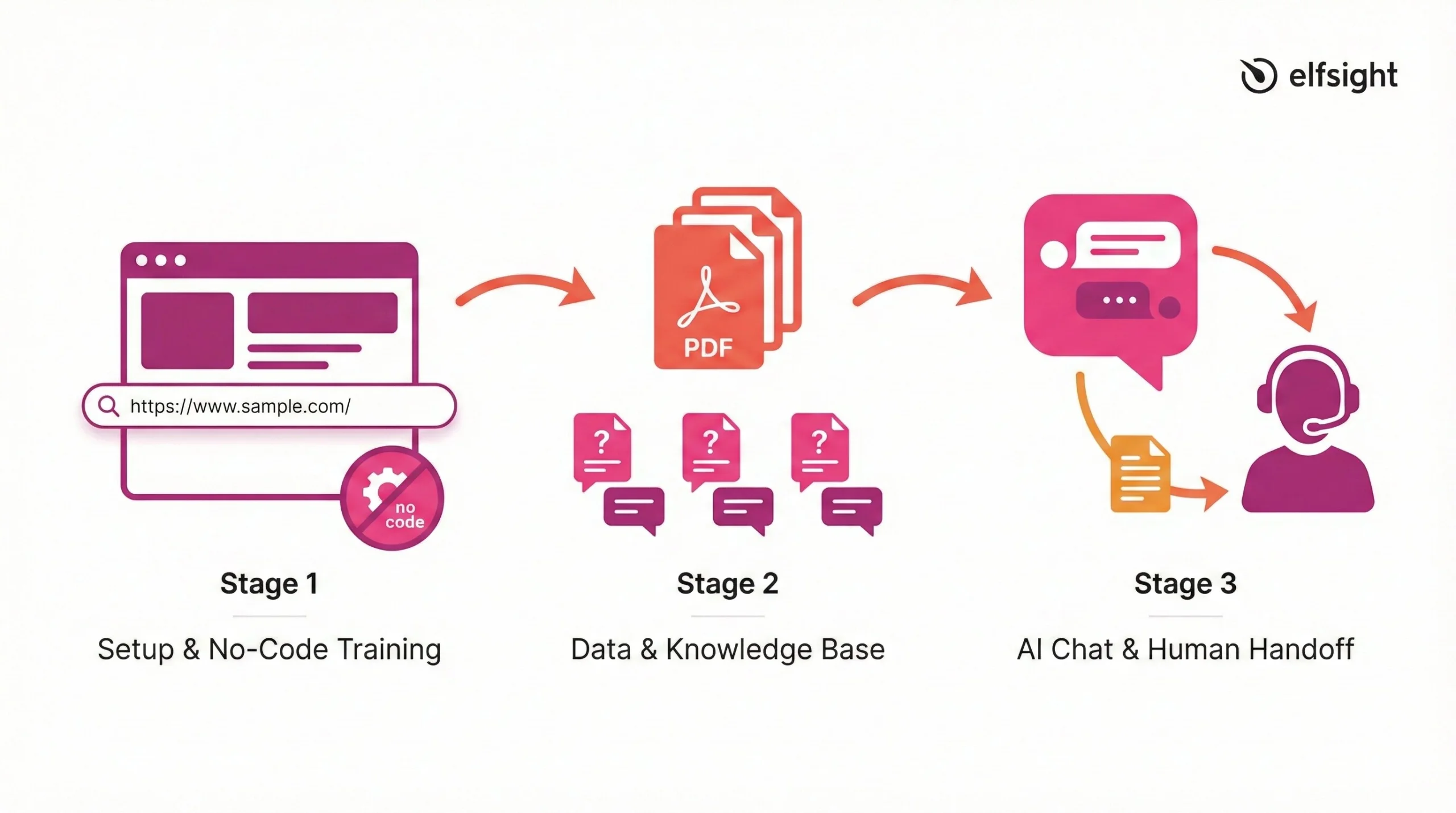
Complexity
Setup complexity stops SMBs before they start. Most businesses don’t have a developer on hand to build and maintain a chatbot. The result is either a delayed deployment or a rigid rule-based bot that frustrates customers more than it helps them.
Elfsight’s AI Chatbot widget is built to address this constraint — no code required, and setup starts with your website URL. The widget automatically pulls up to 200 pages from your sitemap to build the knowledge base in one pass, so it’s trained on your actual content rather than generic AI responses.
Wrong answers
Invented claims destroy trust faster than no chatbot at all. The risk of hallucination is real, but it’s largely preventable when the chatbot is trained exclusively on verified source material.
Elfsight’s knowledge base works from content you provide: your web pages, uploaded PDFs, Word documents, and manually written Q&A pairs. The chatbot doesn’t draw on general AI knowledge; it only surfaces answers from what you’ve given it. For pricing, legal disclaimers, or refund terms where accuracy is non-negotiable, manually curated Q&A pairs take priority over general knowledge base content.
No path to a human agent
This is the failure mode Forrester documented in over 50% of deployments: customers who exhaust the chatbot’s capabilities with no way to reach a person.
Our AI Chatbot addresses this with a built-in contact form that collects the visitor’s name, email, and phone number mid-conversation, along with the full chat transcript, which is sent directly to your team’s inbox. The human agent receives complete context: what the customer asked, what the chatbot answered, and doesn’t start from scratch. That handoff is what separates a functioning support system from a dead end.
Chatbot Implementation Checklist
Most chatbot projects fail for operational reasons, not technical ones. This checklist addresses the documented failure points before they become problems.
- Define the scope before you configure anything. List the 10–15 query types your chatbot will handle and the specific triggers that escalate to a human. If you can’t articulate the boundary, neither can your chatbot.
- Audit your knowledge base content before training. Outdated product pages, contradictory policies, and unstructured content produce confident wrong answers. Clean the source material first.
- Design the escalation path on day one, not as an afterthought. Who receives the transcript? What’s the response SLA? What happens outside business hours? These questions need answers before launch.
- Test with adversarial inputs before going live. Ask your most complex billing question. Ask it something it shouldn’t know. Try to get it to contradict your policies. Find the failures before your customers do.
- Measure resolution rate, not containment rate. A customer who gives up and closes the chat is counted as “contained” in most platform dashboards — that’s not a success metric. Track whether issues were actually resolved.
- Schedule a monthly knowledge base review. Products change, policies update, prices shift. An unreviewed knowledge base is a liability that compounds over time.
Frequently Asked Questions
What are the main benefits of chatbots for business?
What are the biggest disadvantages of chatbots?
Are chatbots worth it for small businesses?
What is the biggest mistake businesses make when deploying a chatbot?
What are the disadvantages of chatbots when it comes to complex queries?
What's the difference between a rule-based chatbot and an AI chatbot?
Moving Forward
Most of the disadvantages of chatbots covered in this article are implementation issues, not technological ones. A chatbot that gives wrong answers has a knowledge base issue. A chatbot with no escalation path has a design issue. A discontinued chatbot indicates a maintenance issue. None of those are inherent to the technology – they’re gaps in how the deployment was planned and managed.
Businesses that get implementation right are responding faster, capturing leads their competitors miss, and freeing up staff for higher-value work. The advantages and disadvantages of chatbots don’t boil down to a simple yes or no. They reduce to the question of whether you’re willing to treat deployment as a service that requires ongoing attention rather than a one-time project.
If you’re ready to evaluate a no-code option that addresses the three core failure points — setup complexity, answer accuracy, and human fallback – Elfsight’s AI Chatbot is worth a look.