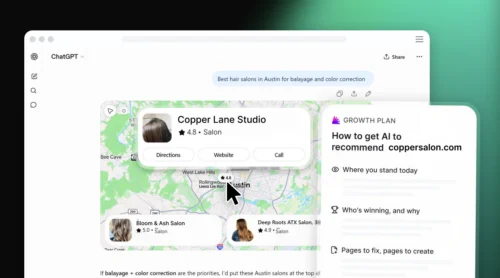


A ChatGPT mention looks like a simple yes-or-no signal: your brand appears in the answer, or it does not.
For marketers, though, the useful part starts after the mention is detected.
Was your company recommended or merely referenced? Did ChatGPT bring it up independently, or was the brand already named in the prompt? Were competitors placed above it? Was the description positive, neutral, or inaccurate? And is the same pattern appearing consistently over time?
The best tools to track brand mentions in ChatGPT help answer those questions rather than simply adding another mention to a counter.
We compared six platforms by the context they provide around each appearance, their monitoring workflow, additional brand intelligence, and pricing.
- Which tools can track brand mentions specifically in ChatGPT.
- What information you should look for beyond a mention count.
- How six platforms differ in response context, sentiment, citations, and competitors.
- Which products fit SMB, local, agency, and advanced monitoring workflows.
- How to build a useful ChatGPT mention tracking setup.
What makes a ChatGPT mention worth tracking?
Not every appearance of your company tells you the same thing. Imagine a fictional hotel brand called Harborstay.
A user could ask: “What amenities does Harborstay offer?”
The brand is already part of the question, so ChatGPT mentioning it tells you very little about discovery. Now compare that with: “What are some good boutique hotels for a weekend in Lisbon?”
If ChatGPT introduces Harborstay without the user naming it first, the mention carries a different signal: the brand has entered the AI-generated consideration set.
And even then, context matters. There is a difference between: “Harborstay is another option in the area.” and: “Harborstay is particularly worth considering for travelers looking for…” Both are mentions. Only the second carries a clear recommendation.
A useful monitoring tool therefore needs to preserve enough context to distinguish prompted mentions, discovery mentions, recommendations, competitor comparisons, and citation-backed mentions.
Best tools to track ChatGPT brand mentions at a glance
These six platforms all detect brand appearances in ChatGPT, but they differ in what they let you investigate after a mention is found.
| Tool | Best for | What you can inspect | Standout angle | Starting price |
| Beamtrace | SMBs and website owners | Prompt, full answer, mention frequency, position, recommendation context, sentiment, competitors, citations, and historical trends | Connects individual mentions with visibility, rankings, competitor and citation gaps, then turns findings into prioritized optimization Actions | $20/mo annually |
| Siftly | Teams concerned with answer variability | Mention rate, position, sentiment, citations, response | Repeated sampling of ChatGPT responses | $63/mo annually |
| LLM Pulse | Agencies and reporting workflows | Mentions, entities, position, citations, competitors, sentiment | Strong automation and external integrations | $50/mo annually |
| Peec AI | Marketing and SEO teams | Prompt, actual chat, position, sentiment, competitors, sources | Easy access to the underlying AI conversations | $80/mo annually |
| Knowatoa | Brands with multiple entities | Company, product, executive, accuracy, sentiment, sources | Tracks aliases, products, executives, and misinformation | $59/mo |
| MentionedOn | Local businesses | Recommendation prompts, competitors, trends, alerts | Built around local AI recommendations | $82.50/mo annually |
Prices and packaging change frequently, so check each provider’s current terms before purchasing.
Best tools to monitor brand mentions in ChatGPT
Each platform takes a different approach to mention tracking, so the right choice depends on whether you care most about response context, sentiment, competitors, automation, or local recommendations.
1. Beamtrace

Built by the team behind Elfsight, Beamtrace approaches ChatGPT mention tracking from the individual response level. Users can see the prompts where their business appeared and open the full ChatGPT answer rather than working only from an aggregated visibility percentage.
Each mention can be viewed alongside the brand’s position, sentiment, competitors appearing in the same response, and associated sources. Historical data then makes it possible to see whether mentions are becoming more or less frequent. Beamtrace’s wider product connects those findings with rankings, citations, competitor analysis, reputation, and optimization Actions instead of leaving the mention as an isolated datapoint. Beamtrace’s internal ChatGPT product framework likewise defines mention tracking as finding the prompts where ChatGPT discusses a brand and seeing how often, where, and in what context those mentions occur.
Main Features:
- Exact prompts triggering brand mentions
- Full ChatGPT response
- Brand position in the answer
- Sentiment analysis
- Competitors appearing alongside the brand
- Citation and source context
- Historical mention trends
- Connections to optimization Actions
| 👍 Best for | 💰 Pricing plans |
| SMBs, local businesses, and marketing teams that want to understand each ChatGPT mention in context and connect findings with practical improvements. |
|
Beamtrace is better suited to lean teams than highly complex enterprise environments.
2. Knowatoa

Knowatoa expands the meaning of “brand mention” beyond one company name.
A tracked brand can include product names, executives, events, alternate spellings, and other associated terms. That is useful when people know the product more readily than the parent company, when executives are part of the public brand, or when ChatGPT commonly uses variations of a name.
The platform also puts noticeable emphasis on accuracy. It can flag incorrect or outdated claims about a business, such as old pricing or features that no longer exist. For communications and reputation teams, that can make an inaccurate mention more important than a missing one.
Main Features:
- Company mentions
- Product and executive tracking
- Alternate names and misspellings
- Mention context
- Sentiment monitoring
- Competitor comparison
- Accuracy and misinformation tracking
- Citation sources
- Historical trends and alerts
| 👍 Best for | 💰 Pricing plans |
| Brands that need to monitor products, executives, naming variations, and factual accuracy in addition to the main company name. |
|
The Starter plan covers ChatGPT and Google’s AI products, while broader coverage requires Growth. Its public pricing page also advertises annual billing without currently displaying a clear annual monthly equivalent.
3. LLM Pulse

LLM Pulse provides a particularly detailed answer-level view. A brand mention is treated as an explicit appearance of the configured company or product name in the response text, while citations are kept as a separate signal. Teams can inspect AI responses individually and see mention position, brand sentiment, and other brands appearing in the same answer.
Its ChatGPT Entities functionality adds another useful layer. Instead of looking only for competitors you configured beforehand, it extracts brands, products, organizations, marketplaces, and publications that ChatGPT introduces into the response. This can reveal previously unnoticed competitors.
LLM Pulse also stands out when mention data needs to leave the dashboard. Its Zapier integration can push brand mentions and other AI events into tools such as Slack, Google Sheets, HubSpot, Notion, and email.
Main Features:
- Complete AI response history
- Brand mention detection
- Mention position
- Competitor mentions
- ChatGPT entity extraction
- Citation tracking
- Sentiment on higher tiers
- Zapier and webhook automation
- Historical mention trends
| 👍 Best for | 💰 Pricing plans |
| Data-oriented marketing teams and agencies that want detailed mention data and the ability to connect it with external reporting or automation workflows. |
|
Starter uses weekly tracking by default, and sentiment analysis is reserved for Growth. Teams needing daily reputation monitoring should account for the higher plan cost.
4. Peec AI

Peec makes it easy to move from an aggregate graph into the individual AI conversations behind it.
Its Recent Chats view can be filtered specifically to responses that mention your brand. Each result shows the original prompt, your position when mentioned, other tracked brands in the response, sentiment, and when the answer was collected. Users can open individual prompts to inspect a larger history of responses as well.
Peec also clearly separates brand visibility from source visibility. Your brand can be mentioned even when your website is not cited, and your website can be used as a source without the brand itself being named. That makes it easier to avoid treating citations and mentions as interchangeable.
Main Features:
- Brand mention filtering
- Actual AI chats
- Mention position
- Sentiment
- Competitor tracking
- Citation and source analysis
- ChatGPT query fan-outs
- Custom aliases and advanced brand matching
- Daily tracking
| 👍 Best for | 💰 Pricing plans |
| SEO and marketing teams that want transparent access to the actual AI responses behind their mention and visibility metrics. |
|
Self-serve plans are designed around multi-model AI tracking rather than ChatGPT alone, so businesses interested in only one platform may not use the full package they are paying for.
5. Siftly
Siftly is particularly interesting because it treats ChatGPT’s answer variability as part of the measurement problem. Instead of assuming that one run represents a permanent result, it samples prompts repeatedly and reports a mention rate with additional context.
The platform also distinguishes conversational ChatGPT responses from ChatGPT Search. Around each mention, teams can examine position, sentiment, competitors, citations, and the original response. Alerts can flag when mention rates cross configured thresholds.
Main Features:
- Repeated ChatGPT sampling
- Mention rate
- ChatGPT Search vs. conversational tracking
- Answer position
- Sentiment analysis
- Competitor Share of Voice
- Citation tracking
- Prompt-level response inspection
- Visibility change alerts

| 👍 Best for | 💰 Pricing plans |
| Teams that want to measure how consistently ChatGPT mentions their brand rather than relying on one response per prompt. |
|
Siftly includes a much broader GEO execution stack, including content and outreach tools. Teams interested only in straightforward mention monitoring may be paying for more functionality than they need.
6. MentionedOn

MentionedOn is the most specialized product in this comparison because its workflow is built around local business recommendations.
Instead of expecting a restaurant, contractor, clinic, or hotel to build a large prompt library manually, the Local plan monitors 100 questions relevant to the business. Its top 25 questions are checked every day on ChatGPT and Gemini, while all 100 receive a weekly sweep across ChatGPT, Claude, Gemini, and Perplexity.
The product also identifies competitors that AI recommends instead of the business and sends alerts when performance slips. That makes it less appropriate for broad SaaS or enterprise monitoring, but potentially much easier to interpret for location-dependent companies.
Main Features:
- Local customer-question monitoring
- Daily ChatGPT checks
- Competitor recommendation tracking
- Weekly broader AI scans
- Performance alerts
- Weekly summaries
- Manual rechecks after changes
- Multi-location option
- Optimization to-do list
| 👍 Best for | 💰 Pricing plans |
| Local businesses, service providers, restaurants, hospitality companies, and multi-location businesses monitoring recommendation-style ChatGPT prompts. |
|
MentionedOn is intentionally local-business focused. SaaS companies, global brands, and teams needing general-purpose ChatGPT brand intelligence will probably find the other platforms more flexible.
Which ChatGPT mentions matter and how should you track them?
A mention count alone says very little. To understand whether ChatGPT is actually helping people discover and consider your brand, look at what triggered the mention, how your business was presented, and whether the same pattern repeats over time.
🔍 Prioritize non-branded discovery mentions
Start with questions where the user does not mention your company. These show whether ChatGPT considers your brand relevant independently rather than simply responding to a branded query.
Build your prompt set around real customer decisions, such as:
- Best software for scheduling field technicians
- Good accounting tools for freelancers
- Boutique hotels for couples in Barcelona
Keep these separate from branded prompts. Branded questions are useful for reputation monitoring, but non-branded mentions are usually more informative when you want to understand discovery and customer acquisition.
👍 Separate mentions from recommendations
Being named is not the same as being recommended.
A passing reference, a neutral comparison, and an explicit recommendation should not all count as equivalent wins. Keep access to the full ChatGPT response so you can see whether the answer actually gives users a reason to consider your brand.
This context is much more useful than watching the mention counter move from 18 to 24 without knowing what changed.
🆚 Watch competitive mentions in the same answers
A mention becomes more meaningful when you know who appears beside you.
Look at whether competitors appear more frequently, earlier in the response, with stronger recommendation language, or for customer needs where your own brand disappears.
Use a stable group of prompts so you can see whether these competitive patterns change over time rather than reacting to one unusually good or bad answer.
💬 Monitor how ChatGPT describes your brand
Mention volume can look healthy while the surrounding narrative creates a different problem.
Watch the attributes ChatGPT repeatedly associates with your company, for example, whether it describes the brand as affordable, premium, technical, beginner-friendly, or limited in a particular area.
Also pay attention to outdated or factually incorrect statements. In some cases, fixing how the brand is represented can matter more than generating additional mentions.
🔗 Inspect the sources behind citation-backed mentions
When ChatGPT provides sources, check which ones appear alongside your brand.
A product page, review platform, comparison article, business directory, community discussion, or independent publication may help explain why ChatGPT introduces your company in a particular context.
Mentions and citations are different signals, but analyzing them together can reveal what information is supporting or limiting your brand presence.
📈 Look for patterns, not individual wins
ChatGPT responses can vary, so one strong recommendation does not establish a trend.
Track the same core set of commercially relevant prompts repeatedly and look for sustained changes in mention frequency, recommendation context, position, competitors, sentiment, and citations.
Treat every ChatGPT mention as a piece of evidence rather than the final KPI. The prompt, surrounding answer, competitors, sentiment, and sources explain whether that mention actually matters.
Which tool fits your mention monitoring goal?
There is no single best platform for every use case. The better choice is the one that matches the type of mention data your team actually needs.
| If your main goal is… | Consider |
| Understand mentions and turn gaps into improvements | Beamtrace |
| Track products, executives, aliases, and factual accuracy | Knowatoa |
| Send mention data into reporting and automation workflows | LLM Pulse |
| Inspect the raw AI conversations behind your metrics | Peec AI |
| Account for variations between repeated ChatGPT answers | Siftly |
| Monitor whether AI recommends a local business | MentionedOn |
There is no need to choose the platform with the largest feature list.
For many businesses, the best tool to track ChatGPT brand mentions is simply the one that answers three questions clearly:
Where were we mentioned? What did ChatGPT say? What should we investigate next?
A local business may care most about recommendation prompts and nearby competitors. A product company may need to track several product names and executives. An agency may prioritize exports and automation. A small website owner may simply need enough context to understand why particular mentions appear or disappear.
Start with the monitoring problem, then choose the platform.
Final thoughts
ChatGPT mention tracking is most useful when you stop treating every appearance as equal.
A branded mention, an unsolicited recommendation, a competitor comparison, and a citation-backed reference each tell you something different about how AI understands and presents your business.
The strongest monitoring setup therefore combines frequency with context.
Track the questions that matter, preserve the actual responses, compare your presence with competitors, and watch how those patterns evolve. That gives you something much more useful than a running total of how many times ChatGPT happened to type your company name.