
AI says it used 40 sources around your category. That number alone tells you very little.
Were those sources pages from your own website? Competitor content? Reddit discussions? Review platforms? Industry publications? And which of them actually appeared in the AI answer rather than simply being retrieved in the background?
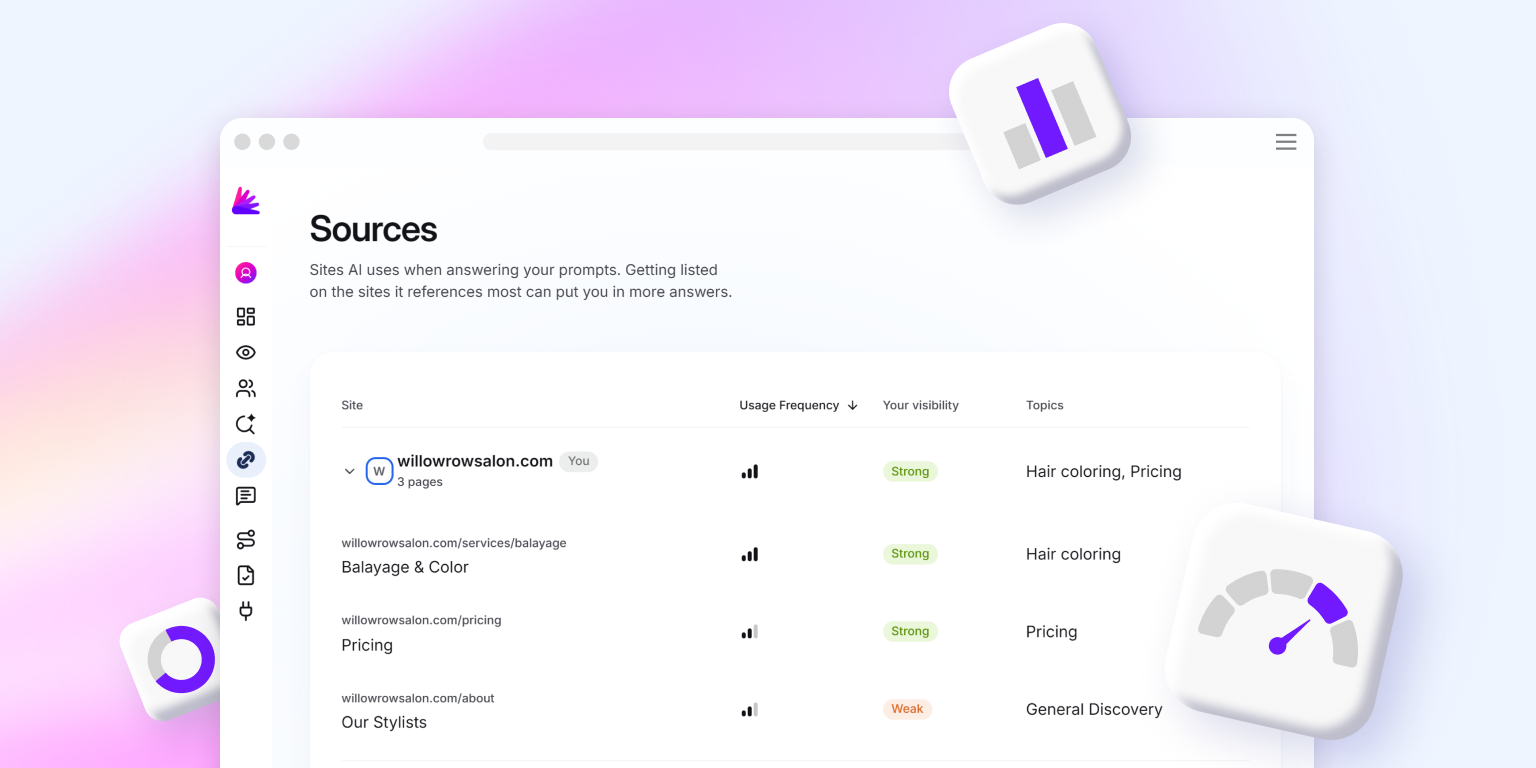
The real signal is in how those sources are used: which pages support the answer, which brands they reinforce, and where your own website is missing.
The best AI visibility tool for citation analysis should do more than count links. It should help you understand which domains and pages AI relies on, where your brand is missing, which sources support competitors, and whether those patterns are changing over time.
We compared six platforms by how well they help answer those questions.
Best AI citation analysis tools at a glance
Citation tools approach the problem from very different angles: some focus on source influence, others on competitor gaps, retrieval behavior, or citation trends. Here’s how the six platforms compare:
| Tool | Citation question it answers best | Distinctive angle | Starting price |
| Beamtrace | Where are citations connected to my visibility and competitor gaps? | Citation context inside the wider AI-search picture | $20/mo annually |
| Scrunch | Which sources influence the widest set of relevant answers? | Influence Score + deep source segmentation | $250/mo |
| Profound | When is a cited page beginning to lose influence? | Citation Decay and source lifecycle | $99/mo annually |
| Semrush AI Visibility | Which sources support competitors but not my brand? | Source Opportunities connected with SEO research | $99/mo/domain annually |
| Peec AI | Is AI retrieving my content without actually citing it? | Retrieval Rate vs. Citation Rate | ~$81/mo annually |
| Otterly.AI | Which individual URLs are gaining or losing citations? | Winners & Losers + citation trend monitoring | $25/mo annually |
Where public annual pricing is available, the table shows the monthly equivalent. Pricing and plan limits can change, so check current terms before purchasing.
How we compared citation analysis tools
Citation analysis becomes useful only when it helps answer a question you can act on. So instead of scoring tools by the number of citation-related features they advertise, we looked at how far each platform can take you through an investigation.
We used four practical questions:
Can I find the source?
A citation report should reveal more than a domain name. We looked for individual URLs, source ownership, prompt context, and the AI answer in which the citation appeared.
Can I tell why it matters?
A source cited once is different from one that repeatedly shapes dozens of answers. Metrics such as citation frequency, consistency, retrieval rate, prompt coverage, or source influence help separate meaningful patterns from isolated links.
Can I see what is changing?
Citation landscapes move quickly. We looked for historical trends, rising and declining URLs, citation decay, model differences, and other ways to understand whether a source is gaining or losing influence.
Can I find the next opportunity?
The most useful tools expose gaps: competitor sources you lack, pages AI retrieves but does not cite, valuable third-party domains, or owned content that is beginning to lose citations.
This produces a different comparison from a general AI visibility ranking. That means a platform can be excellent at discovering citation patterns across a market and still be the wrong tool for monitoring ten business-critical URLs – or the other way around.
Best AI visibility tools for citation analysis
The differences become clearer once you look at what each platform actually helps you investigate.
1. Beamtrace
Beamtrace treats citations as one part of the explanation behind AI visibility rather than as a standalone link counter.
Its Citation Analysis shows the exact domains and URLs AI uses, how frequently your own pages are cited, competitor sources, citation gaps, and the full answer around each citation. Those findings connect with rankings, prompts, competitors, and visibility, making it easier to understand what a citation actually means.
Beamtrace also carries those findings into Actions, where visibility and citation gaps can become prioritized recommendations for what to improve next. This closes the loop between finding a source problem and deciding how to respond to it.
| Best when | Watch out for | Pricing |
| You want citation gaps explained alongside prompts, competitors, and wider AI visibility | Less suited to large multi-brand citation datasets and enterprise BI workflows | From $20/mo annually; 14-day trial, no card |
2. Scrunch
Scrunch provides a particularly detailed citation view in this comparison.
It separates sources by owner – your brand, competitors, and third parties – and tracks domains and individual URLs using citation frequency, consistency, prompt coverage, and an Influence Score. Citation data can also be segmented by platform, topic, persona, funnel stage, country, and other dimensions.
| Best when | Watch out for | Pricing |
| You need to prioritize citation sources across audiences, topics, and stages of the funnel | The extra segmentation creates more complexity than smaller teams may need | $250/mo Core; 7-day free trial |
3. Profound
Profound’s most distinctive citation feature is Citation Decay.
Instead of treating citation performance as a static count, it tracks the lifecycle of individual URLs, including first citation, growth to peak, peak volume, and half-life. That helps teams see when a previously influential page begins losing its place in AI answers.
| Best when | Watch out for | Pricing |
| You manage a large content library and want citation data to drive refresh decisions | The value is strongest when used with Profound’s broader Answer Engine Insights and content workflows | Starter $99/mo annually; Growth $399/mo annually |
4. Semrush AI Visibility
Semrush is strongest when citation analysis needs to connect with existing SEO and competitor research.
Its AI Visibility reports separate Cited Sources, Cited Pages, and Source Opportunities. Source Opportunities highlight websites appearing in AI answers around competitors but not your brand, while AI Volume can help prioritize gaps by estimated demand. Full responses show how individual sources were used in the answer.
| Best when | Watch out for | Pricing |
| AI citation analysis needs to feed an existing SEO and off-page workflow | Citation research is spread across a broader suite rather than concentrated in one dedicated workspace | AI Visibility Base $99/mo per domain annually |
5. Peec AI
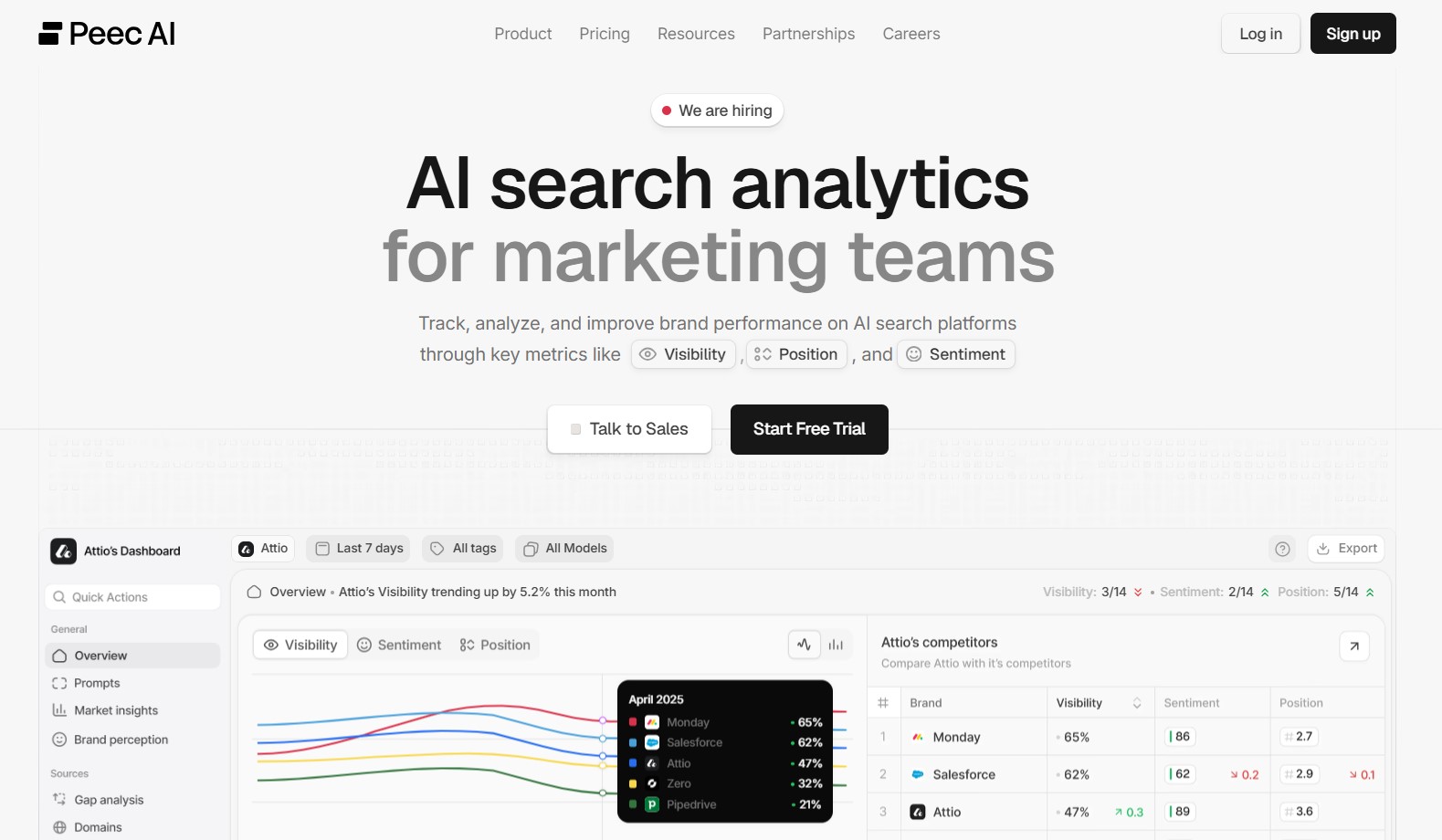
Peec approaches citation analysis through source performance and gap analysis.
Its workflows let teams isolate frequently and rarely cited URLs and investigate where their own source coverage is weak. Peec’s source-gap methodology is particularly useful for identifying pages with high citation potential rather than treating every missing citation equally.
| Best when | Watch out for | Pricing |
| You want to diagnose why already-retrieved content is not turning into citations consistently | Standard plans limit the number of models selected, so wider engine coverage requires more capacity | Starter $95/mo, or about $81/mo annually; 50 prompts, 3 models |
6. Otterly.AI
Otterly.AI is particularly useful for seeing which individual sources are gaining or losing citation presence.
Its updated Citations Report includes Top Winners & Losers, Citations Over Time, URL-level detail, prompt context, and bookmarkable sources. The interface makes it easy to spot pages that suddenly gained or lost citation presence between periods.
That makes Otterly a good fit when the main question is operational: what changed since the last reporting period, and which URLs deserve attention now?
| Best when | Watch out for | Pricing |
| You want straightforward URL-level citation monitoring and trend changes | It offers less market-wide source discovery and segmentation than Scrunch, or Profound | Lite $25/mo annually; higher plans add more tracking capacity |
How to get more value from AI citation analysis
Citation data becomes useful when you stop treating every cited link as equally important. The goal is to understand which sources matter, what they support, and where the most valuable gaps are.
🏠 Separate owned sources from third-party influence
Start by dividing citations into three groups:
- Your own website
- Competitor-owned content
- Independent third-party sources
A high citation count driven mostly by independent publishers tells a different story from one driven by your own documentation or product pages.
🔍 Read the answer around the citation
A citation does not automatically mean the source is helping your brand.
Open the response and check what the cited page actually supports. It may:
- Reinforce a recommendation for your brand
- Provide a neutral fact
- Support a competitor
- Explain a category or use case
- Supply background information without affecting the recommendation
Context can matter more than the citation count itself.
🔄 Separate retrieval from attribution
Some AI systems can retrieve a page without explicitly citing it in the final answer.
| What happens | What it may suggest |
| Page is not retrieved | Discovery or relevance may be the first problem |
| Page is retrieved but not cited | AI can find it, but may prefer another source for attribution |
| Page is repeatedly cited | The source is consistently useful for that topic or prompt set |
Tools such as Peec help make this distinction easier by separating source retrieval from citation performance.
🔗 Look for recurring sources
One successful citation can disappear on the next run.
More useful patterns emerge when the same domain, page, or source type repeatedly appears across:
- Related prompts
- Several tracking periods
- Multiple AI platforms
- Competitor answers
- Commercially important questions
Those recurring sources are much more likely to be worth investigating than one-off citations.
📌 Turn citation gaps into specific next steps
Once you identify a meaningful gap, decide what kind of problem it actually represents.
- Competitor page repeatedly cited – compare its content coverage and evidence with yours
- Third-party publication repeatedly cited – investigate whether your brand can earn inclusion there
- Your page retrieved but not cited – strengthen clarity, specificity, supporting evidence, or structure
- Previously strong page losing citations – review freshness and competing sources
- One source dominates several commercial prompts – treat it as a high-priority authority opportunity
The best citation analysis ends with a concrete research or optimization task, not just another dashboard metric.
Final thoughts
The best AI visibility tool for citation analysis is not necessarily the platform with the largest citation database. What matters is whether it helps you understand what those citations actually mean.
A useful workflow should show which sources repeatedly shape important AI answers, where competitors have an advantage, what is changing over time, and which gaps are worth acting on.
The goal is to move beyond “we received X citations” and answer a more useful question:
Which sources shape the AI answers that matter to us and where is our brand missing from that source landscape?