
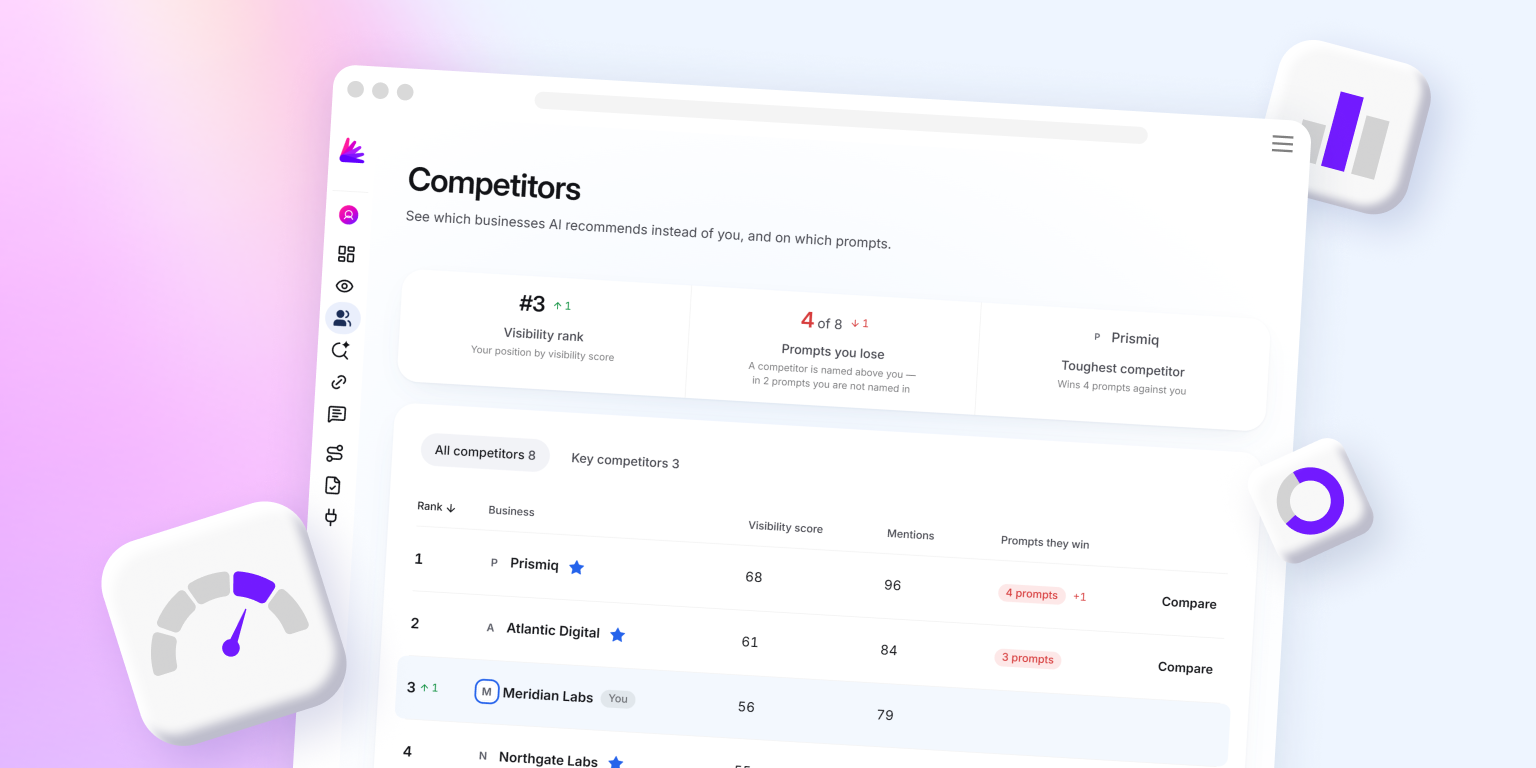
Your competitor has twice your AI Share of Voice. Useful to know. But what are you supposed to do with that?
A higher visibility score can come from very different advantages. A competitor may appear for questions your brand completely misses. They may be mentioned in the same answers but consistently rank above you. AI may describe their product more favorably, or repeatedly rely on third-party sources where they are present and you are not.
That is why competitor analysis in AI search should go beyond a leaderboard.
The best AI visibility tool for competitor analysis should help you move from “they are ahead” to more specific questions: Which prompts are creating the gap? What happens inside those answers? Which sources support the competitor? And does the same pattern keep happening?
We compared seven platforms with that goal in mind.
Best AI competitor analysis tools at a glance
These platforms take different routes to competitive analysis. Some begin with a fixed set of prompts, while others search much larger datasets to uncover competitors and source patterns you may not already know about.
| Tool | Where it finds competitor wins | How it helps explain the gap | Best for | Starting price |
| Beamtrace | Prompts where they win, you win, or both appear | Opens the original answer with positions, mentions, and sources | SMBs and marketing teams | $20/mo annually |
| Otterly.AI | Prompts where competitors appear and you do not | Combines prompt results with ranking, coverage, responses, and citations | Small teams | $25/mo annually |
| Peec AI | Share of Voice, position, and prompt gaps | Daily competitive trends plus source and citation gaps | Marketing and SEO teams | ~$81/mo annually |
| Semrush AI Visibility | Weak and missing prompts/topics | Missing Sources, AI Volume, full responses, and wider SEO research | SEO teams | $99/mo/domain annually |
| Ahrefs Brand Radar | Competitors across a broad AI-search market | Large AI index reveals unexpected brands, citations, and Share of Voice | SEO and research teams | $199/mo per AI index |
| Profound | Gaps by prompt, topic, and AI platform | Visibility Rank, Share of Voice, citations, and answer-engine data | Advanced teams | $99/mo annually |
Where annual pricing is publicly available, we show the monthly equivalent. Pricing and packaging change frequently, so check current terms before purchasing.
What does it actually mean when a competitor “wins”?
There is no single competitor-win metric in AI search.
A competing brand may be ahead because it:
- Appears while you are absent from an important prompt.
- Ranks above you when both brands appear.
- Owns more Share of Voice across a group of relevant questions.
- Receives stronger recommendation language in AI responses.
- Gets supported by citations or sources where your brand has little presence.
Those are different problems.
If you are absent entirely, content or entity coverage may deserve investigation. If both brands appear but the competitor is consistently recommended first, positioning and authority become more interesting. If third-party sources repeatedly support them, editing another landing page may not address the real gap.
The value of competitor analysis comes from separating these situations instead of reducing them to one visibility percentage.
How we evaluated the tools
We evaluated each platform specifically for its ability to investigate a competitive advantage, rather than counting every AI-search feature it offers.
The best AI tool for competitor analysis should help with four stages.
1. Find the gap.
Can you identify the prompts, topics, models, or markets where competitors outperform you?
2. Inspect what happened.
Can you move past the aggregate metric and examine positions, mentions, full responses, sentiment, or other answer-level context?
3. Investigate the supporting evidence.
Can you compare citations and sources, discover missing third-party coverage, or identify patterns behind repeated competitor wins?
4. Prioritize what matters.
Does the tool help distinguish a recurring commercial gap from one unusual AI answer?
No platform needs to do all four equally well. What matters is whether its strongest type of analysis matches the competitive question your team is actually trying to answer.
Best AI visibility tools for finding why competitors win
1. Beamtrace
Beamtrace focuses on the exact AI questions where competitors win. Its They win, We win, and Both appear views let you isolate competitive gaps and open the original AI response to inspect brand positions, mentions, and sources.
This makes Beamtrace particularly useful for moving from a broad observation – “Competitor A has more visibility” – toward something much more specific: “They repeatedly beat us on these comparison and purchase-intent questions, appear ahead of us in the answers, and these sources keep showing up around those wins.”
Main features
- Side-by-side AI Visibility Score
- They win / We win / Both appear views
- Prompt-level competitor ranking
- Mention comparison
- Full AI-response inspection
- Brand positions inside the answer
- Competitor citation and source analysis
- Historical performance trends
- Connection with wider optimization Actions

| 👍 Best for | 💰 Pricing plans |
| SMBs, local businesses, startups, and lean marketing teams that want to quickly find the prompts and AI answers behind competitor wins. |
|
Beamtrace is designed around focused business and marketing workflows rather than large enterprise intelligence programs. Teams managing many brands, websites, or complex BI environments may need a broader platform.
2. Otterly.AI

Otterly.AI combines competitor benchmarking with prompt-level gap analysis. You can compare Share of Voice, Brand Coverage, rankings, citations, and then inspect questions where competitors appear while your brand does not.
It is a relatively simple way for smaller teams to turn recurring competitor gaps into something they can investigate.
Main features
- Competitor Share of Voice
- Brand Coverage trends
- Brand Ranking
- Prompt-level competitor analysis
- Actual AI responses
- Competitor citation analysis
- Unlimited tracked competitors
- AI-suggested competitor discovery
- Daily tracking
| 👍 Best for | 💰 Pricing plans |
| Small businesses, consultants, and independent marketers that want affordable competitor-gap analysis with prompt, ranking, and citation context. |
|
Otterly is strong at identifying competitor gaps, but it provides less depth for investigating the broader market around them. Teams looking for large-scale competitor discovery or more advanced segmentation may find the analysis relatively lightweight.
3. Peec AI

Peec AI is especially useful when the question is not only where competitors are ahead today, but whether that advantage is becoming stronger or weaker over time.
Its visibility dashboard tracks Visibility, Position, Sentiment, and Share of Voice against competitors every day. Its source and citation data adds another layer by showing where competitors receive support from domains or URLs your brand may be missing.
Main features
- Daily competitor tracking
- Visibility comparison
- Share of Voice
- Average position
- Sentiment
- Automatically suggested competitors
- Prompt-level gaps
- Domain- and URL-level citation analysis
- Source Gap Analysis
- Brand Insights by topic, model, and geography
| 👍 Best for | 💰 Pricing plans |
| Marketing and SEO teams that want daily competitor benchmarking and a clear view of how Share of Voice, position, and source gaps change over time. |
|
Peec is particularly good at tracking competitive movement over time, but its workflow is more monitoring-focused than diagnostic. You may still need additional research to understand why a competitor consistently wins a specific group of prompts.
4. Semrush AI Visibility

Semrush separates competitive gaps into Strong, Weak, and Missing prompts and also highlights Missing Sources cited for competitors but not your brand.
Its main advantage is what comes next: AI-search gaps can be investigated alongside Semrush’s existing content, backlink, keyword, and technical SEO data. Its prompt database currently covers more than 317 million AI queries.
Main features
- Compare up to four competitors
- Strong, Weak, and Missing prompts
- Missing Sources
- AI Visibility benchmarking
- Competitor mentions
- AI Volume for prioritization
- Full AI responses
- Prompt Research
- Daily custom Prompt Tracking
- Wider keyword, backlink, and SEO research
| 👍 Best for | 💰 Pricing plans |
| SEO teams that want to connect AI competitor gaps with existing keyword, backlink, content, and technical research. |
|
Semrush distributes AI-search analysis across several datasets and reports. That provides considerable research depth, but the workflow is less lightweight than a focused competitor tracker.
5. Ahrefs Brand Radar
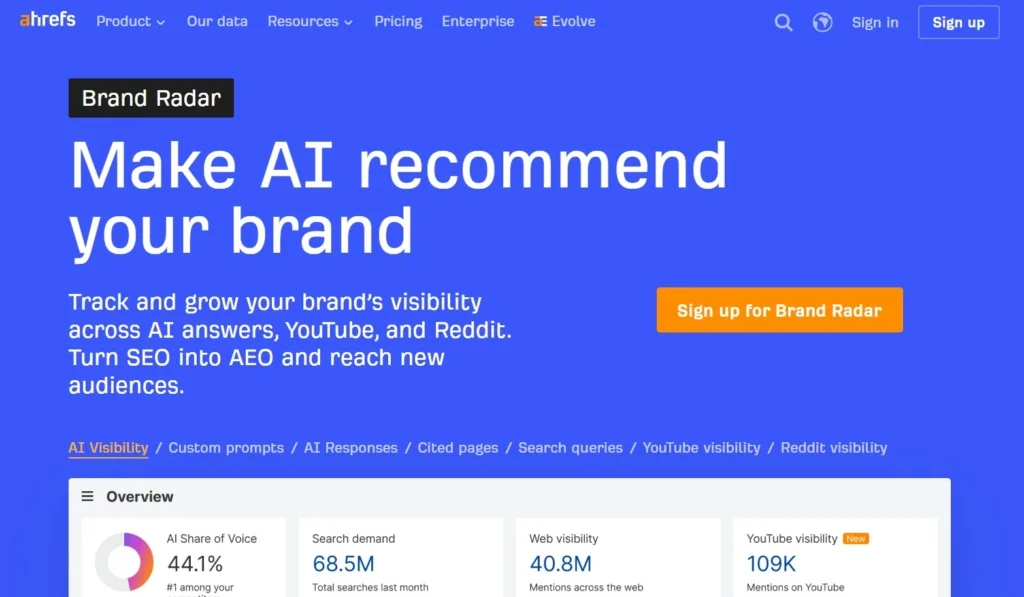
Ahrefs Brand Radar is strongest at finding competitors you may not already be tracking. Its large AI Visibility Index lets you compare brands across mentions, citations, estimated impressions, and AI Share of Voice at a broader market level.
That makes it more useful for competitive discovery than for monitoring only a fixed list of rivals.
Main features
- Large AI Visibility Index
- Automatic competitor discovery
- AI Share of Voice
- Brand mentions
- Citations
- Estimated impressions
- AI-response exploration
- Top cited domains and pages
- Multi-platform analysis
- Custom prompt tracking
| 👍 Best for | 💰 Pricing plans |
| SEO and research teams that want to discover unexpected AI competitors and explore the wider competitive landscape beyond a predefined rival list. |
|
The broad index is most valuable when market discovery matters. If you already know the exact competitors and buyer questions you need to monitor, a smaller prompt-based tracker can be simpler and less expensive.
6. Profound

Profound is better suited to organizations where competitor analysis is part of a larger answer-engine intelligence program. It analyzes competitors across prompts, topics, and AI platforms using Visibility Rank, Share of Voice, citations, sentiment, and other answer-engine data.
Its strength is scale: larger teams can identify recurring competitive patterns across many products, audiences, or markets rather than investigating prompts one by one.
Main features
- Competitive Visibility Rank
- Share of Voice
- Prompt-level comparison
- Topic-level comparison
- Cross-platform benchmarking
- Competitor citation analysis
- Sentiment and positioning
- Automatically surfaced AI competitors
- Daily monitoring
- Wider AEO and content workflows
| 👍 Best for | 💰 Pricing plans |
| Advanced marketing teams, agencies, and larger organizations that need competitor analysis across many prompts, topics, and AI platforms. |
|
The platform’s depth becomes most valuable for mature AI-search programs. Smaller businesses tracking a limited set of competitors may not need the broader research and workflow environment.
How to investigate why a competitor keeps winning
The tool gives you the data. The next step is deciding which differences are actually worth investigating.
🎯 Start with commercially important losses
Not every lost prompt matters equally.
A competitor beating you for a broad informational question may be less important than repeatedly winning questions such as:
- “Best X for small businesses”
- “X vs Y”
- “Best alternative to X”
- “Which X should I choose?”
- “Best X in [location]”
- “Is X worth it?”
Start close to evaluation and purchase intent. Once you understand those gaps, expand outward.
🆚 Separate “they appear” from “they win”
A mention alone does not tell you how competitive the answer is.
Imagine both brands appear in the same response:
1. Competitor A – recommended as the best overall choice
4. Your brand – included as another alternative
Technically, both brands received a mention. Competitively, the result is very different.
Look at presence, position, recommendation language, and Share of Voice together before deciding how serious the gap is.
🔍 Open the actual AI answers
Aggregate metrics are useful for spotting the problem. They rarely explain it.
Read several answers where the same competitor wins and ask:
- How is the competitor described?
- Which benefits keep appearing?
- Which audiences or use cases are associated with them?
- Does your brand appear at all?
- Are comparisons framed differently?
- Is the same claim repeated across several answers?
Repeated language can reveal a positioning or information gap that a graph cannot.
🔗 Compare the sources behind the wins
One of the most useful questions is:
What does AI have supporting the competitor that it does not have supporting us?
Look for repeated citations from:
- Industry publications
- Review websites
- Comparison pages
- Directories
- Reddit and other communities
- Educational resources
- The competitor’s own pages
Semrush exposes this particularly clearly through Missing Sources, while the other tools in this comparison provide different levels of citation and source analysis.
If the same independent websites repeatedly support the competitor, the opportunity may sit outside your own website.
🧩 Look for patterns, not isolated explanations
AI-generated answers naturally vary. Do not rewrite a product page because you lost one prompt once.
A much stronger signal is when:
- The same competitor wins several related prompts.
- The gap remains across repeated checks.
- The same sources keep appearing.
- One topic consistently produces weak positioning.
- The same competitor benefit appears across multiple models.
That is when competitor analysis starts to become a useful strategy rather than reactive dashboard watching.
📈 Check whether the gap actually closes
Once you make a change, keep the underlying prompt set stable enough to compare performance over time.
Watch whether:
- Your presence increases.
- The competitor’s Share of Voice falls.
- Your average position improves.
- New citations start appearing.
- Previously missing prompts become shared or winning prompts.
A good competitive workflow ends with another measurement, not with publishing the change.
Final thoughts
Competitor analysis in AI search is most useful when it goes beyond a simple visibility score.
A higher Share of Voice can tell you that another brand is ahead, but the real value comes from understanding where the gap appears, how the competitor is presented, which sources support them, and whether the same pattern keeps repeating.
That is also the main difference between the tools in this comparison. Some are better at finding exact prompt-level losses, others at monitoring competitive movement, discovering unexpected rivals, or connecting AI-search gaps with wider SEO and content research.
There is no universal best AI tool for competitor analysis. The right choice depends on how far you need to go from “they are winning” to “here is what we should investigate next.”
For most teams, that is the more useful benchmark than simply choosing the platform with the largest number of competitor metrics.