

When surveyed, 64% of customers say they prefer companies don’t use AI in customer service. Yet when both chatbot and live chat are available simultaneously, 67% choose the chatbot. This gap between stated preferences and actual behavior is the core problem in the chatbot vs. live chat debate. The real question for small businesses isn’t “which is better”, but “when each delivers value.”
This article provides a framework based on actual SMB economics. You’ll see real cost comparisons, performance benchmarks from the largest customer service datasets available, and a decision model based on three variables: monthly inquiry volume, customer age profile, and query complexity.
- Why the 2023 generative AI shift changed what chatbots can do
- The preference-behavior gap: what customers say versus choose
- Real cost comparison ($0.50–$1 per bot vs. $5–$12 for human)
- Decision framework based on volume, demographics, and complexity
- 4-step hybrid implementation with handoff best practices
- Performance targets for resolution rates and response times
Understanding the Shift in Chatbot vs Live Chat Debate
“By 2029, agentic AI will autonomously resolve 80% of common customer service issues without human intervention, leading to a 30 percent reduction in operational costs.” — Gartner Research, March 2025
The chatbot vs live chat question existed before 2023, but the variables changed fundamentally with generative AI. The old framework positioned chatbots as scripted FAQ handlers and live chat for everything else. That binary made sense when chatbots could only match keywords to canned responses.
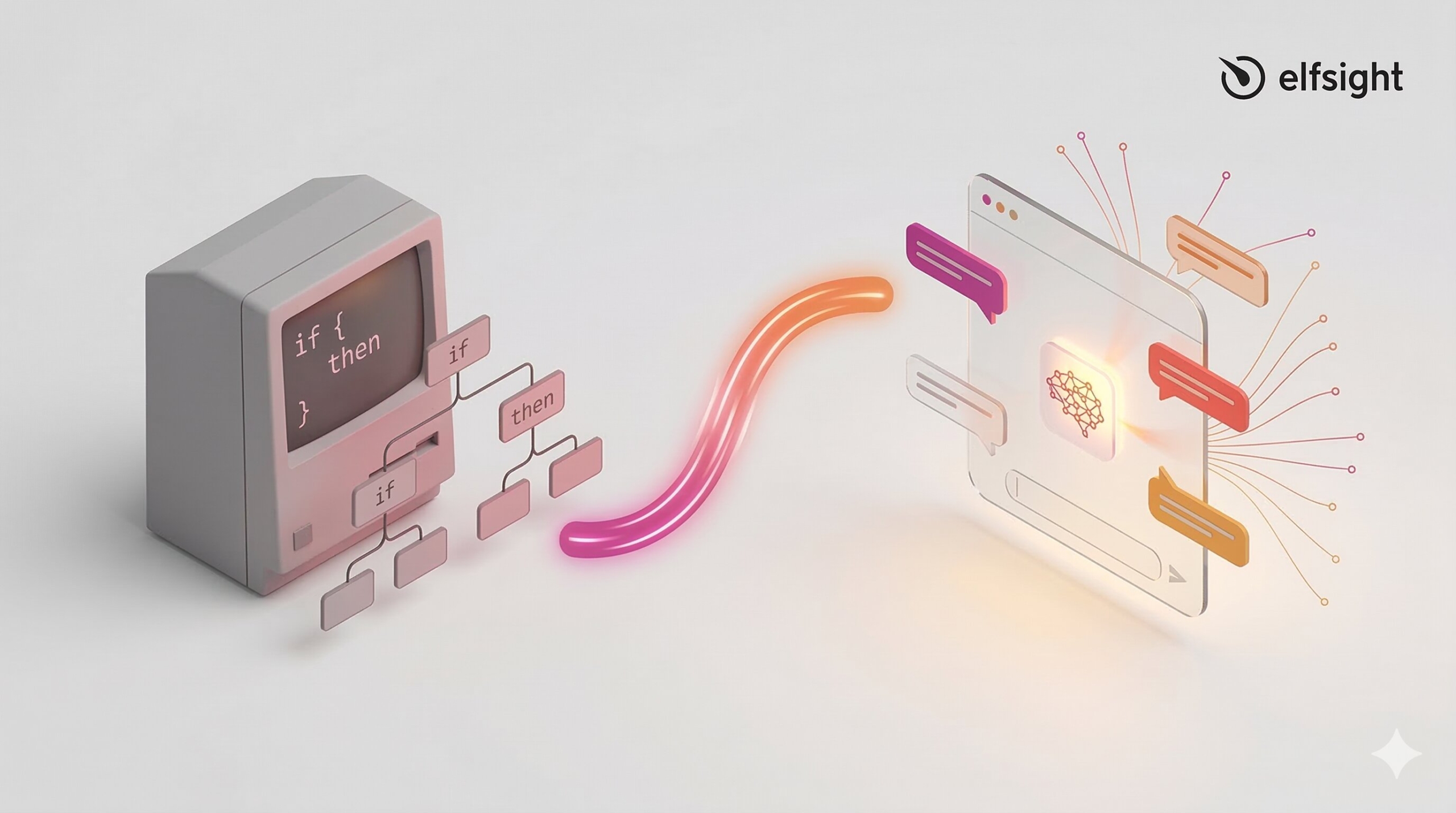
LLM-powered chatbots of today interpret context, maintain conversation history, handle unexpected questions, support 85+ languages automatically, and take autonomous actions like processing orders. Salesforce’s Agentforce has autonomously resolved 84% of 380,000+ customer interactions, with only 2% requiring human intervention.
This doesn’t make live chat obsolete. Human agents handle complex problems, provide empathy in sensitive situations, and make judgment calls that AI can’t. But it changes the economic calculus for when you deploy each tool.
The Preference Gap: Why Survey Data Misleads
Ask customers what they prefer, and the answer seems clear. Gartner surveyed 5,728 customers and found 64% prefer that companies don’t use AI. Kinsta’s research with 1,011 U.S. consumers found 93.4% prefer humans. Five9’s study of 4,000 people showed 75% prefer real humans, with 56% frustrated by AI chatbots.
Behavioral data tells a different story. When both options appear simultaneously, 67% choose the chatbot. LiveChat’s analysis of 87 billion visits revealed chatbot CSAT at 64.7%, essentially matching human CSAT at 64.2%. When framed with context, 62% say they’d rather use a chatbot than wait 15 minutes for a human.
The gap exists because abstract preference surveys measure what sounds reasonable when customers aren’t facing actual problems. In the moment – checking order status or return policies – speed and convenience override abstract preferences.
Research published in the Journal of Consumer Research explains why. Consumers evaluated the bot service more negatively than an identical human service because they assumed the automation was used to cut costs at their expense. But the study found two remedies that eliminate the bias: clearly superior bot performance or sharing economic benefits through price discounts.
| Source | Finding | What It Means |
|---|---|---|
| Gartner (5,728 customers) | 64% prefer no AI | Abstract preference without context |
| Kinsta (1,011 consumers) | 93.4% prefer humans | Stated preference without trade-offs |
| Freshworks behavioral data | 67% choose chatbot when both available | Revealed preference: convenience wins |
| LiveChat (2B chats) | Chatbot 64.7% vs. human 64.2% CSAT | Well-built bots match human performance |
How Modern AI Chatbots Differ From What You Remember
If your last chatbot experience involved typing the same question three times before giving up, you’re not evaluating the right technology. Rule-based systems that earned negative reputations operated on if/then logic, matched keywords to scripts, and couldn’t handle typos or unexpected phrasing.
The shift to generative AI chatbots changed what’s possible. Let’s look at the Elfsight AI Chatbot as an example of what modern implementations deliver:
- Powered by ChatGPT-5 mini – uses advanced AI for natural, context-aware conversations
- Simple onboarding – pulls up to 200 pages from your sitemap without manual data entry
- No-code setup – embeds in a few simple steps without technical expertise required
- Lead capture & insight – sends chat transcripts straight to your email and collects user info
- Flexible training sources – learns from files in PDF, JSON, DOCX formats, or custom Q&A pairs
- Full customization – adjusts its tone, appearance, and behavior to match your brand
Deployment barriers collapsed for SMBs. Non-technical owners can now implement GPT-powered chatbots easily in under an hour using no-code platforms. The AI chatbot addresses users by name, sends follow-up messages after inactivity, and produces context-aware responses, mitigating customer frustration.
Curious what an AI chatbot could look like on your site? Build one here
Live Chat: When Human Connection Matters
While AI handles volume efficiently, live chat delivers what automation can’t: genuine human judgment, emotional intelligence, and relationship building. Research shows live chat achieves 70–79% first-contact resolution across most issue types, outperforming chatbots, particularly for complex problems, billing disputes, and situations requiring empathy.
Elfsight’s All-in-One Chat widget demonstrates how modern live chat implementations work for small businesses:
- Multi-messenger support – connects visitors via WhatsApp, Telegram, Facebook Messenger, and Viber from one widget, so you don’t miss a single customer’s query
- Smart triggering – automatically opens chat based on time on website, scroll depth, or exit intent to engage visitors at the right moment
- Flexible positioning – deploy as a floating bubble, a fixed widget, or embedded directly in content like product pages to help a visitor complete their purchase
- Audience targeting – show chat only to new visitors, returning customers, or everyone, based on your unique strategy
- Page-specific display – activate chat on high-value pages like pricing or checkout while hiding it elsewhere
Live chat connects visitors directly to your existing accounts – whichever messenger they prefer. The availability of human support functions serves as a trust signal for customers who remain anxious about engaging with a chatbot. The constraint remains staffing: true 24/7 coverage requires multiple agents for shift rotation, making hybrid approaches more practical for most SMBs.
Chatbot vs. Live Chat: Side-by-Side Comparison
Understanding the difference between chatbot and live chat requires examining how each performs across dimensions that matter for customer experience and operations, from speed and cost to the nuanced advantages and limitations.
AI chatbots deliver first responses in under 10 seconds with no degradation during traffic spikes or outside business hours. Live chat averages 35 seconds for first response, but queue waiting time averages 4 minutes 18 seconds, and 27.4% of customers drop out before being served. Chatbots win decisively on speed and 24/7 availability.
The economics diverge sharply. AI chatbot resolutions cost approximately $0.50–$1.00 per interaction, while live chat interactions cost $5–$12 each when factoring in agent time, platform fees, and overhead. A single full-time U.S. agent costs $35,000–$55,000 annually fully loaded, and 24/7 coverage requires 4–5 FTEs per seat for shift rotation.
Chatbot containment rates average 50% for most implementations, with optimized systems reaching 70–80%. But rates vary by issue type – Gartner data shows 58% for returns and cancellations, only 17% for billing disputes. Live chat achieves 70–79% first-contact resolution across most issue types, with humans handling edge cases and exceptions that require judgment.
Modern AI chatbots access conversation history and tailor responses based on customer data, but they lack genuine emotional intelligence. Live chat agents read tone, recognize frustration before it escalates, and provide empathy in sensitive situations. Zendesk’s 2025 report found 64% of consumers trust AI more when it exhibits empathy, but that empathy is simulated pattern-matching.
| Dimension | AI Chatbot | Live Chat | Winner |
|---|---|---|---|
| First Response | <10 seconds | 35 sec avg (4+ min with queue) | Chatbot |
| Cost per Interaction | $0.50–$1.00 | $5–$12 | Chatbot (5-12x cheaper) |
| Resolution Rate | 50% avg, 70-80% optimized | 70-79% first-contact | Live chat for complex issues |
| Scalability | Unlimited concurrent | Linear (more agents = more cost) | Chatbot |
| CSAT | 64.7% (LiveChat data) | 64.2% (LiveChat data) | Tied in well-built systems |
“AI helped human agents respond to chats some 20 percent faster — improving performance even more for less experienced agents.” — Zhang & Narayandas, Management Science
Harvard Business School research analyzing 256,934 conversations found AI-assisted agents responded 20% faster than unassisted agents, with improved empathy. The effect was strongest for less-experienced agents, providing the equivalent of 1.5 years of additional experience. The highest-performing model isn’t a bot or a human – it’s a bot-augmented human.
The Decision Framework: Chatbot, Live Chat, or Both?
The practical question isn’t “do you prefer chatbot or live chat?” It’s “given my situation, which configuration delivers the best outcome?” That requires three variables that most businesses can measure.
Monthly inquiry volume establishes baseline economics. Under 50 inquiries monthly may favor part-time live chat over chatbot platform fees. Break-even typically occurs at 50–100 inquiries per month. Businesses handling 500+ gain a clear advantage with chatbot-first, human-escalation.
Customer demographic age predicts acceptance rates. YouGov data shows 51% of Gen Z use AI weekly versus 25% of Boomers. Gen Z is most forgiving after bad bot experiences – only 20% won’t retry, compared to 61% of Boomers. If your base skews younger (18–34), chatbot-forward works. If older (45+), lead with live chat.
Query complexity mix determines what percentage chatbots can realistically handle. E-commerce answering order status and return policies typically sees 70–80% bot-appropriate queries. Professional services with customized proposals may find only 30–40% suitable for automation.
Five Scenarios
- E-commerce, 200–400 monthly inquiries, Gen Z/Millennial: Chatbot-first with escalation for billing disputes and complex returns.
- Professional services, mixed demographics, complex inquiries: Live chat-first with chatbot handling scheduling and FAQs.
- SaaS product, high-volume basic questions, technical troubleshooting: Hybrid with smart routing – bots for onboarding, humans for debugging.
- Local service business, under 100 inquiries, older demographic: Live chat with a simple booking bot.
- Content/media site, high traffic but low engagement: Chatbot-only with email escalation.
The Break-Even Point
Research suggests chatbot investment pays off at 50+ inquiries monthly, with most businesses seeing a return within 3–6 months. Zendesk reports that teams handling 20,000 requests monthly save 240+ hours with chatbots – equivalent to six full-time weeks recovered.
Calculate your numbers: multiply monthly inquiries by $5–12 (human handling cost) versus chatbot platform costs, plus setup time. For most SMBs handling 100+ monthly inquiries, the math favors a hybrid implementation.
Zendesk’s 2025 report found 90% of CX leaders report positive ROI from AI, with “CX Trendsetters” 128% more likely to report high ROI. The difference isn’t the technology – it’s deliberate implementation with clear escalation paths and maintained knowledge bases.
Implementing Hybrid Support: 4 Steps
The theory of combining chatbot and live chat is straightforward. The practice requires deliberate design around escalation, knowledge bases, handoffs, and monitoring.
Step 1: Define Escalation Triggers
Program explicit rules for bot-to-human transfer: explicit human requests (“speak to a person”), sentiment detection catching frustration before escalation, loop detection when customers rephrase the same question 2–3 times, high-value accounts or VIP customers, regulated topics involving health/legal/financial information, and after 2–3 failed resolution attempts.
Modern implementations build these triggers directly into the chatbot configuration. The Elfsight AI Chatbot widget, for example, includes a “Contact a Human” skill that activates automatically when:
- User explicitly asks for a human agent
- AI recognizes that a question is outside its knowledge base
- Specific keywords signal sensitive issues requiring human judgment
- Based on the custom scenarios you define
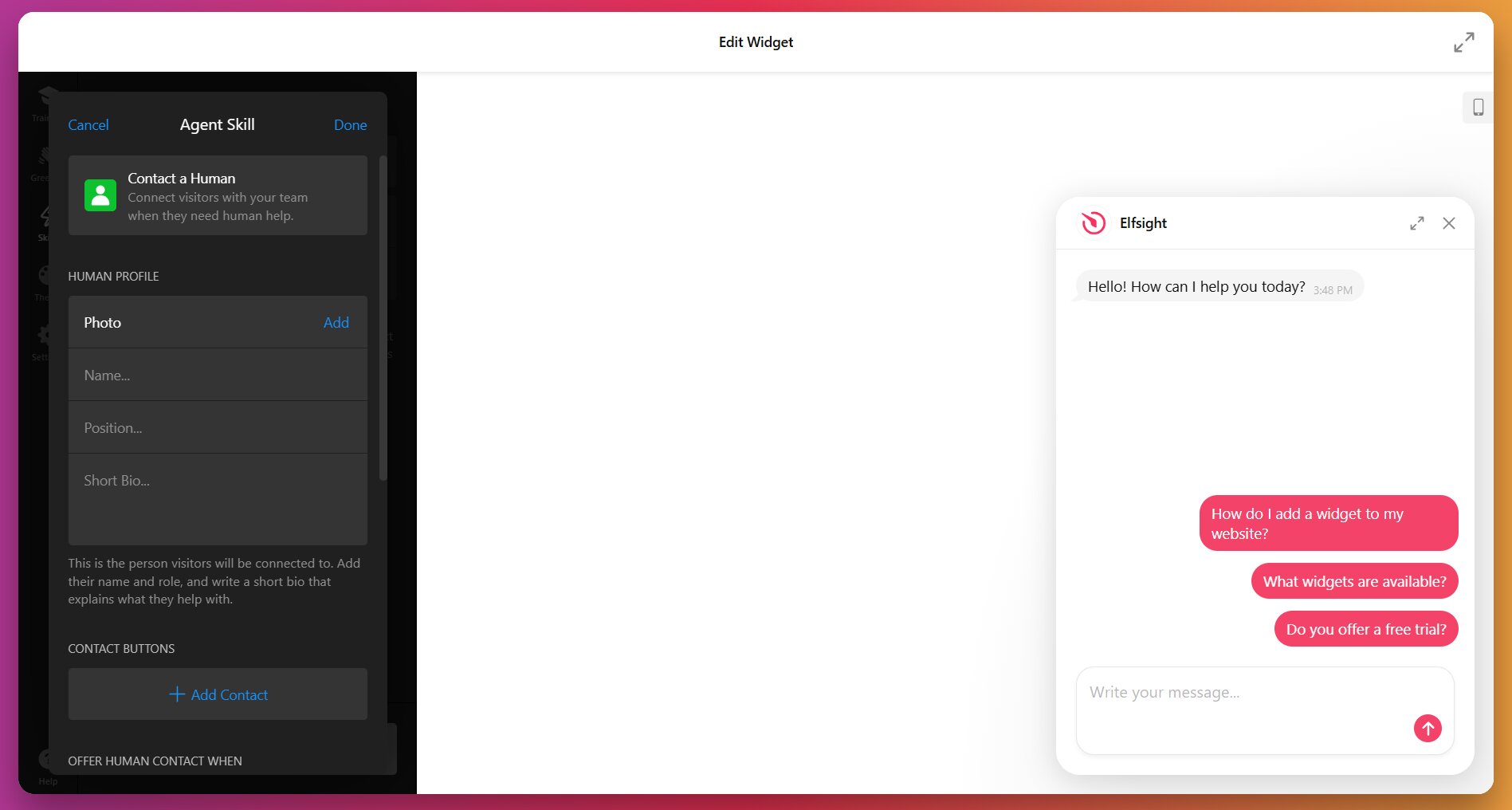
Make escalation easy and obvious. Since 80% of consumers will only engage with chatbots if they know a human option exists. Hiding that option destroys trust faster than any other decision.
Step 2: Build Your Knowledge Base
Start with your top 15-20 most frequent questions based on actual support data. Upload product documentation, FAQs, and policies in structured formats – JSON typically produces best results. Use retrieval-augmented generation that grounds responses in verified company data rather than allowing AI to improvise.
Set clear boundaries for what the bot should and shouldn’t answer. For topics outside its scope, the bot should acknowledge limitations and offer human escalation immediately.
Build monthly reviews into your workflow. When you update pricing, change policies, or launch products, the chatbot continues serving old information until manually retrained.
Step 3: Configure the Handoff Flow
Full conversation context must transfer automatically – customers should never repeat information. Transfer should happen when triggered, not “an agent will reach out within 24 hours.” Display honest wait times if no agent is available. After-hours should create tickets with full chatbot history or offer callback scheduling.
Harvard research revealed a counterintuitive finding: when AI-assisted agents responded too quickly after handoff, customer sentiment improved less because customers suspected they were still talking to a bot. A brief natural delay signals human presence. Never hide the human option behind multiple bot interactions.
Step 4: Monitor and Optimize
Track containment rate (50% baseline, 70%+ target), escalation reasons, CSAT by channel, first-contact resolution, and response times. Monthly reviews should update knowledge bases, refine escalation triggers based on false positives and negatives, and analyze failed bot interactions for patterns.
Common mistakes: pushing chatbots to handle everything without clear escalation, set-and-forget mentality, letting knowledge bases go stale, hiding human options behind multiple interactions, failing to pass conversation context during handoffs, and not planning human fallback from day one.
FAQ: Chatbot vs. Live Chat Questions
What is the difference between chatbot and live chat?
A chatbot is automated software that uses AI to respond to customer inquiries based on a knowledge base and predefined logic. Live chat connects customers directly with human support agents in real time. Modern AI chatbots powered by GPT-4 or similar models can understand context and handle complex conversations, while live chat provides human judgment and empathy for sensitive or nuanced issues.
Do customers prefer chatbot or live chat?
Surveys show 64-93% of customers say they prefer human agents, but behavioral data reveals 67% choose chatbots when both options are available. Preference depends on context: customers want chatbots for speed on routine issues like order tracking and FAQs, but prefer humans for complex problems and complaints. Critically, 80% of consumers will only engage with chatbots if they know a human option exists.
Are chatbots cheaper than live chat?
Yes. Chatbot interactions cost $0.50-$1.00 per resolution, while human live chat costs $5-$12 per interaction. However, total cost depends on volume and coverage needs. For businesses with under 50 monthly inquiries, part-time live chat may be more cost-effective than chatbot platform fees. Break-even typically occurs around 50-100 inquiries monthly.
Can chatbots replace live chat entirely?
For most businesses, no. Modern AI chatbots can handle 70-80% of routine inquiries, but customers still need human access for complex issues, complaints, and situations requiring empathy or judgment. Research shows chatbots achieve 50-80% containment rates, meaning 20-50% of conversations still require human intervention. The optimal approach for most SMBs is hybrid: chatbot-first with seamless escalation.
How do I know if my business needs a chatbot, live chat, or both?
It depends on three factors: monthly inquiry volume, customer demographics, and query complexity. Under 50 inquiries monthly with older demographic and complex issues suggests live chat. Over 200 monthly inquiries with routine questions like FAQs and order status suggests chatbot with human escalation. Hybrid works best for 100-500 monthly inquiries with mixed demographics and blended simple/complex questions.
What's the difference between old chatbots and modern AI chatbots?
Rule-based chatbots (pre-2023) follow scripted if/then logic and only respond to exact keyword matches. Modern AI chatbots use large language models like GPT-4 to understand context, handle unexpected phrasing, maintain conversation history, and support 85+ languages automatically. Old chatbots frustrate customers with rigid responses; AI chatbots can autonomously resolve complex issues. However, modern chatbots still require proper setup, maintained knowledge bases, and human escalation paths.
Choosing the Right Approach for Your Business
The chatbot vs live chat question assumes a binary choice, but successful small businesses combine both. The specific configuration depends on your numbers – inquiry volume, customer demographics, and issue complexity. The businesses getting this right design systems where each handles what it does best: chatbots absorb high-volume routine inquiries with instant responses, while human agents focus on relationship-building and situations requiring empathy.
The competitive advantage isn’t in waiting for perfect technology – it’s in learning what works for your business, refining knowledge bases and escalation triggers, and building operational muscle around hybrid support while your market delays. Implement one component at a time, let performance data guide next steps, and remember that 80% of customers will only engage with your chatbot if they know a human option exists.