

People apply social expectations to chatbots the same way they do to humans – judging tone, reading intent, forming opinions within seconds. This isn’t a quirk of early adopters. It’s a pattern researchers at Stanford documented in the mid-1990s and that three decades of follow-up studies have consistently confirmed: when users interact with a machine that communicates in language, they can’t help but treat it as a social actor. Your website chatbot already has a personality. The only question is whether you chose it or left it to chance.
This article covers the psychology behind why chatbot personality drives trust, two practical frameworks for designing one, how personality should differ by industry, and the mistakes that cost brands credibility. Whether you’re setting up your first AI chatbot or refining an existing one, chatbot personalization starts before it writes a single response.
- What chatbot personality actually is — and how AI changed the way it’s built
- The psychological research behind why personality drives trust and engagement
- Two practical frameworks for choosing the right personality traits
- How personality should differ by industry and use case
- The most damaging personality mistakes — and how to avoid them
What Is Chatbot Personality?
Chatbot personality is the combination of voice, tone, behavior patterns, and conversational style that defines how your AI chatbot communicates. It’s brand identity expressed through conversation – the difference between a chatbot that sounds like your business and one that sounds like every other automated bot on the internet.
It’s worth distinguishing personality from its surface-level signals. A name and avatar are branding elements, not personality. Personality runs deeper – it’s the reason two chatbots trained on identical knowledge bases can feel completely different to interact with. One might be warm and conversational, guiding visitors through options with gentle follow-ups. The other might be brisk and efficient, delivering answers with minimal small talk.
With AI-powered chatbots, personality is defined through natural-language instructions that shape all generated responses at once. Tools like Elfsight’s AI Chatbot let you describe the tone, behavior, and communication style you want in a few paragraphs, and the AI applies that across every conversation it handles.
Why Chatbot Personality Matters
The foundational research here is the Computers Are Social Actors, or CASA, paradigm (Nass & Reeves, 1996), which demonstrated that people automatically apply social rules to computers: being polite to them, assigning them personality traits, forming expectations about their behavior, even when they fully understand they’re interacting with a machine.
What recent research adds is how this process works. A 2025 study in Frontiers in Computer Science found that anthropomorphic chatbot features don’t improve user experience directly – instead, they work through an emotional pathway, increasing perceived empathy and trust, which then drive satisfaction. In other words, personality isn’t cosmetic. A parallel study in Frontiers in Psychology reinforced this, showing that a chatbot’s social-oriented communication style – informal language, greetings, and expressions of concern – directly boosts customer satisfaction through perceived warmth.
The Business Case
“AI is not the differentiator anymore. How intelligently you apply it is.” — Tom Eggemeier, CEO of Zendesk
The data on user expectations is clear. Zendesk’s CX Trends 2025 report found that 64% of consumers value AI agents that are friendly, engaging, and empathetic, and 67% said traits like creativity, empathy, and friendliness lead to better outcomes. On the flip side, Salesforce’s State of the Connected Customer report found that 68% of customers wouldn’t use a company’s chatbot again after a single negative experience.
These two data points frame what you might call the personality imperative. Users aren’t arriving enthusiastic about chatbots – they’re arriving skeptical. Personality and humanization are the primary tools for overcoming that skepticism. When a chatbot feels generic or robotic, it confirms every negative assumption the user already had. When it feels natural, responsive, and aligned with the brand, it earns the trust that the technology alone cannot.
What Happens Without It
A chatbot with no intentional personality defaults to whatever the underlying AI model produces – typically flat, generic, and indistinguishable from every other chatbot. Practitioners consistently report that this drives high bounce rates from the chat widget itself: visitors open it, receive an automated, impersonal response, and close it without completing their question. The chatbot technically works, but it fails at the one thing that matters most in the first few seconds – giving the user a reason to keep talking.
How to Design Your Chatbot’s Personality
Choosing a chatbot personality isn’t about picking a name and writing a witty greeting. It’s about defining consistent behavioral traits that align with your brand and audience, then translating those traits into instructions your AI can follow.
Framework 1: The Big Five Personality Model
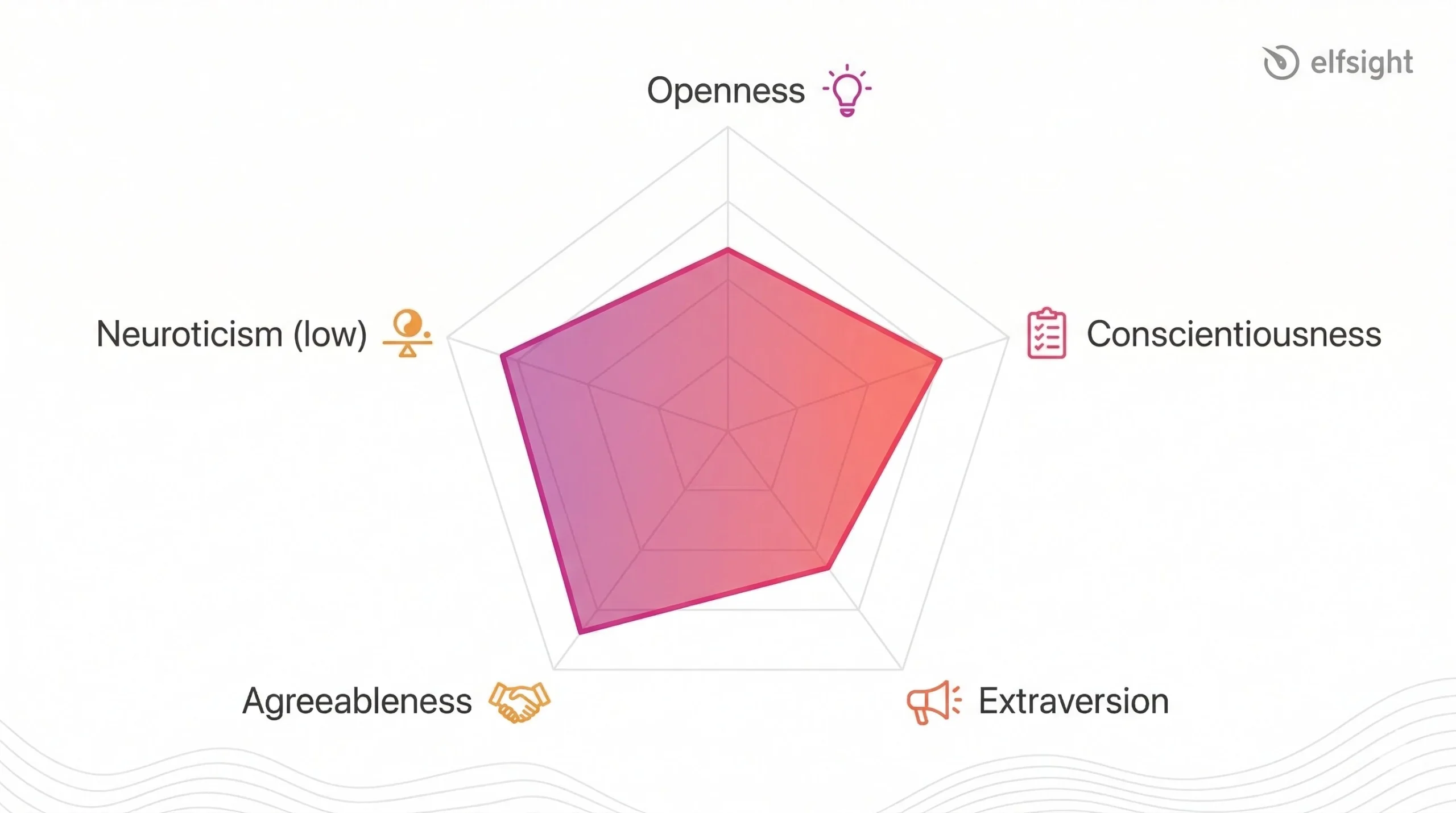
The most significant recent validation of this approach comes from a study by Cambridge and Google DeepMind. Researchers tested 18 different LLMs and demonstrated that Big Five personality traits – openness, conscientiousness, extraversion, agreeableness, and neuroticism – can be reliably shaped through prompts, and that these changes carry through to real-world task behavior, altering how the AI communicates.
“It was intriguing that an LLM could so convincingly adopt human traits. But it also raised important safety and ethical issues. Next to intelligence, a measure of personality is a core aspect of what makes us human.” — Gregory Serapio-García
A separate study in MDPI Informatics found that among users interacting with chatbots designed with different Big Five profiles, agreeableness was the most preferred trait chosen by 61.1% of participants, followed by conscientiousness at 29.6%. Interestingly enough, users attributed competence and honesty only to their preferred chatbot personality, even though all chatbots were equally capable. Personality creates a halo effect that influences perceived quality beyond actual performance.
Here’s how each dimension translates to chatbot behavior:
| Trait | What it means for your chatbot | Example instruction phrasing |
|---|---|---|
| Openness | Curiosity, creativity, and willingness to explore tangential questions | “Be open to follow-up questions even if they go slightly off-topic. Offer related suggestions when relevant.” |
| Conscientiousness | Thoroughness, reliability, structured, and complete answers | “Always provide complete answers. If information is missing, say so rather than guessing. Follow up to confirm the user’s question was fully addressed.” |
| Extraversion | Energy, enthusiasm, proactive engagement | “Use a warm, upbeat tone. Proactively suggest next steps or related topics the visitor might find useful.” |
| Agreeableness | Warmth, patience, cooperative language, conflict avoidance | “Be patient and supportive. If a visitor seems frustrated, acknowledge their concern before answering. Never use dismissive or curt language.” |
| Neuroticism (low) | Calm, composed, steady under pressure | “Maintain a calm and reassuring tone even when handling complaints or confusion. Never mirror a visitor’s frustration.” |
Framework 2: Four Tone Dimensions
If the Big Five feels too abstract, the Nielsen Norman Group’s four tone-of-voice dimensions offer a more intuitive alternative. You place your brand on four spectrums and translate those positions directly into chatbot instructions. This works particularly well for SMB owners who want a structured approach they can apply in a single sitting.
| Dimension | Spectrum | Example instruction for each end |
|---|---|---|
| Humor | Funny ↔ Serious | Funny: “Use light humor when appropriate — a brief quip or playful phrasing is fine, but never joke about the visitor’s problem.” / Serious: “Keep all responses straightforward and professional. No humor, jokes, or playful language.” |
| Formality | Formal ↔ Casual | Formal: “Use complete sentences, proper grammar, and professional language at all times.” / Casual: “Write like a friendly colleague — contractions are fine, keep sentences short, and use conversational phrasing.” |
| Respect | Respectful ↔ Irreverent | Respectful: “Treat every question as valid. Never imply the visitor should already know the answer.” / Irreverent: “Be direct and a little cheeky — challenge assumptions playfully when it fits the brand voice.” |
| Energy | Enthusiastic ↔ Matter-of-fact | Enthusiastic: “Show genuine interest in helping. Use affirmative language like ‘Great question!’ or ‘Happy to help with that.'” / Matter-of-fact: “Be helpful but spare with enthusiasm. Answer clearly and move on.” |
The advantage of this framework is speed: most business owners can place their brand on all four spectrums within minutes, because these dimensions map closely to decisions they’ve already made about brand voice in other channels.
Turning Framework Choices Into Instructions
Both frameworks converge at the same practical step: translating personality into the natural-language instructions that govern your AI chatbot’s behavior. The instructions you write become the single source of truth for how the chatbot communicates: its default tone, how it handles edge cases, what language it avoids, and how it escalates to a human when needed.
What matters here is that your framework choices give those instructions direction. Instead of writing instructions in a vacuum (“be friendly and helpful” — which tells the AI almost nothing), you’re writing from a defined position: “high agreeableness, moderate extraversion, high conscientiousness” or “casual, serious, respectful, matter-of-fact.” That specificity is what makes the AI’s output consistent rather than generic.
Chatbot Personality by Industry and Use Case
“Digital assistants in industries like insurance or banking usually require some level of gravitas, while a bot on an e-commerce site geared to Millennials can be much more casual.” — Dawn Harpster, Senior Conversation Architect, Talkdesk
The personality that works for a Shopify store selling streetwear will alienate clients of an accounting firm, and vice versa. A study in Technological Forecasting and Social Change demonstrated this empirically: for high-stakes interactions, people want less personality and more impartial precision. Context modulates everything.
Here’s how personality should shift across the four most common chatbot use cases:
| Use case | Recommended tone | Priority traits | What to avoid |
|---|---|---|---|
| E-commerce | Casual, energetic, product-savvy | Extraversion, openness | Pushy upselling, excessive formality |
| Customer support | Patient, empathetic, thorough | Agreeableness, conscientiousness | Dismissive phrasing, rushing the user |
| Lead generation | Warm, goal-oriented, helpful | Agreeableness, moderate extraversion | Aggressive qualification, salesperson tone |
| Professional services | Formal, calm, reassuring | Conscientiousness, low neuroticism | Casual slang, humor, excessive enthusiasm |
E-commerce chatbots benefit from energy and a willingness to explore; visitors are often browsing rather than searching for a specific answer, so a chatbot that proactively suggests products and responds with enthusiasm matches the shopping mindset.
Customer support chatbots face a fundamentally different dynamic: visitors arrive with a problem, often already frustrated, and the chatbot’s first job is to acknowledge that frustration before solving anything. Agreeableness and patience matter more here than any other trait.
Lead generation chatbots walk the narrowest line. The personality needs to be warm enough to keep visitors engaged but goal-oriented enough to guide conversations toward contact capture or qualification. The mistake most businesses make is leaning too hard toward the sales side – a chatbot that feels like a pushy rep triggers the same resistance as a human one.
Professional services demand the most restrained personality. Visitors to a law firm or financial advisory site expect precision and composure. Humor, casual language, or excessive enthusiasm can undermine credibility, even when the answers are technically correct.
AI Chatbot Personality Mistakes That Damage Trust
Getting personality wrong costs more than getting it right earns. A poorly designed chatbot personality actively damages brand perception in ways that a generic one doesn’t. These are the six most common failure patterns, ranked by their frequency in practitioner case studies and user research.
🙂 No intentional personality
The single most common mistake. The chatbot uses whatever default tone the underlying model produces – flat, generic, and indistinguishable from every other automated response. Visitors open the chat, receive something that feels like a template, and leave. The chatbot technically functions, but it fails to create any reason for the user to prefer this experience over a search bar.
💢 Tone-brand mismatch
Casual, emoji-laden language from a law firm’s chatbot. Cold, corporate phrasing from a brand known for warmth and personality. Even when the answers are factually correct, the disconnect between chatbot tone and brand identity creates a sense that something is off – and users interpret that dissonance as untrustworthiness.
👤 Over-humanization
LLMs have reached a point where they can be indistinguishable from human interlocutors. Research on the “uncanny valley” in text-based interactions suggests that when a chatbot is too human, even small mistakes – a factual error, an off-tone response – starkly reveal its artificial nature and trigger harsher backlash than a modestly human bot would face. The goal is natural but transparent, not deceptive.
🌀 Persona drift
The chatbot shifts tone mid-conversation – formal in one response, suddenly casual in the next, or breaking character when it encounters an unfamiliar question. Inconsistency erodes trust faster than a consistently imperfect personality, because users lose the ability to predict how the chatbot will behave.
🔧 Persona over utility
This is the most counterintuitive mistake: investing so much in personality that it gets in the way of actually helping people. A chatbot that prioritizes being clever, witty, or character-consistent over answering the question clearly has its priorities inverted.
✅ Set and forget
Launching with a personality and never revisiting it. Conversation logs reveal patterns – questions the chatbot handles awkwardly, responses where the tone falls flat, moments where visitors disengage. Without regular review and iteration, personality decays as the gap between what users need and what the chatbot delivers slowly widens.
Common Questions
What is chatbot personality?
Why is chatbot personality important for businesses?
How do I choose the right personality for my chatbot?
Can chatbot personality actually affect conversions?
What's the difference between chatbot personalization and chatbot personality?
Should my chatbot pretend to be human?
Where to Start
Users will assign your chatbot a personality, whether you design one or not – it’s built into how humans process conversational interactions. The difference between a chatbot that builds trust and one that drives bounces often comes down to whether that personality was an intentional choice or an accidental byproduct. Pick one of the two frameworks in this guide, map your brand’s position, and turn those decisions into the instructions that shape your AI chatbot’s behavior.
Personality isn’t a one-time launch-day decision. It evolves as you review conversation logs, notice where visitors disengage or where tone falls flat, and refine your instructions based on what you learn. The businesses that get the most from their chatbots treat personality the way they treat any other customer-facing communication – as something worth revisiting, testing, and improving over time.
Resources
- Serapio-García, G. et al. (2025). “A psychometric framework for evaluating and shaping personality traits in large language models.”, Nature Machine Intelligence – https://www.nature.com/articles/s42256-025-01115-6
- Nielsen Norman Group “The Four Dimensions of Tone of Voice” (2016) – https://www.nngroup.com/articles/tone-of-voice-dimensions/
- Peter, S., Riemer, K., & West, J.D. (2025). “The benefits and dangers of anthropomorphic conversational agents.”, PNAS – https://pmc.ncbi.nlm.nih.gov/articles/PMC12146756/
- Zendesk CX Trends 2025 Report – https://cxtrends.zendesk.com/
- Salesforce, State of the Connected Customer (6th Edition, 2024) – https://salesforce.com/resources/research-reports/state-of-the-connected-customer/
- Frontiers in Computer Science (2025). “Effect of anthropomorphism and perceived intelligence in chatbot avatars.” – https://www.frontiersin.org/journals/computer-science/articles/10.3389/fcomp.2025.1531976/full
- Technological Forecasting and Social Change (2024). “Anthropomorphism of AI chatbots in online health consultation services.” – https://www.sciencedirect.com/science/article/abs/pii/S0040162524002038