
If you’ve searched for a chatbot for your business recently, you’ve probably noticed a shift: tools that were called “chatbots” a year ago are now labeled “AI agents.” The interfaces look similar, the features often overlap – what should be a clear distinction between two categories has been blurred by a wave of rebranding.
The confusion isn’t accidental. The agentic AI market is growing fast, and many products adopt the “agent” label, whether their capabilities justify it or not. This article breaks down what actually separates AI agents from chatbots, why the distinction is getting harder to see, and how to choose based on what the tools do – not what they’re called.
- What chatbots and AI agents actually are, and the spectrum between them
- Why “agentwashing” is flooding the market with misleading labels
- When a chatbot is enough for your website, and when you genuinely need an agent
- How to evaluate tools based on what they do, not what they’re called
What Do These Terms Actually Mean?
The confusion starts with definitions. “Chatbot,” “AI chatbot,” “AI agent,” “conversational agent,” and “virtual assistant” are used interchangeably across marketing pages, product reviews, and even analyst reports. These terms describe different levels of capability, and understanding the differences helps you evaluate what you’re actually buying.
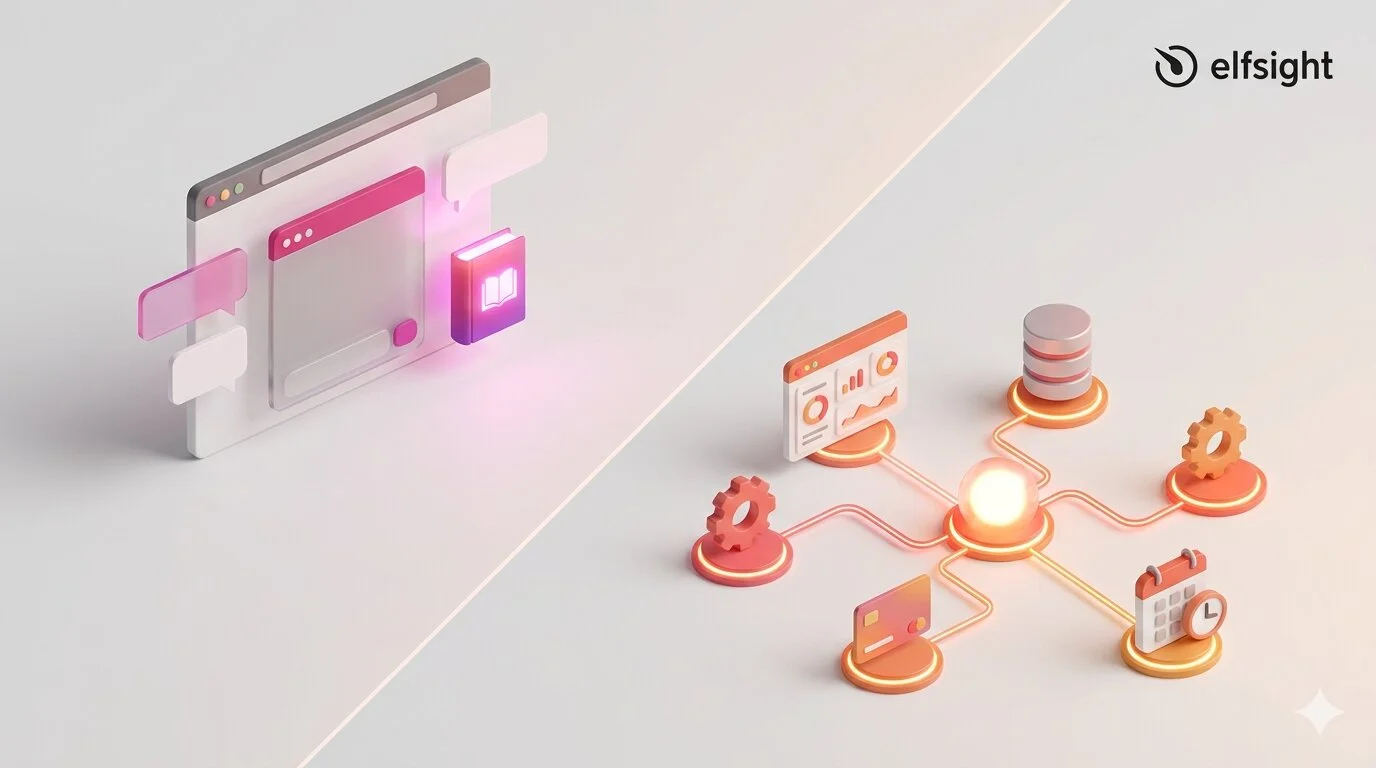
Chatbots: From Scripts to Language Models
A chatbot is software that conducts a conversation with a visitor, typically through a text-based interface on a website. That’s the broad definition, and it covers a wide range of sophistication.
At the simpler end, rule-based chatbots follow decision trees and keyword matching. They respond to specific inputs with pre-written answers – think “type 1 for pricing, type 2 for support.” These are still common on many small business websites and work fine for narrow, predictable interactions.
At the more capable end, AI-powered chatbots use natural language processing, LLMs, and knowledge bases often supported by a centralized UX research repository to handle open-ended conversations, a significant step up from scripted flows. You can ask them a question in your own words, and they’ll generate a relevant response based on the content they’ve been trained on.
AI Agents: Autonomy Is the Dividing Line
An AI agent, in the most rigorous sense, is a system that can autonomously pursue goals, make decisions, take actions across multiple systems, and adapt its behavior without constant human direction. This is fundamentally different from even a sophisticated AI chatbot, which responds to prompts within a single conversational interface.
Gartner’s framework is the clearest available. They draw an explicit hierarchy:
- AI assistants simplify tasks, but depend heavily on human input
- AI agents can perform complex, end-to-end tasks with task specialization and a degree of autonomy
- Agentic AI ecosystems are networks of coordinated agents managing workflows across systems
A Spectrum, Not a Binary
In practice, most products don’t fall neatly into “chatbot” or “agent.” They sit on a spectrum, and recognizing where a product falls helps you evaluate it more accurately than any category label:
- Rule-based chatbots follow decision trees and keyword matching. No AI involved. Still effective for simple, predictable interactions like store hours or basic FAQs.
- AI-powered chatbots use NLP and large language models combined with a knowledge base to handle open-ended questions. They can answer things they weren’t explicitly programmed for.
- Enhanced AI chatbots with agent-like features handle conversation and take limited actions — triggering a form, routing to WhatsApp, offering action buttons, or escalating to a human with full context.
- True AI agents work autonomously across multiple backend systems, make decisions, execute multi-step workflows, and adapt without a human prompt.
For most small and mid-sized businesses, the relevant decision is between tiers 1 and 2/3. Tier 4 is primarily an enterprise play, and the gap between “enhanced chatbot” and “true agent” is where a lot of marketing language gets creative.
Why So Many “AI Agents” Are Really Chatbots
“Most agentic AI projects right now are early-stage experiments or proof of concepts that are mostly driven by hype and are often misapplied.” — Anushree Verma, Senior Director Analyst, Gartner
Understanding the spectrum helps explain why the market is so confusing right now. The AI agent category is growing quickly, with estimates around $7–8B in 2025 and projections reaching $50–200B by the early 2030s. That level of growth creates strong incentives to reposition products under the “AI agent” label.
Agentwashing
Gartner has given this pattern a name: agentwashing. Their research found that roughly 130 “agents” deliver genuine agentic capabilities. The issue is when the label creates expectations that don’t match the product’s actual functionality, which makes it harder for buyers to compare options clearly. AI agents also sit at the “Peak of Inflated Expectations” on Gartner’s 2025 Hype Cycle for AI, which typically signals that the technology is real, but market expectations have outpaced current capabilities.
What does this mean in practice? Gartner predicts that over 40% of agentic AI projects will be canceled by the end of 2027 – mainly due to rising costs, unclear business value, or weak risk controls.
How to Distinguish
For SMBs evaluating tools, the takeaway is simple: focus on what a product can actually do, not the category it claims to be in. A few signals help you assess agentic capabilities:
- It can execute multi-step tasks across different systems without requiring a human
- It makes decisions based on data from multiple sources, not just a single knowledge base
- It adapts its behavior based on outcomes, not just updated training data
- It can initiate actions proactively – not just respond to prompts
If a product requires a human to start every interaction and operates entirely within a chat window, it’s a chatbot. That’s perfectly fine for most website use cases, but understanding what you’re buying helps you set the right expectations and budget.
Chatbot vs AI Agent: Key Differences
With the agentwashing context in mind, a clean side-by-side comparison helps separate the real differences from the marketing noise. This table focuses on AI-powered chatbots (tier 2–3) versus true AI agents (tier 4), since that’s the comparison driving the search.
| Dimension | AI Chatbot | AI Agent |
|---|---|---|
| Scope | Operates within a single conversational interface | Works across multiple systems and tools |
| Autonomy | Responds to user prompts; needs a human to initiate | Pursues goals independently; can initiate actions |
| Decision-making | Retrieves and presents information from a knowledge base | Evaluates options, makes choices, and executes based on goals |
| Integration depth | Connects to a knowledge base; may trigger basic actions (forms, links) | Deep integration with CRMs, databases, APIs, and backend systems |
| Adaptation | Improves when the knowledge base is updated manually | Learns from outcomes and adjusts behavior over time |
| Typical deployment | Website widget, messaging channel, support portal | Enterprise workflows, IT operations, complex service environments |
| Best for | FAQs, lead capture, product questions, basic support | Multi-step workflows requiring autonomous decision-making |
Self-sufficiency
The most important row is autonomy. A chatbot, even a very good one, waits for a visitor to ask something. An AI agent can identify that a problem exists, decide how to solve it, and execute the solution across systems without being prompted.
That’s the clearest test for whether a product is genuinely agentic, and it’s the dimension most often obscured by agentwashing.
Scale & Limits
Scope is the second differentiator. Chatbots live inside a conversation window. Agents operate across your tech stack, pulling data from a CRM, updating a database, triggering an API, and circling back to the customer with a resolution.
This cross-system orchestration is what makes agents powerful for complex enterprise processes, but also what makes them expensive and technically demanding to deploy.
When a Chatbot Is Enough (and When It Isn’t)
Understanding the spectrum and consumer expectations makes the practical question easier to answer: which type of tool does your website actually need?
A Chatbot Covers Most Website Use Cases
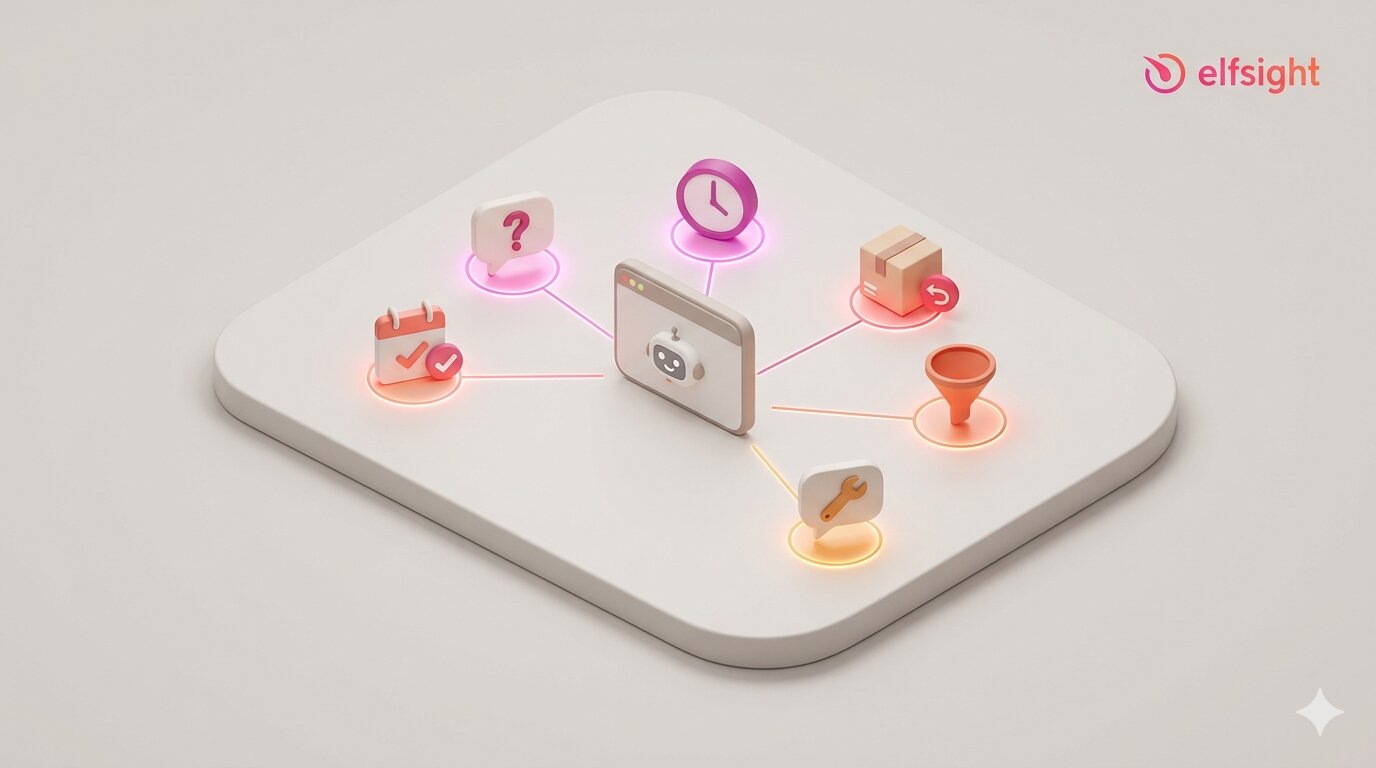
For the majority of SMB websites, an AI-powered chatbot handles the interactions that matter most. Product questions, business hours, shipping and return policies, lead capture, basic troubleshooting, appointment booking – these are high-volume, well-defined interactions where a knowledge-trained chatbot delivers immediate value.
The chatbot draws on your own content, responds in seconds, and handles multiple conversations simultaneously. This aligns with Gartner’s practical guidance: use assistants for simple retrieval, automation for routine workflows, and reserve agents for situations where autonomous decisions are genuinely needed.
If 80–90% of your visitor questions fall into predictable categories, a chatbot trained on your actual business content will handle them accurately without requiring enterprise infrastructure or enterprise pricing.
When You Genuinely Need AI Agent Capabilities
AI agents earn their complexity when the task involves multi-step, cross-system processes in which autonomous decision-making delivers measurable ROI. An IT support agent that checks a user’s device status in one system, resets their VPN in another, updates the ticket in a third, and schedules a follow-up – all without human intervention – is doing something a chatbot architecturally can’t.
Enterprise customer service provides another clear example: handling a refund that requires verifying the order in one system, checking inventory in another, processing the payment reversal in a third, and sending a confirmation. Gartner projects that by 2029, agentic AI will autonomously resolve 80% of common customer service issues without human intervention.
Yet for a 10-person e-commerce shop, that level of orchestration is usually neither necessary nor cost-effective today. The following table maps common scenarios to the right tool tier:
| Scenario | Recommended Tool | Why |
|---|---|---|
| Answering product questions, FAQs, business hours | AI chatbot (tier 2) | Knowledge-based retrieval — exactly what AI chatbots are built for |
| Capturing leads and routing to sales via WhatsApp or email | Enhanced AI chatbot (tier 3) | Requires conversation + action-taking within a single interface |
| Escalating complex issues to a human with full context | Enhanced AI chatbot (tier 3) | Context handoff is an agent-like feature many chatbots now support |
| Processing a refund across order, payment, and shipping systems | AI agent (tier 4) | Multi-system orchestration requiring autonomous decision-making |
| IT support: diagnose, fix, and follow up across tools | AI agent (tier 4) | Multi-step workflow across backend systems without human intervention |
Where Elfsight AI Chatbot Fits on the Spectrum
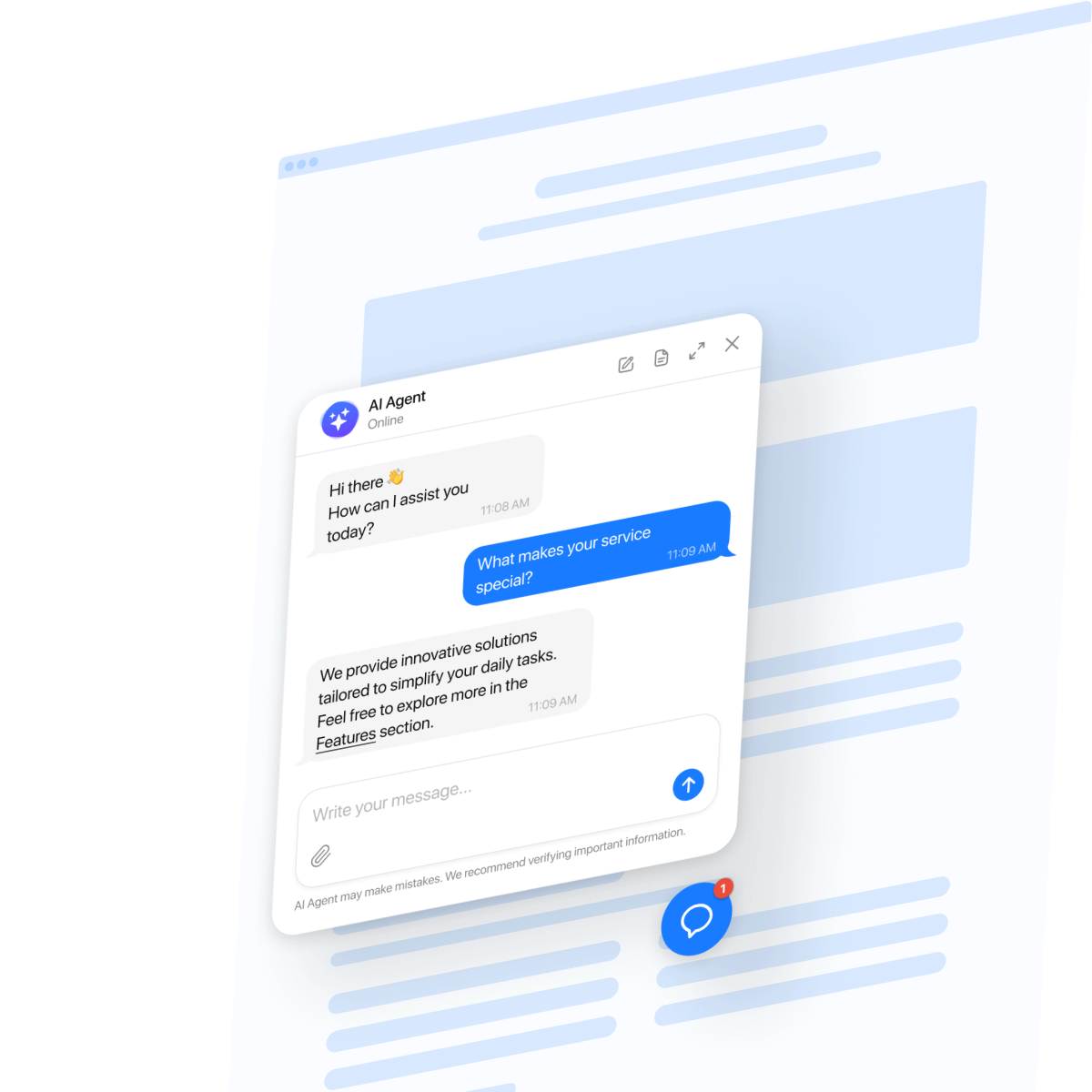
Elfsight’s AI Chatbot sits at tier 2–3 on the spectrum – an AI-powered chatbot with agent-like features. It runs on ChatGPT-5 mini, trains on the user’s own business content, and handles open-ended conversation without requiring any code to set up.
What it can do:
- Train on up to 200 web pages, uploaded files, and custom Q&A pairs
- Recognize which page a visitor is on and adjust responses to match that context
- Capture leads mid-conversation with a built-in contact form and deliver full chat transcripts
- Trigger contextual actions via Action Buttons (opening WhatsApp, redirecting to a URL, etc.)
- Route visitors to a real person through the Contact Human feature
- Maintain conversation memory and cross-page continuity so visitors don’t repeat themselves
What it doesn’t do:
- Execute autonomous workflows across backend systems (CRMs, databases, payment platforms)
- Make independent decisions or take actions without a visitor’s prompt
- Connect to external APIs or orchestrate multi-step processes across tools
Create your own AI chatbot in the interactive editor ↓
For most website use cases, such as answering questions, capturing leads, and routing to a human, the capabilities in the first list are what matter. The second list describes enterprise agent territory, and it’s the signal that you’ve outgrown a chatbot-tier tool.
Common Questions
What is the main difference between an AI agent and a chatbot?
Is an AI chatbot the same thing as an AI agent?
What is agentwashing?
Do customers prefer chatbots or human agents?
When does a small business need an AI agent instead of a chatbot?
What is a conversational agent vs. a chatbot?
Seeing Through the Noise
The AI agent vs chatbot distinction is real. Agents can orchestrate across systems in ways chatbots architecturally can’t, and that capability will reshape enterprise customer service over the next several years.
The market has made the comparison harder to navigate than it needs to be. When most “agents” are enhanced chatbots, and most websites need the capabilities that enhanced chatbots already provide, the label on the product becomes the least reliable way to evaluate it.
Focus on what the tool demonstrably does: whether it answers from your actual content, responds quickly, remembers context, captures leads, and routes to a human when it should. If a well-configured chatbot covers those needs, you’ve solved the problem your visitors actually have – without paying for enterprise agent infrastructure you don’t need yet.
Primary sources
- Gartner, “Gartner Predicts Over 40% of Agentic AI Projects Will Be Canceled by End of 2027” – https://www.gartner.com/en/newsroom/press-releases/2025-06-25-gartner-predicts-over-40-percent-of-agentic-ai-projects-will-be-canceled-by-end-of-2027
- Zendesk, CX Trends 2026 Report – https://www.zendesk.com/newsroom/press-releases/contextual-intelligence-becomes-the-new-standard-for-exceptional-customer-experience-in-2026/
- Gartner, “Gartner Predicts 40% of Enterprise Apps Will Feature Task-Specific AI Agents by 2026” – https://www.gartner.com/en/newsroom/press-releases/2025-08-26-gartner-predicts-40-percent-of-enterprise-apps-will-feature-task-specific-ai-agents-by-2026-up-from-less-than-5-percent-in-2025
- Fortune Business Insights, Agentic AI Market Size – https://www.fortunebusinessinsights.com/agentic-ai-market-114233
- Gartner, “Gartner Predicts Agentic AI Will Autonomously Resolve 80% of Common Customer Service Issues by 2029” – https://www.gartner.com/en/newsroom/press-releases/2025-03-05-gartner-predicts-agentic-ai-will-autonomously-resolve-80-percent-of-common-customer-service-issues-without-human-intervention-by-20290
- SurveyMonkey, Customer Service Statistics – https://www.surveymonkey.com/curiosity/customer-service-statistics/