
You’re comparing chatbot options, but the prices don’t make sense. One vendor quotes $15 per month. Another wants $500. A development agency just sent an estimate for $75,000. All three claim to solve the same problem: automating customer conversations on your website.
The confusion is understandable. From $0–$50 monthly on a basic chatbot to custom-built solutions that can reach half a million for enterprise deployments – the gap between these numbers isn’t arbitrary. It reflects fundamentally different products serving different needs, and understanding which tier fits your situation is the single most important cost decision you’ll make.
This guide breaks down real chatbot costs across three pricing tiers, exposes hidden fees that double advertised prices, and shows what you’ll actually pay based on your business size and volume.
- The three chatbot pricing tiers and which fits your business size
- Real costs for 20+ platforms including hidden fees that double advertised prices
- How per-resolution pricing reshapes budgets and introduces new risks
- When free tiers work and when you’ll need to upgrade
- Actual annual costs for solopreneurs, growing SMBs, and mid-market businesses
- ROI evidence from enterprise deployments and why SMB data remains thin
The Chatbot Cost Spectrum
Chatbot costs fall into three broad categories, each with distinct economics. A no-code widget that captures leads on your homepage operates in a completely different cost universe than an enterprise AI agent integrated across your entire tech stack.
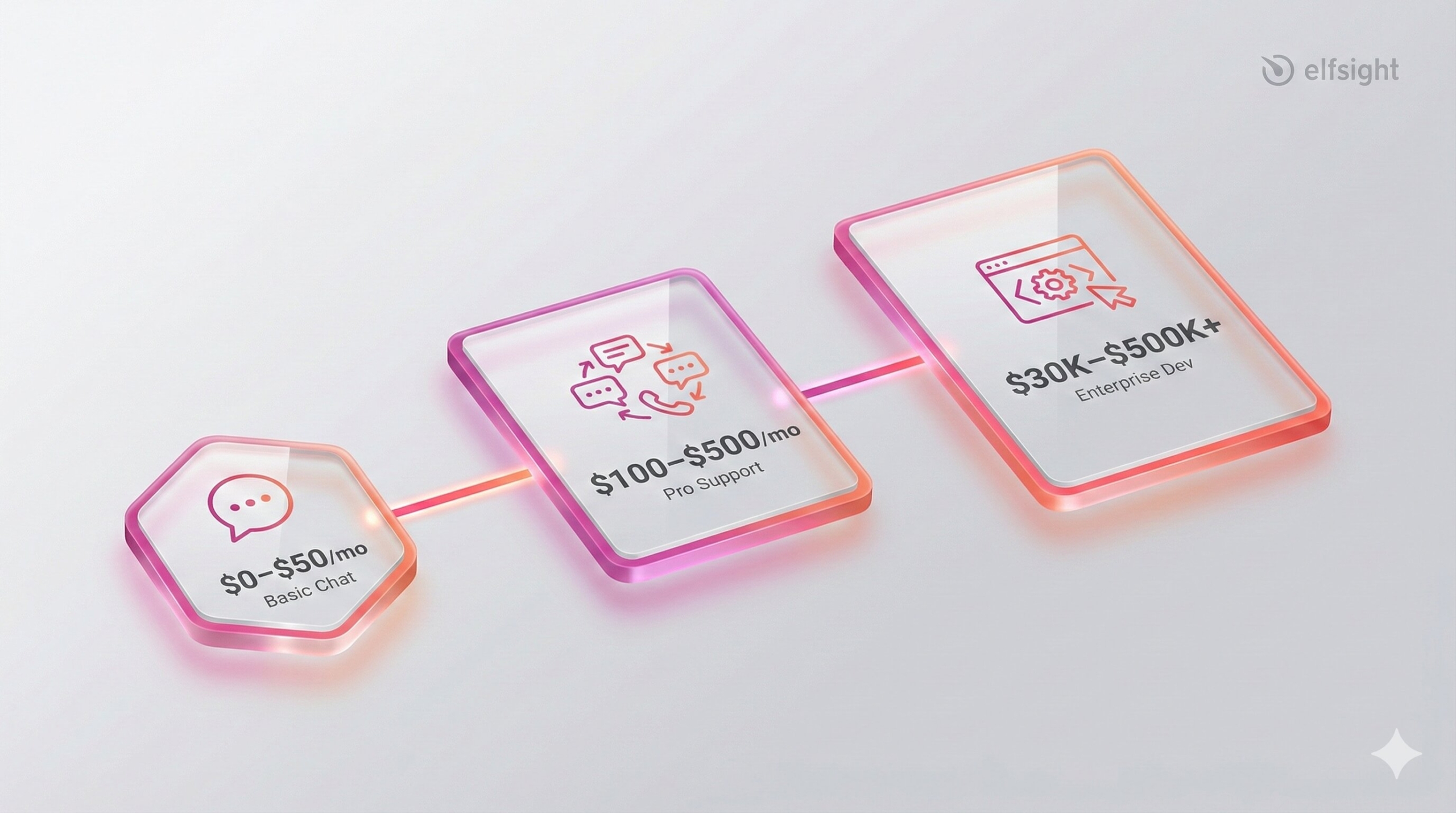
The entry tier starts at zero
Platforms like Elfsight, ManyChat, and Tidio offer free plans suitable for solopreneurs handling 50–200 conversations monthly. Paid plans range from $6 to $50 per month for micro-businesses needing straightforward automation.
The middle tier is where most SMBs land
SaaS chatbot platforms running $100–$500 monthly, once you account for actual features used. Intercom, Zendesk, Freshchat, and Crisp offer full customer service platforms with AI capabilities, CRM integrations, and omnichannel support. Advertised entry prices rarely reflect what you’ll pay once you add AI features, remove branding, and scale beyond starter limits.
The high end involves custom development
Agency-built AI chatbots cost $30,000–$150,000, with enterprise solutions reaching $200,000–$1,000,000. Annual maintenance runs 15–20% of the initial build cost – a $50,000 chatbot requires $7,500–$10,000 yearly just to stay current.
The rise of embedded generative AI features and outcome-based pricing has introduced new cost dynamics that benefit some businesses while creating budget unpredictability for others.
Three Pricing Tiers: Which One Fits Your Business?
Understanding which tier matches your operation prevents both overspending on features you don’t need and underspending in ways that force expensive platform migrations later.
Tier 1 — No-Code Widgets ($0–$50/Month)
No-code chatbot widgets require zero technical expertise. You configure them through a visual interface, paste an embed code on your website, and the chatbot appears.
Elfsight’s AI Chatbot uses view-based pricing: free for 200 page views per month – sufficient for small business websites with modest traffic, with paid plans at $6/month for 5,000 views, $12/month for 50,000 views, and $24/month for 150,000 views.
ManyChat offers a free plan with basic automation for 1,000 contacts. Their Pro plan is at $15/month, though GPT-powered features require a $29/month add-on. Chatfuel starts at $20/month for 1,000 conversations.
This tier suits solopreneurs, freelancers, and micro-businesses handling straightforward interactions: answering common questions, collecting contact information, and routing complex inquiries to human agents.
Tier 2 — SaaS Chatbot Platforms ($29–$500+/Month)
SaaS chatbot platforms offer sophisticated AI capabilities, omnichannel support, deep CRM integrations, and analytics dashboards. This is where growing businesses with dedicated support teams operate, and where chatbot subscription costs become more complex.
Tidio’s $29/month Starter plan becomes $97/month once you add Lyro AI ($39), Flows automation ($29), and branding removal ($20). Intercom charges $29–$132 per seat monthly, plus $0.99 per AI resolution. Freshchat offers a free plan for 10 agents with Freddy AI sessions at $0.49 each. Crisp provides flat-rate pricing at €95/month with unlimited conversations.
For a team of 3–5 people handling 2,000–5,000 monthly conversations with AI, realistic spend ranges from $150 to $800. These platforms integrate with existing tech stacks – Salesforce, HubSpot, Slack, Shopify – and support multiple channels simultaneously (website chat, Facebook Messenger, WhatsApp, Instagram, and SMS).
Tier 3 — Custom Chatbot Development ($5,000–$500,000+)
Custom development makes sense when your requirements exceed what platforms can deliver or when compliance regulations demand proprietary infrastructure.
Chatbot development cost breaks down as follows: North American agencies charge $100–$200 per hour, while offshore agencies charge $20–$50 hourly. A simple rule-based chatbot costs $5,000–$30,000, whereas an AI-powered chatbot with NLP runs $75,000–$150,000. Enterprise-grade solutions with deep system integrations, custom machine learning, and compliance features may reach $200,000–$1,000,000.
The upfront cost is only part of the equation. Chatbot maintenance cost adds significant ongoing expenses – that $50,000 chatbot requires $7,500–$10,000 per year for security patches, updates, model retraining, and integration maintenance as your other systems evolve. Add infrastructure costs: cloud hosting ($200–$1,000/month), LLM API fees (typically $50–$300/month), vector databases for knowledge retrieval ($50–$500 monthly), and monitoring tools.
Custom builds suit businesses with unique workflows that platforms can’t accommodate, strict data sovereignty requirements, or those building chatbots as core product features.
Chatbot Pricing Comparison: 20+ Chatbots Side-by-Side
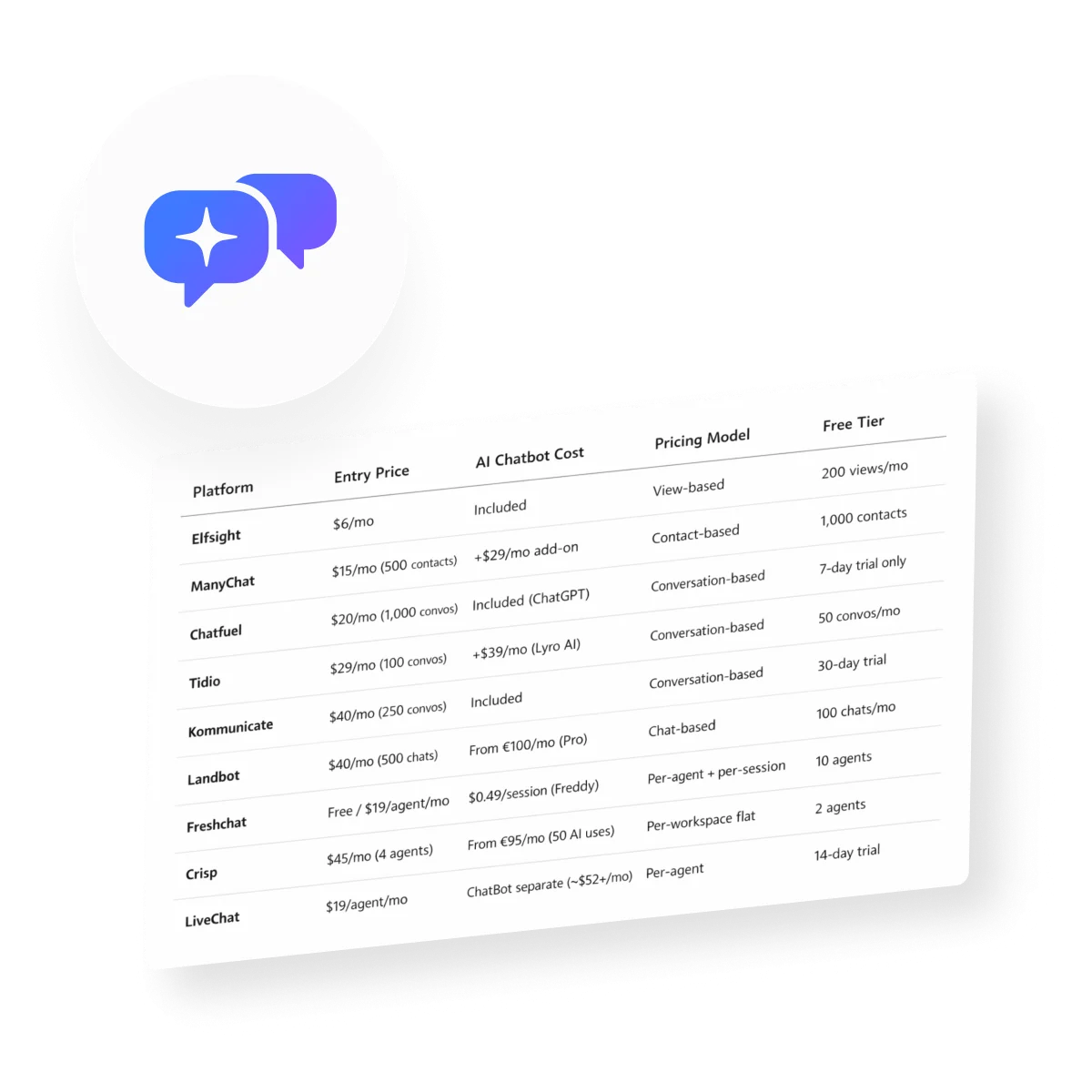
This comparison compiles verified AI chatbot pricing from official platform sources as of February 2026. All prices reflect monthly billing unless noted.
| Platform | Entry Price | AI Chatbot Cost | Pricing Model | Free Tier |
|---|---|---|---|---|
| Elfsight | $6/mo | Included | View-based | 200 views/mo |
| ManyChat | $15/mo (500 contacts) | +$29/mo add-on | Contact-based | 1,000 contacts |
| Chatfuel | $20/mo (1,000 convos) | Included (ChatGPT) | Conversation-based | 7-day trial only |
| Tidio | $29/mo (100 convos) | +$39/mo (Lyro AI) | Conversation-based | 50 convos/mo |
| Kommunicate | $40/mo (250 convos) | Included | Conversation-based | 30-day trial |
| Landbot | €40/mo (500 chats) | From €100/mo (Pro) | Chat-based | 100 chats/mo |
| Freshchat | Free / $19/agent/mo | $0.49/session (Freddy) | Per-agent + per-session | 10 agents |
| Crisp | €45/mo (4 agents) | From €95/mo (50 AI uses) | Per-workspace flat | 2 agents |
| LiveChat | $19/agent/mo | ChatBot separate (~$52+/mo) | Per-agent | 14-day trial |
| Botpress | $0 + AI Spend | $5 free credit; usage-based | Subscription + usage | 500 msgs/mo |
| Voiceflow | $60/mo/editor | Usage credits | Per-editor + credits | 100 credits |
| Intercom | $39/seat/mo | +$0.99/resolution (Fin) | Per-seat + per-resolution | 14-day trial |
| Zendesk | $55/agent/mo (Suite) | +$1.50/resolution; +$50/agent AI | Per-agent + per-resolution | 14-day trial |
| HubSpot | $20/seat/mo (Starter) | From ~$500+/mo (Professional) | Per-seat/per-Hub | Basic bots |
| Drift (Salesloft) | ~$2,500/mo est. | Bionic chatbot ~$10K/yr add-on | Contact sales | None |
| Ada | ~$30,000/yr minimum | Custom | Contact sales | None |
Freshchat offers the strongest entry point with a genuinely free plan supporting 10 agents plus 500 free Freddy AI sessions. Intercom pioneered per-resolution pricing with its Fin AI Agent, resolving over 1 million support tickets per week at an average resolution rate of 66% ($0.99/resolution). Zendesk follows a similar model at $1.50 per automated resolution, with 5–15 free monthly resolutions per agent, plus an optional $50/agent/month Advanced AI add-on.
Elfsight’s view-based pricing offers a predictable alternative to conversation or resolution models, scaling based on page loads rather than message volume, making costs easier to forecast for businesses where chatbot usage varies but traffic remains consistent.
Hidden Costs That Double Your Real Chatbot Price
The sticker price on a platform’s pricing page is rarely what SMBs actually pay. Several cost categories consistently surprise buyers and can double or triple the advertised monthly rate.
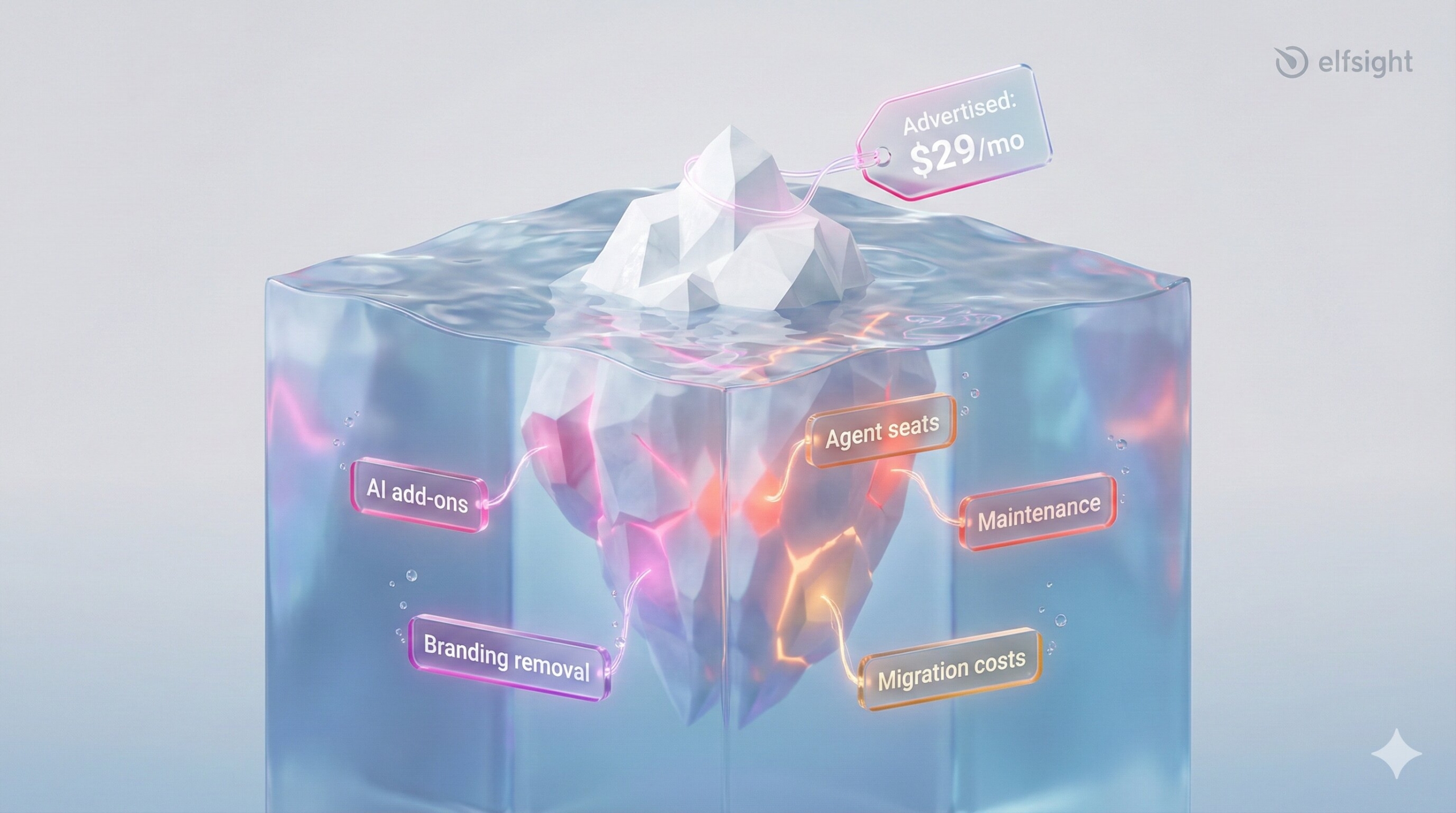
AI and LLM Token Costs
Platforms like Botpress and custom builds pass through LLM costs directly. GPT-4o-mini processes a typical conversation for roughly $0.004–$0.005, meaning 5,000 monthly conversations cost just $20–$75 in API fees. The premium GPT-4o model runs about $0.075 per conversation ($375–$750 monthly at 5,000 conversations). For most SMB volumes, raw API costs are negligible – but choosing the wrong model can unnecessarily inflate costs by 10–20x.
Add-On Stacking
Most platforms separate core features from premium capabilities, meaning the entry price covers basic functionality, while advanced features require add-ons. Tidio’s $29/month Starter plan, for example, becomes $117/month when you add Lyro AI ($39), Flows automation ($29), and branding removal ($20). Intercom’s 5-person team on the Advanced plan starts at $425/month for seats, with additional costs for Fin AI resolutions ($990 for 1,000 resolutions), Copilot ($175), and Proactive Support ($99) – bringing the total to approximately $1,689/month.
Maintenance and Knowledge Base Upkeep
Custom builds require 15–20% of the initial build cost annually for updates, security patches, and model tuning – unmaintained chatbots degrade as your business, products, and systems evolve.
Even SaaS users must invest 5–15 hours monthly for training data preparation, conversation flow updates, and accuracy monitoring. Vector database costs for RAG implementations start at $50/month (Pinecone Standard). Integration maintenance for custom builds runs $500–$1,500/month, depending on complexity.
Human Handoff Staffing
No AI chatbot achieves 100% automation. Even Intercom’s Fin – one of the highest-performing AI agents in the market – resolves roughly 51–65% of conversations autonomously. The remaining 35–49% require human agents, and each live agent seat adds $29–$169/month plus salary. Budget for at least one human agent for every chatbot deployment: the cost savings come from handling more conversations with fewer agents, not from eliminating agents entirely.
Per-Resolution Pricing: The New Cost Model Reshaping the Market
Chatbot pricing models are evolving: traditional per-seat subscriptions are giving way to outcome-based pricing, where vendors charge only when their AI successfully resolves a customer issue. This model aligns costs with value – you pay only for results. But it introduces budget unpredictability that flat subscriptions avoid.
An e-commerce company averaging 2,000 AI resolutions monthly on Intercom Fin pays approximately $1,980 in resolution fees. A product recall or viral social media incident could spike volume to 10,000 resolutions, sending that single line item to ~$9,900 in a single month.
For SMBs with predictable traffic, flat-rate platforms offer the most budget certainty. For businesses with highly variable volume, per-resolution pricing can be cheaper during slow periods but requires careful monitoring and volume commitments to manage spikes.
Free Chatbot Tiers: What You Actually Get (and When You’ll Outgrow Them)
Nearly every major platform offers a free tier. These typically include a basic live chat widget, rule-based flows (5–10 templates), 1–3 operator seats, and 50–1,000 conversations monthly, limited to the website only. The most generous free tiers come from Freshchat (10 agents), ManyChat (1,000 contacts), and HubSpot (basic bots with CRM integration). Elfsight stands out by including AI capabilities in its free tier, while most platforms require paid plans or per-use fees for AI features.
Most growing SMBs outgrow free tiers within 1–3 months. The typical triggers:
- Exceeding 50–200 conversations per month
- Needing a second channel beyond website chat
- Requiring CRM integration to route leads properly
- Removing “Powered by [Platform]” branding
The first meaningful paid tier across the market clusters around $20–$50 monthly. Migration costs if you later switch platforms can run $3,500–$17,000 according to vendor estimates, making the initial platform choice more consequential than the entry price suggests.
Chatbot ROI: Do the Cost Savings Actually Materialize?
“By 2029, agentic AI will autonomously resolve 80% of common customer service issues without human intervention, leading to a 30% reduction in operational costs.” — Gartner
The per-interaction cost comparison is stark: a chatbot interaction averages roughly $0.50 versus $6.00 for a human agent – a 12x cost advantage. This calculation includes platform costs, LLM API fees, and amortized setup costs against the fully loaded cost of a human agent (salary, benefits, training, management overhead, and infrastructure).
Real-world case studies demonstrate significant returns at scale. Klarna’s AI assistant handled 2.3 million conversations in its first month – equivalent to the work of 700 full-time agents – cutting resolution time from 11 minutes to under 2, and generating an estimated $40 million in profit improvement in 2024. Vodafone’s TOBi chatbot resolves 70% of customer inquiries, resulting in a 70% reduction in cost per chat.
The strongest evidence of chatbot cost savings comes from enterprise deployments and vendor-commissioned studies, but conducting a rigorous chatbot cost benefit analysis for SMBs is more challenging. A practical SMB break-even calculation: a business receiving 1,000 support requests per week that automates 80% at a manual cost of $3 per interaction saves approximately $2,400 per week, or $124,000+ annually, easily justifying even premium chatbot subscriptions.
For deeper insights on AI implementation in customer service, including strategic deployment approaches, explore our comprehensive guide.
What a Chatbot Actually Costs: Three Real-World Scenarios
Abstract pricing models become clearer through realistic scenarios matching common SMB profiles.
Scenario 1 — Solopreneur or micro-business
If you handle under 500 conversations/month, use a free or entry-level tool. Elfsight ($6–$12 monthly), ManyChat free tier, or Tidio’s free plan handle basic needs. Upgrade to a $29–$50 monthly paid plan when branding removal or AI features become necessary.
Realistic annual cost: $0–$600.
Scenario 2 — Growing SMB
For 2,000–5,000 conversations/month with 3–5 agents, a platform-based solution is optimal. Tidio with Lyro AI runs $100–$200/month. Freshchat Pro with Freddy AI sessions costs roughly $250–$400/month. Intercom Essential with Fin at 2,000 resolutions monthly totals approximately $400–$600/month. Crisp Essentials at €95/month with unlimited conversations offers the most cost-predictable option.
Realistic annual cost: $1,200–$7,200.
Scenario 3 — Mid-market SMB building a custom solution
With 5,000+ conversations/month, opt for a platform like Botpress or Voiceflow for the builder ($89–$150 monthly), a freelancer for setup ($2,000–$10,000 one-time), plus GPT-4o-mini API costs ($20–$75 monthly for 5,000 conversations) and vector database ($50–$150 monthly).
Realistic total: $2,000–$10,000 upfront plus $160–$375 monthly ongoing.
Frequently Asked Questions
How much does it cost to build a chatbot?
What are the monthly costs for an AI chatbot?
What is the most cost-effective chatbot pricing model?
Do chatbot costs include AI language model fees?
What hidden costs should I budget for?
How much can a chatbot reduce customer service costs?
Choosing the Right Chatbot for Your Budget
The chatbot market offers genuine options at every budget level, but the gap between advertised and actual costs remains the biggest trap for SMB buyers. Sticker prices on SaaS platforms frequently double or triple once AI add-ons, additional conversation quotas, and branding removal are factored in. The industry’s shift toward per-resolution pricing aligns cost with value but introduces budget volatility that flat-rate alternatives deliberately avoid.
Start with the tier that matches your current volume, plan for hidden costs that inflate advertised prices, and choose platforms with transparent pricing to avoid expensive migrations later. The right chatbot investment isn’t about finding the cheapest option; it’s about finding the one that reduces operational costs more than it costs to operate.