
Geolocation services are essential for ecommerce and many other business sectors, which is why Google Maps became the default choice for so many website owners. After it raised its rates, though, a lot of us started looking for alternative mapping services. This article walks through the most popular alternatives and what each one offers.
Why Look for Google Maps alternatives
A Maps API is a ready-made interface for working with location-based services. It lets you add location data, maps, routing, and other geo features to a website or app.
Google Maps API is the most popular of these. In 2018, though, it cut its free usage limits by roughly 30 times, raised prices, and introduced a strict API-key requirement tied to a billing-enabled account.
Previous 25,000 free displays per day have become 28,000 ones per month with charge of $7 extra for each subsequent 1,000.
That change gave many businesses a reason to look elsewhere. The upside is that those higher prices spurred growth in open-source mapping, so today you have far more geocoding API options to choose from.
TOP 5 alternatives vs. Google Maps
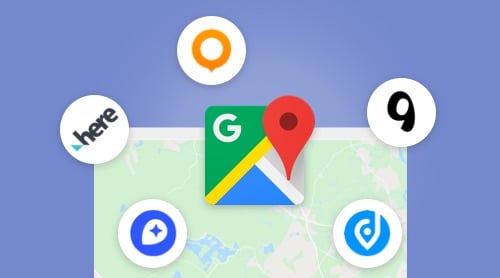
The Elfsight team compared the main features of popular open-source and commercial alternatives to Google Maps. Here’s the shortlist of location-based services worth knowing.
Alternative #1: OsmAnd
OsmAnd is a maps and navigation app built on OpenStreetMap, an open-data platform inspired by Wikipedia. OpenStreetMap is an editable map whose data is collected by a community of mappers and ground surveys. The app works on the web and offers highly detailed maps with routes, voice guidance, place information, and traffic data.

- Price: Free; $1.99 (month); $3.99 (3 months); $7.99 (year)
- API tools: location, trip recording, distance measurement, POIs info (provided by Wikipedia), different overlays like touring/navigation GPX tracks.
- Features: #opendata, #navigation, #tile, #vector, #overlays, #daily updates, #voice-guidance, #SDK
Alternative #2: Mapbox
Mapbox is one of the main alternatives to Google Maps, originally developed as a customizable mapping tool for websites and apps. Most of its data comes from open-source mapping communities such as OpenStreetMap, USGS, and Landsat. Its main strength is the ability to integrate maps with other tools like Directions, Geocoding, Static Images, and even augmented reality (AR) navigation.

- Price: Free (50,000 requests) – $5/month (100,000 requests)
- API tools: live updating maps, navigation with augmented reality (AR) mode and guidance, tools for automated driving experience.
- Features: #opendata, #vector, #tile, #SDK, #place-based AR, #live-update, #satellite
Alternative #3: JawgMaps
If you need a Maps API alternative that’s adjustable and mobile-friendly, JawgMaps is worth a try. The tools are easy to customize, and you can pick whichever SDK fits your needs. Alongside mapping, geolocation, routing, and elevation data, you can also track real-time stats and analyze your map usage.

- Price: Free (50,000 requests) – €500/month (1,000,000)
- API tools: geolocation search, real-time statistics for all services, routing, navigation guidance, near location and POI definition, and elevation data.
- Features: #opendata #pixel #tile #vector #SDK #routing, #navigation #guidance #elevation #mobile-friendly #real-time metrics.
Alternative #4: HERE
HERE offers an impressive range of mapping tools and geo solutions. You’ll find products for fleet performance, location-based advertising, routing, real-time traffic insight, and other business needs.

- Price: Free (250,000 requests) – Pro $449/month (1,000,000 requests).
- API tools: navigation with augmented reality (AR), fleet telematics, high-precision maps, location advertising, tracking, routing
- Features: #tile, #vector, #AR, #SDK, #POI database, #logistics, #mobile-friendly, #user-tailored
Alternative #5: GraphHopper
GraphHopper is an open-data routing library based on OpenStreetMap. It helps optimize routes and navigation for logistics services, supports commercial use through its API, and improves POI search. It also includes handy tools like Map Matching and Matrix Calculations.

- Price: Free (15,000 requests) – €304/month (1,500,000 requests).
- API: route-planning, navigation with time distance and guidance, fleet and logistics tracking, location-based and POI search.
- Features: #open-source #directions #routes #POI #SDK
Main Features of Google Maps API competitors
The table below summarizes the main strengths of each Google Maps alternative side by side, so you can compare features and pick the best fit for your website or app.
The table below summarizes the main strengths of each Google Maps alternative side by side, so you can compare features and pick the best fit for your website or app.
| OsmAnd | Mapbox | JawgMaps | HERE | GraphHopper | Google Maps | |
|---|---|---|---|---|---|---|
| Free requests/month | unlimited | 50,000 | 50,000 | 250,000 | 15,000 | 28,000 |
| Paid plans (from) | $1.99 | $5 | $250 | $449 | $48 | $7 / 1,000 calls |
| Types of maps | tile, vector | tile, vector | tile, vector | tile, vector | vector only | tile, vector, satellite |
| Open-source data | ✅ | ✅ | ✅ | ❌ | ✅ | ❌ |
| Business geocoding | ✅ | ❌ | ✅ | ✅ | ✅ | ✅ |
| Navigation | ✅ | ✅ | ✅ | ✅ | ✅ | ✅ |
| Voice guidance | ✅ | ❌ | ❌ | ✅ | ❌ | ✅ |
| Traffic insights | ❌ | ✅ | ❌ | ✅ | ❌ | ✅ |
| Layers | ✅ | ✅ | ✅ | ✅ | ✅ | ✅ |
| GPX tracks | ✅ | ✅ | ❌ | ✅ | ✅ | ✅ |
| Street view | ✅ | ❌ | ❌ | ✅ | ❌ | ✅ |
| POI search | ✅ | ✅ | ✅ | ✅ | ✅ | ✅ |
| Custom design | ❌ | ✅ | ✅ | ✅ | ❌ | ✅ |
| Update frequency | daily | daily | daily | no info | no info | daily |
| Augmented reality | ❌ | ✅ | ❌ | ✅ | ❌ | ✅ |
| Map usage stats | ❌ | ❌ | ✅ | ✅ | ❌ | ✅ |
Haven’t found your favourite service listed? Email us and we’ll be happy to add it.
Listing variants are not the only solution for your business or logistics needs. And there are plenty of alternatives to the Google Maps API, even cheaper than the option presented, but they require some coding skills. Try the following free open-data tools: Leaflet, OpenTools, Mapfit, LocationIQ, rasters.io, Sygic Maps, and others.
For further reading, see how to add Google Reviews to your website.
Conclusion: Pros and Cons of Alternative Maps Services
Open spatial data sources like OpenStreetMap are convenient and free to use. So is there any downside to open-data mapping, or has Google Maps API become pointless?
- First, open data is built by volunteer mappers who want to contribute and improve these services. That cuts both ways: some locations have richer, more accurate data than even Google Maps (pedestrian lanes, parking spots), while remote or isolated areas can be sparsely mapped.
- Second, a lot of the data isn’t authoritative or fully up to date. Some of it is verified at a national level with daily updates or traffic insight, but the quality often depends on how active the volunteer community is.
- Third, customization and analytics aren’t the strong suit of these services, and neither are ad campaigns or POI search. Several Google Maps competitors solve these gaps, but their subscription plans usually aren’t cheaper than Google’s own rates.
If your call volume is much higher and cost is a real concern, it’s worth exploring the open-source alternatives and embedding one on your site. Keep in mind, though, that their data quality and reliability may not always match Google’s, so aim to give users accurate, trustworthy information wherever you can.
A No-Code Store Locator for Your Locations
The five services above are full mapping APIs, built for developers who need geocoding, routing, and raw map data. Plenty of businesses looking for a Google Maps alternative don’t actually need that. They need to show their stores, branches, or service points on a website without writing code or enabling billing, and for that, a ready-made widget is a simpler fit than any API.
Elfsight’s Store Locator is a no-code widget that puts multiple business locations on an interactive map with a searchable, filterable list beside it. Visitors search by address, ZIP code, or name, and can share their location to sort by distance to the nearest spots. Each location opens a detailed card with contact info, business hours, and open or closed status, photos, and action buttons.
Build your store locator in the interactive editor ↓
What you can do with it
It’s built for the practical side of displaying locations rather than for raw map data, so the core capabilities cover most small-business mapping needs:
- Add locations in two ways: auto-fetch details from Google Maps by name or address, or bulk-import up to 1,000 via CSV.
- Let visitors filter locations by Open Now, categories, and tags, shown inline or in a side panel.
- Match your site with custom marker colors, a brand icon, adjustable fonts, and a choice of map color schemes.
- Attach action buttons to each location, including Call, Directions, WhatsApp, Booking.com, OpenTable, Yelp, and Uber Eats.
- Show the distance to every location once a visitor shares their position.
When it’s the right fit
Because the widget installs by pasting a snippet, there’s no API key, no billing setup, and no request quota to track. The limit is monthly widget views rather than API calls, and the free plan covers a single widget with Elfsight branding, while paid tiers scale views, locations, and support. The displayed map renders on open, OpenStreetMap-based tiles; Google Maps is used only to look up location details and to power the “Open in Google Maps” directions link.
That makes the choice straightforward. Reach for one of the APIs above when you need live traffic, Street View, or Google’s exact basemap inside a custom build. Choose the widget when your real goal is getting accurate, branded location info onto your page quickly, without code or a metered API bill.