
ChatGPT has gone from a research preview to a mainstream tool used by 900 million people every week. In just over three years, it reshaped how individuals and businesses interact with AI — and the numbers behind that shift are worth understanding, whether you’re building a product, making a business case, or simply tracking where this technology is headed.
This article compiles the most current ChatGPT statistics covering growth, usage, revenue, demographics, and competitive positioning.
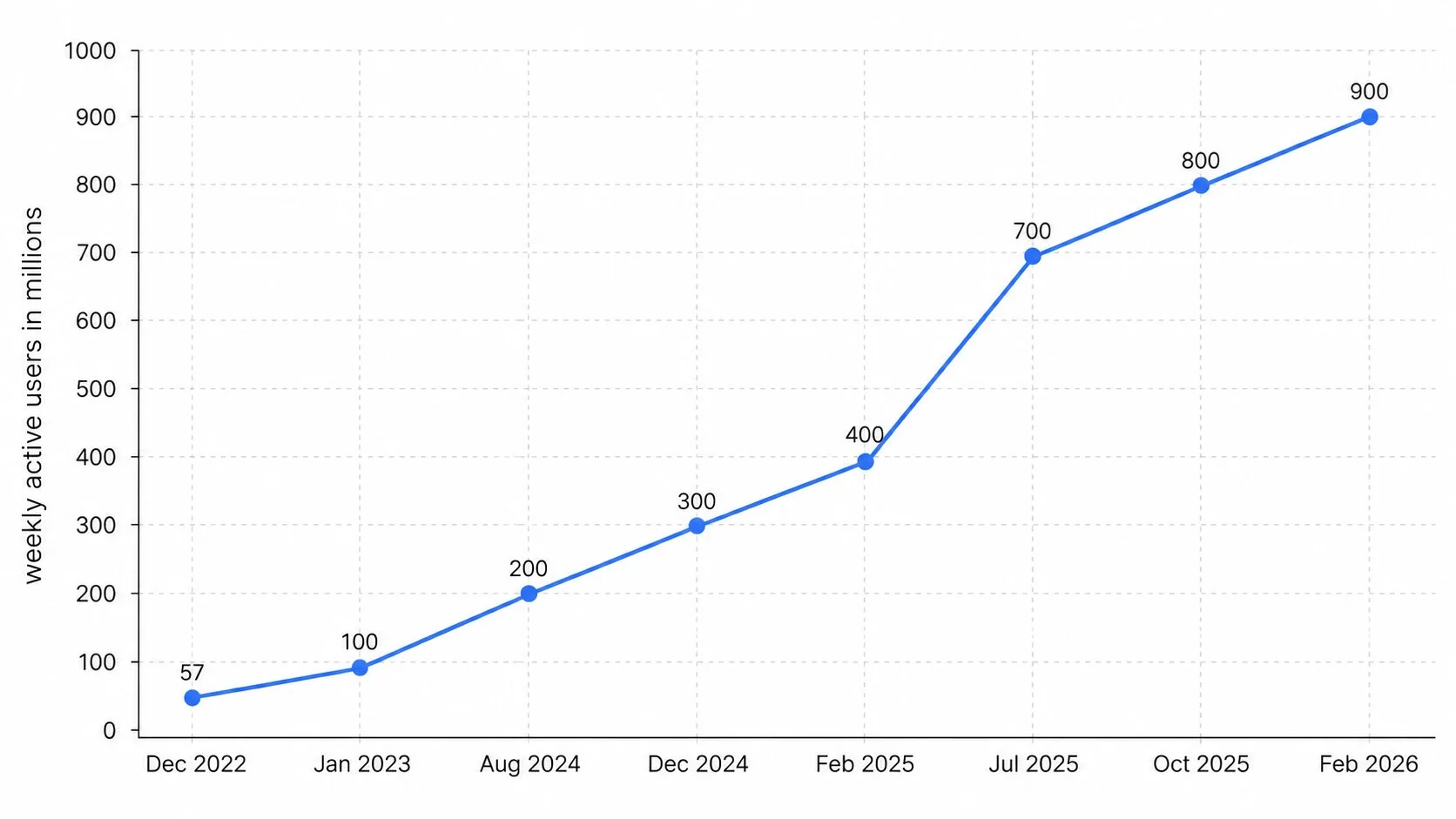
- 900 million weekly active users as of February 2026, up from 300 million in December 2024
- ~5.5 billion monthly web visits (April 2026, SimilarWeb)
- $25 billion annualized revenue; 50 million paid subscribers
- 2nd most downloaded app globally in 2025; first app ever to hit 1 billion cumulative downloads
- 73% of consumer ChatGPT usage is non-work-related
- ChatGPT holds ~80% of AI-chatbot web traffic — but mobile share has fallen below 50%
Key ChatGPT Statistics
ChatGPT’s growth has accelerated sharply since late 2024, with user counts tripling in just over a year and engagement metrics holding strong even as the audience broadens.
A record-breaking user base
Within five days of its launch in November 2022, ChatGPT reached 1 million users — at the time, the fastest user acquisition in digital history. (Meta’s Threads has since broken this record, reaching 1 million users within approximately one hour of its July 2023 launch.)
As of February 2026, ChatGPT has approximately 900 million weekly active users, tripling from 300 million at the end of 2024. Users collectively send approximately 2.5 billion prompts per day as of mid-2025 — equivalent to roughly 18 billion messages per week. OpenAI has not published an updated daily volume figure since July 2025, though usage has grown significantly since then.
Strong engagement metrics
ChatGPT users spend an average of 5 minutes and 52 seconds per session (April 2026), with visitors exploring an average of 3.55 pages per visit (April 2026, SimilarWeb). Session duration has trended slightly down over the past year as the user base has broadened to include more casual users — a sign of mainstream adoption rather than declining engagement.
ChatGPT’s bounce rate sits at 33.47% (April 2026, SimilarWeb), meaning roughly two-thirds of visitors engage beyond their initial entry point. This is an improvement from 37.07% in late 2024, indicating stickier engagement as the platform matures.
ChatGPT traffic
ChatGPT.com received approximately 5.5 billion monthly visits as of April 2026 (SimilarWeb), up from roughly 3.7 billion in December 2024. The platform’s peak so far was approximately 6.1 billion visits in October 2025, with some seasonal variation — December typically dips, while January and March tend to rebound.
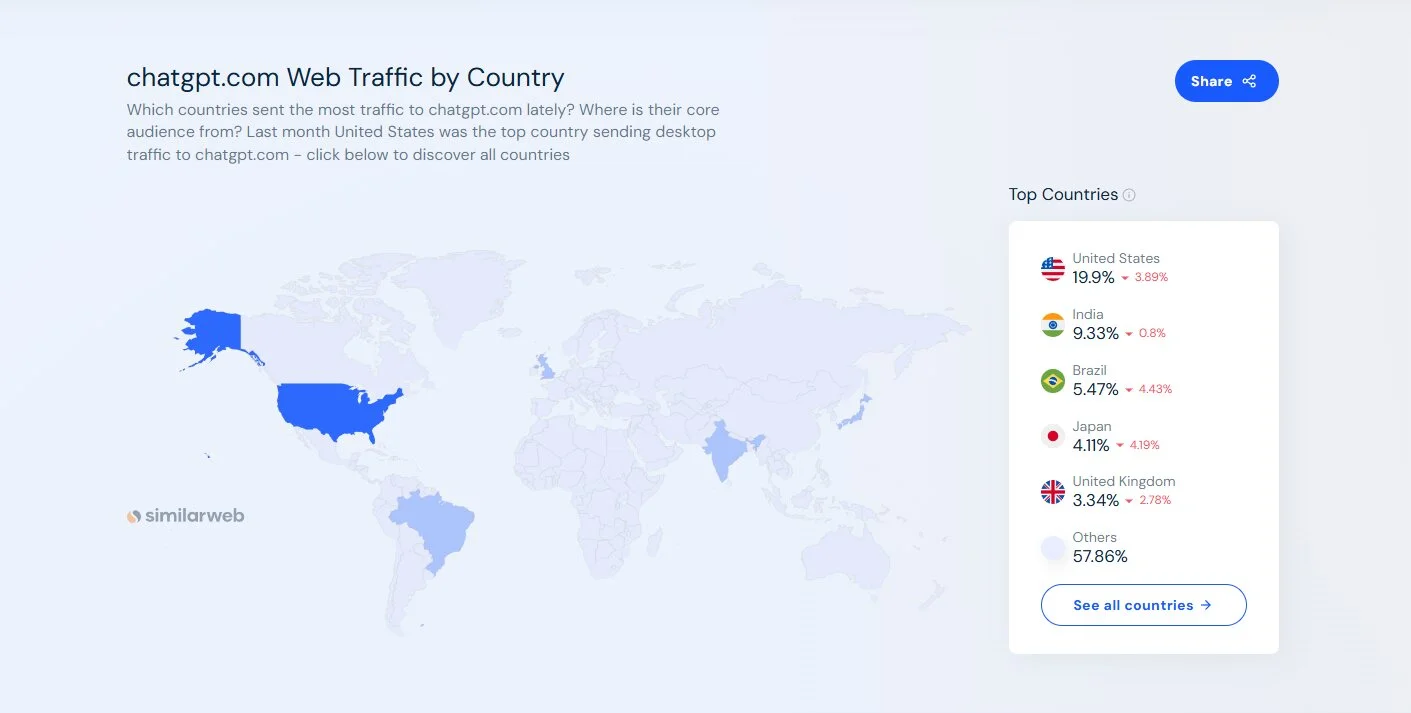
Geographically, the United States accounts for 19.9% of traffic, followed by India at 9.33%, Brazil at 5.47%, Japan at 4.11%, and the United Kingdom at 3.34% (SimilarWeb). The US share has declined slightly from 17% in late 2024 as global adoption broadens, while India and Brazil have held steady.
ChatGPT’s traffic is largely driven by organic search and direct visits, reflecting strong brand recognition and habitual use. Social media platforms and word-of-mouth recommendations continue to drive discovery, particularly in markets where ChatGPT adoption is still accelerating.
The road to 1 billion
In late 2024, projections suggested ChatGPT would surpass 1 billion users by the end of 2025. That didn’t happen — but growth was still extraordinary. As of February 2026, ChatGPT has reached 900 million weekly active users, growing from 300 million to 900 million in just 14 months. OpenAI stated in its February 2026 announcement that it expects to be “soon the fastest platform to 1 billion weekly active users.”
It’s worth noting that ChatGPT’s mobile app did cross 1 billion cumulative downloads in July 2025 — but cumulative downloads and weekly active users are different metrics and should not be conflated. As ChatGPT becomes a primary discovery tool for hundreds of millions of users, the question for businesses shifts from how to use it to whether it mentions them at all. This breakdown of why businesses don’t appear in ChatGPT responses explains the mechanics behind it.
ChatGPT Growth Timeline
ChatGPT’s trajectory from a free research preview to a platform with 900 million weekly users spans just over three years. The timeline below captures the key product milestones and user growth inflection points.
Launch and early adoption
- November 30, 2022: ChatGPT officially launched as a free-to-use AI chatbot. Within 5 days, it reached 1 million users — an achievement that signaled immediate, massive demand for conversational AI.
- December 2022: By the end of its first month, ChatGPT had garnered approximately 57 million users, fueled by organic interest and global media coverage.
When did ChatGPT become popular?
ChatGPT’s popularity surged in early 2023, particularly after users started sharing creative and practical use cases on social media. The viral nature of these posts — from writing entire essays to debugging complex code — made it a trending topic across technology, education, and productivity circles. Free accessibility, broad functionality, and the novelty of conversational AI at this level all contributed.
ChatGPT usage over time
The table below tracks ChatGPT’s key milestones from launch through early 2026, including product updates and user growth markers.
| Date | Milestone | Details |
|---|---|---|
| November 30, 2022 | ChatGPT Launch | OpenAI launched ChatGPT to the public as a free research preview, quickly gaining attention for its conversational AI capabilities. |
| December 5, 2022 | 1 Million Users | ChatGPT reached 1 million users within just 5 days, setting a record for rapid adoption of an AI platform. |
| January 2023 | 100 Million Users | ChatGPT surpassed 100 million monthly active users, becoming the fastest-growing platform in history. |
| February 1, 2023 | ChatGPT Plus | OpenAI introduced ChatGPT Plus, a subscription plan priced at $20/month, offering faster response times, priority access, and later GPT-4. |
| March 14, 2023 | GPT-4 Release | OpenAI launched GPT-4, a major update that brought multi-modal capabilities, improved reasoning, and greater contextual understanding. |
| March 2023 | ChatGPT Plugins | OpenAI implemented plugins for ChatGPT, including browsing, file uploads, and API integration, allowing users to expand its functionality. |
| May 2023 | iOS App Release | OpenAI launched the official ChatGPT app for iOS devices, making the chatbot accessible on mobile platforms for the first time. |
| July 2023 | Android App | The ChatGPT app became available for Android users, further broadening its global reach. |
| July 2023 | Custom Instructions Feature | OpenAI added the “custom instructions” feature, letting users personalize ChatGPT’s interaction style. |
| September 2023 | Multi-Modal and Voice Capabilities | GPT-4 gained image processing abilities and voice interactions, enabling users to upload visual content and have spoken conversations. |
| November 2023 | First Developer Conference | OpenAI hosted its first developer conference, unveiling new APIs to help developers integrate ChatGPT into apps and services. |
| August 2024 | 200 million weekly active users | OpenAI confirmed that ChatGPT had consistently surpassed 200 million weekly active users. |
| July 2025 | 700 million WAU | Growth accelerated to 700 million weekly active users; OpenAI reported 2.5 billion prompts per day. |
| February 2026 | 900 million WAU, 50M Paid Subscribers | OpenAI announced 900 million weekly active users and 50 million paid subscribers, tied to a $110 billion funding round. |
ChatGPT growth drivers
- Ease of access. Launching as a free tool reduced barriers globally. The addition of a free tier even after Plus launched (and later Go, a lower-priced plan for emerging markets) kept the funnel wide.
- Community-driven discovery. Viral examples of ChatGPT applications — from coding to creative writing to exam preparation — spurred experimentation across demographics.
- Frequent product updates. OpenAI’s regular upgrades, including the ChatGPT API integration, multi-modal input, voice mode, and agentic features like Codex, kept the platform’s capabilities expanding faster than competitors could match.
Current model lineup
Since its initial launch with GPT-3.5, ChatGPT has gone through multiple model generations. The current lineup (as of May 2026) runs on the GPT-5 family, with GPT-5 scoring 92.5% on MMLU and setting new state-of-the-art results across math, coding, and multimodal benchmarks. Free users get GPT-5.3 Instant, while paid subscribers access GPT-5.4 and GPT-5.5.
The growth of ChatGPT reflects how quickly conversational AI has moved from a novelty to infrastructure. With 900 million weekly users and a model lineup that continues to advance, the platform’s trajectory is now less about whether adoption will continue and more about what it displaces next.
ChatGPT has quickly become a versatile tool, appealing to a broad spectrum of users from diverse demographics. Its accessibility, wide range of capabilities, and continuous improvements have made it an essential tool for various tasks.
ChatGPT Mobile App Growth
ChatGPT’s mobile story is one of the fastest app-growth trajectories ever recorded. According to Sensor Tower’s State of Mobile 2026 report, ChatGPT became the second most downloaded app globally in 2025, behind only TikTok — a remarkable position for a tool that didn’t have a mobile app until May 2023.
Downloads grew 148% year-over-year in 2025, while in-app purchase revenue grew 254% and total time spent in the app grew 426%. In July 2025, ChatGPT became the fastest app ever to reach 1 billion cumulative global downloads across iOS and Google Play.
On the revenue side, ChatGPT’s mobile app crossed $1.35 billion in 2025 — a 673% year-over-year jump that made it one of only three new apps (alongside CapCut and WeTV) to surpass $1 billion in in-app purchase revenue that year. These numbers reflect a broader shift: while ChatGPT.com still dominates web traffic, mobile is increasingly the primary entry point for new users, particularly in emerging markets.
ChatGPT User Demographics
ChatGPT’s user base has diversified significantly since its early days, when it skewed heavily toward young, male, tech-oriented users. As the platform approaches 1 billion weekly users, its demographic profile increasingly mirrors the broader internet population.
Who uses ChatGPT the most?
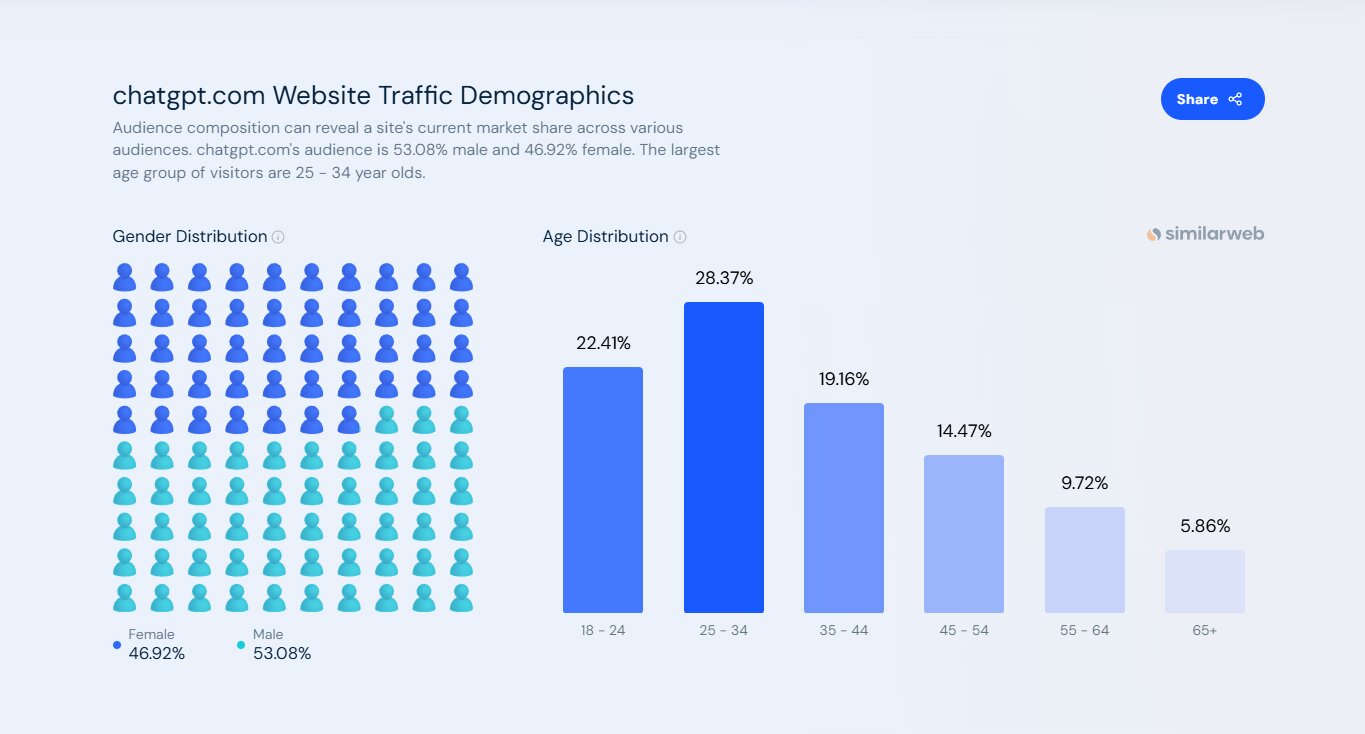
The largest age group among ChatGPT users is 25–34, accounting for 28.37% of the user base (SimilarWeb). The 18–24 age group follows at 22.41%, driven by student adoption and digital-native comfort with AI tools. Usage drops off progressively with age — 19.16% for 35–44, 14.47% for 45–54, and under 16% combined for 55 and above — though older cohorts have grown steadily as ChatGPT has become more mainstream.
Gender distribution
The gender gap has narrowed substantially. According to the SimilarWeb panel, ChatGPT’s audience is 53.08% male and 46.92% female — a significant shift from the roughly 66/34 split reported in early 2024. An OpenAI-commissioned NBER study found that among users with classifiable names, the share with feminine names rose from 37% in January 2024 to 52% by July 2025. This trend reflects ChatGPT’s expansion beyond its initial tech-heavy user base into broader consumer applications.
Workplace adoption has grown significantly, with marketing, technology, and education leading in usage. Employees commonly use ChatGPT for content creation, coding assistance, and streamlining administrative work.
How many Americans use ChatGPT?
According to Pew Research Center, 34% of U.S. adults had used ChatGPT as of early 2025, roughly double the share from 2023. Among adults under 30, that figure rises to 58%. In education, 26% of U.S. teens (13–17) use ChatGPT for schoolwork, up from 13% in 2023. A separate Pew survey found that about two-thirds of U.S. teens use AI chatbots in general, with roughly 30% using them daily.
Popular ChatGPT Use Cases
ChatGPT’s versatility is one of its key strengths, with users leveraging it for a wide range of personal, educational, and business tasks. The most authoritative data on how people actually use ChatGPT comes from an OpenAI-commissioned NBER study published in September 2025, which analyzed real usage patterns at scale.
What the data shows
The NBER study classified ChatGPT messages into three broad categories: 49% were “Asking” (information retrieval, guidance, recommendations), 40% were “Doing” (writing, coding, data analysis, and other task execution), and 11% were “Expressing” (creative writing, conversational use, emotional engagement). Roughly 75% of all conversations involve practical guidance, information retrieval, or writing tasks.
One finding that challenges assumptions about ChatGPT as a productivity tool: 73% of consumer ChatGPT usage is non-work-related (as of June 2025), up from 53% the prior year. Personal use — from meal planning to travel research to creative projects — now dominates the consumer side of the platform.
Education
ChatGPT is widely used in educational settings by students, teachers, and institutions. Its ability to provide personalized assistance and simplify complex concepts has made it a common tool in classrooms and self-directed learning.
- Homework help. Students use ChatGPT to generate ideas, summarize lengthy articles, and explain complicated topics in accessible terms, from scientific theories to historical events.
- Writing assistance. It helps students draft essays, write research papers, and create creative content, with real-time feedback on structure and clarity.
- Language learning. Learners practice conversational skills, get real-time grammar corrections, and use ChatGPT for translations, making it a resource for multilingual education.
- Tutoring and teaching. Teachers incorporate ChatGPT into lesson planning, quiz creation, and personalized student support.
Business
ChatGPT has become an essential tool for businesses, enabling professionals to automate processes, boost creativity, and enhance productivity across roles.
- Customer support. Companies use ChatGPT to automate responses to frequently asked questions, providing 24/7 assistance. For more complex issues, it supports representatives by drafting accurate, quick responses.
- Content creation. Marketers and content creators rely on ChatGPT to write blog posts, product descriptions, email templates, and ad copy.
- Market research. It helps professionals extract insights from complex reports, summarize market trends, and brainstorm business ideas tailored to their industry.
- Project management. Product managers use ChatGPT to draft specifications, create workflow templates, and streamline team communication.
- Internal communication. ChatGPT assists in crafting professional emails, internal memos, and meeting agendas.
Tech and software development
The tech industry has embraced ChatGPT for its ability to simplify programming and project management tasks. OpenAI’s Codex, an agentic coding tool built on the ChatGPT platform, reached 1.6 million weekly users by February 2026.
- Coding assistance. ChatGPT helps developers write, debug, and optimize code across programming languages, from quick scripts to complex system architecture.
- Error debugging. Developers use ChatGPT to identify and fix errors in code, saving hours of troubleshooting.
- Technical documentation. Teams use it to generate detailed documentation for software projects.
- AI-powered prototyping. It assists in brainstorming and creating initial code prototypes for new applications or features.
Marketing and social media
Marketing professionals and social media managers rely on ChatGPT to streamline content production and maximize creativity in campaigns.
- Content marketing. ChatGPT generates blog posts, long-form articles, and press releases, maintaining consistent and engaging output.
- Social media content. It helps draft posts, write captions, and develop creative ideas for campaigns.
- Ad copy and strategy. Marketers use it to test and create ad copy optimized for different platforms and audiences.
- SEO optimization. ChatGPT assists in keyword research and crafting meta descriptions to improve online visibility.
Healthcare
In the healthcare sector, ChatGPT has found applications that benefit both patients and providers. Its ability to process and present information accessibly makes it useful for communication and education.
- Patient communication. Healthcare professionals use ChatGPT to provide clear responses to patient questions about treatments, procedures, and health conditions.
- Medical training. ChatGPT supports medical students by breaking down complex concepts and generating study materials like quizzes or flashcards.
- Workflow optimization. By automating management and analysis of electronic medical records, ChatGPT streamlines workflows for clinical staff.
- Health education. It offers accessible information on health topics, promoting awareness and better self-care.
Customer service
ChatGPT is widely used in customer service to enhance efficiency and provide consistent support across channels.
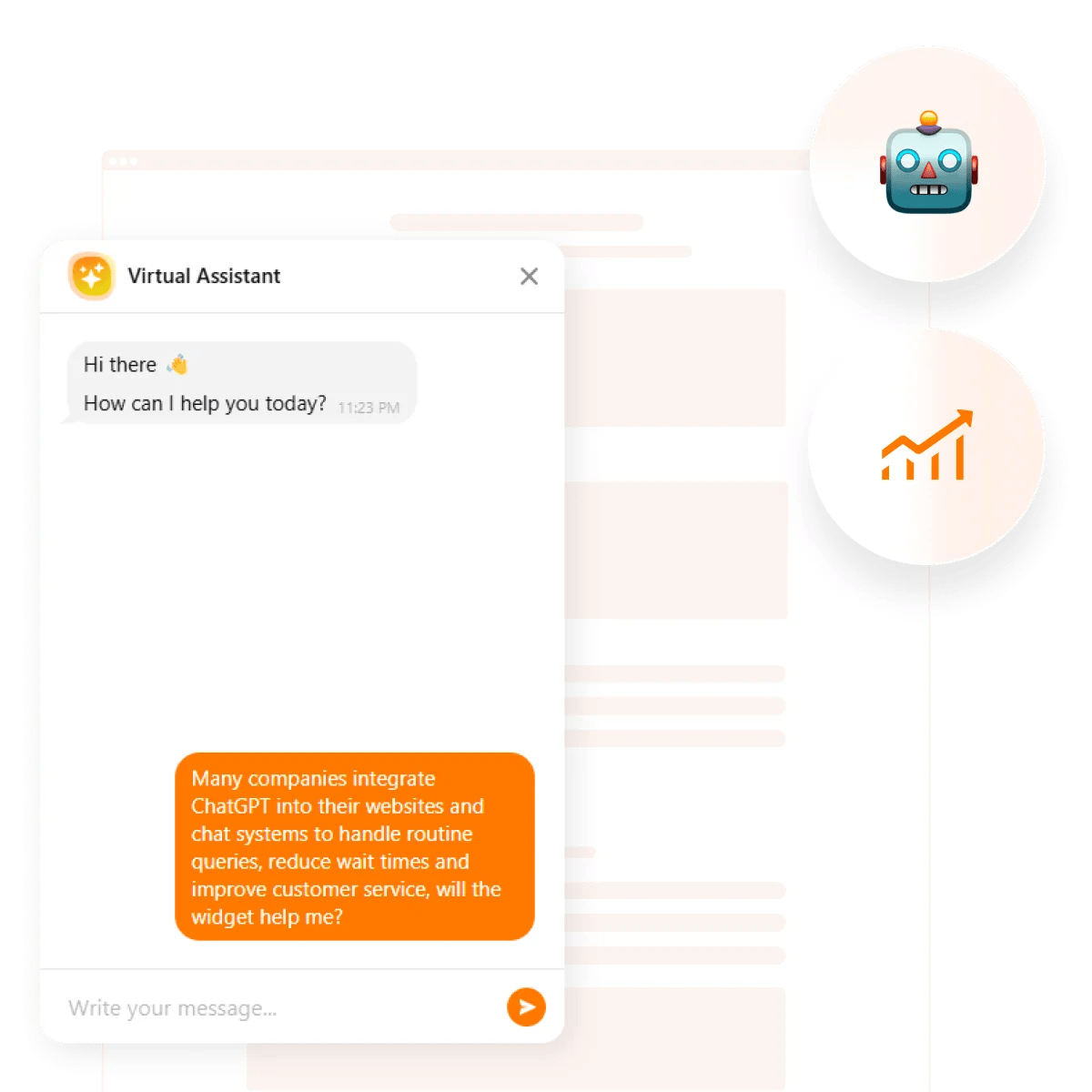
- Automated FAQs. Businesses integrate ChatGPT into their websites and chat systems to handle routine inquiries, reducing wait times and improving customer experience.
- Personalized assistance. Customer service representatives use ChatGPT to craft tailored responses for complex issues.
- Support documentation. It helps create detailed guides and FAQs, empowering customers to solve issues independently.
- Website chatbots. ChatGPT can be integrated into website chatbots to interact with customers in real-time, answering questions and resolving issues.
Build a GPT-powered AI chatbot in the interactive editor ↓
Personal tasks and entertainment
Beyond professional use, ChatGPT serves as a versatile personal tool. The NBER study’s finding that 73% of consumer usage is non-work-related reflects how deeply the platform has integrated into daily life.
- Personal assistant. Users rely on ChatGPT for reminders, to-do lists, schedule planning, and decision-making for personal projects.
- Learning and self-improvement. Many individuals use it for personal learning, from acquiring new skills to researching topics of interest.
- Entertainment. ChatGPT engages users by creating jokes, solving riddles, telling stories, and role-playing scenarios.
- Creative projects. People use ChatGPT for brainstorming and developing ideas for hobbies, crafts, or writing projects.
ChatGPT Revenue and Market Impact
ChatGPT has driven OpenAI’s transformation from a research lab into one of the fastest-growing technology companies in history. The financial trajectory — from approximately $2 billion in 2023 revenue to a $25 billion annualized run-rate by early 2026 — reflects how quickly the platform has scaled its monetization.
Revenue and financial milestones
OpenAI launched ChatGPT Plus in February 2023 at $20/month, establishing the subscription model that now anchors the company’s revenue. By mid-2023, Plus had attracted millions of subscribers. OpenAI’s full-year 2023 revenue reached approximately $2 billion; by end of 2024, that had grown to roughly $6 billion.
The acceleration continued into 2025 and 2026. OpenAI’s CFO confirmed $20 billion in annualized revenue by the end of 2025, with the run-rate exceeding $25 billion by February–March 2026 — approximately $2 billion per month. ChatGPT now has more than 50 million paid subscribers across its Plus, Pro, and Go tiers, alongside 9 million+ paying business users.
| Period | Approximate Revenue | Key Context |
|---|---|---|
| Full year 2023 | ~$2 billion | ChatGPT Plus launched February 2023; rapid subscriber growth |
| Full year 2024 | ~$6 billion | API adoption accelerated; GPT-4o and enterprise products launched |
| End of 2025 (ARR) | $20 billion | Confirmed by OpenAI CFO Sarah Friar |
| Feb–Mar 2026 (run-rate) | $25 billion+ | ~$2B/month; 50M paid subscribers; 9M+ business users |
Valuation milestones
OpenAI’s valuation has tracked its revenue trajectory. The company reached a $500 billion valuation through a secondary share sale in October 2025. In February 2026, it raised $110 billion in a funding round led by SoftBank (with Nvidia and Amazon participating) at a $730 billion pre-money valuation — making OpenAI the most valuable private company in the world.
ChatGPT’s market adoption
In the conversational AI market, ChatGPT established itself as the dominant consumer platform. OpenAI reported that 92% of Fortune 500 companies utilize its products, and the use of its API doubled since the launch of GPT-4o Mini in July 2024.
OpenAI’s partnership with Microsoft has amplified ChatGPT’s enterprise reach through integrations with Microsoft Office products via Copilot, adding distribution channels and revenue streams beyond direct subscriptions.
Usage trends
- Surging professional adoption. Workplace use of ChatGPT has grown sharply as companies automate routine tasks like email drafting, content creation, and customer support. The 7 million+ ChatGPT for Work seats as of February 2026 reflect this shift.
- Rapid growth in emerging markets. Countries in Asia, South America, and parts of Africa are seeing accelerating adoption. India reportedly reached 100 million weekly active ChatGPT users in 2026, and the platform’s lower-priced Go tier is designed specifically for markets where $20/month pricing is prohibitive.
- Growing multilingual usage. ChatGPT’s support for multiple languages has broadened its reach beyond English-speaking markets, particularly in regions where access to high-quality educational and professional tools has historically been limited.
Enterprise and Business Adoption
ChatGPT’s enterprise footprint has grown from a handful of early-adopter companies to a platform serving over 1 million business customers. OpenAI announced this milestone in November 2025, and by February 2026, the numbers had expanded further: 9 million+ paying business users across Team, Enterprise, and Edu plans, with 7 million+ ChatGPT for Work seats. Enterprise seat count grew approximately 9x year-over-year.
This growth tracks a broader industry pattern. According to McKinsey’s State of AI survey (November 2025), 88% of organizations now regularly use AI in at least one business function, and 72% report using generative AI — up from 33% in 2024. However, only about 33% have scaled AI enterprise-wide, suggesting that the adoption-to-value gap remains significant for most organizations. As generative AI becomes a default information layer for nearly a billion weekly users, businesses are also starting to think about the other side of the equation — whether ChatGPT surfaces their brand in its responses.
OpenAI’s developer ecosystem has also expanded. Over 4 million developers have built on OpenAI’s platform, and the API processes approximately 15 billion tokens per minute as of early 2026 — up from roughly 200 million tokens per minute in late 2024, reflecting a 75x increase in throughput.
ChatGPT vs. Competitors: Market Position in 2026
ChatGPT remains the dominant consumer AI assistant, but its competitive position looks different depending on which metric you examine. There is no single “market share” number that captures the full picture — web traffic, mobile downloads, and enterprise revenue each tell a different story.
Web traffic
ChatGPT holds approximately 80% of AI-chatbot web traffic according to StatCounter data from January 2026. However, this share has dropped from roughly 87% in early 2025. The primary beneficiary has been Google’s Gemini, which grew from approximately 5% to over 21% of AI-chatbot web traffic in 12 months, driven by deep integration with Google’s ecosystem.
For businesses, this shift has a practical implication: with hundreds of millions of queries now flowing through ChatGPT instead of traditional search, ranking first on Google no longer guarantees visibility where users are actually looking.
Mobile
The mobile picture diverges sharply from web. ChatGPT’s mobile app market share fell below 50% (to 45.3%) in 2026, down from 69% in January 2025, according to Sensor Tower data. DeepSeek, Gemini, and Grok have all gained mobile share, particularly in markets outside the US where ChatGPT’s early-mover advantage is less entrenched.
Enterprise revenue
In the enterprise and API market, the competitive landscape has shifted further. Anthropic (maker of Claude) surpassed OpenAI in run-rate revenue in April 2026, reaching approximately $30 billion compared to OpenAI’s $25 billion — driven primarily by enterprise and API contracts rather than consumer subscriptions.
| Dimension | ChatGPT Position (2026) | Key Competitor | Trend |
|---|---|---|---|
| AI chatbot web traffic | ~80% (StatCounter, Jan 2026) | Gemini (~21%) | Declining from ~87% (early 2025) |
| Mobile app share | ~45% (Sensor Tower, 2026) | DeepSeek, Gemini, Grok | Declining from 69% (Jan 2025) |
| Run-rate revenue | ~$25B (Feb 2026) | Anthropic (~$30B, Apr 2026) | Anthropic surpassed in enterprise/API |
| Paid consumer subscribers | 50M+ (Feb 2026) | No comparable disclosure | Growing; ~433K new subscribers/week |
The takeaway is nuanced: ChatGPT’s consumer dominance is real but compressing, and in the enterprise segment, it is no longer the revenue leader. For businesses evaluating AI tools, the competitive landscape in 2026 is genuinely multi-player in a way it wasn’t 18 months ago.
Frequently asked questions
How many people use ChatGPT in 2026?
Is ChatGPT still the most popular AI chatbot?
How much revenue does OpenAI make from ChatGPT?
What do people use ChatGPT for most?
How fast is ChatGPT growing?
What’s Next for ChatGPT
ChatGPT’s trajectory over three years — from a research preview to a platform approaching 1 billion weekly users — has compressed what typically takes a decade of technology adoption into a fraction of the time. The numbers tell a story of mainstream integration: 900 million weekly users, $25 billion in annualized revenue, 50 million paid subscribers, and a model lineup that continues to push benchmarks.
The competitive landscape has also matured. ChatGPT’s dominance in consumer web traffic remains strong, but the broader AI market is fragmenting across mobile, enterprise, and vertical applications. For businesses tracking this space, the most useful framing is no longer “how big is ChatGPT” but “where does it fit in an increasingly multi-platform AI ecosystem” — and how that ecosystem reshapes customer expectations, content discovery, and workflow automation in the months ahead.